

Key Takeaways
- You cannot re-patent the same invention after a patent fully expires. The expired patent itself becomes prior art that blocks any new application on identical claims.
- A lapsed patent (one that expired early due to unpaid maintenance fees) can often be revived through a USPTO petition, but the window for filing is typically three years from the missed fee deadline.
- Genuine improvements to an expired patent's technology can support a new, independent patent application, as long as the improvement is novel and non-obvious over the original claims.
- Patent Term Adjustment and Patent Term Extension can add meaningful time to patents still in force, but neither can be applied after a patent has already expired.
- Trade secrets and trademarks are the most durable intellectual property rights once patent protection ends. A trademark has no expiration date as long as it remains in use.
Andrew Rapacke** is a registered patent attorney and the Managing Partner of The Rapacke Law Group, a full-service intellectual property law firm. He helps individuals and corporations across industries with the protection, prosecution, licensing, and enforcement of their intellectual property, with deep experience in patent, trademark, and copyright matters spanning software, AI and machine learning, blockchain, medical devices, and autonomous vehicle technology. A graduate of the United States Naval Academy, Andrew served as a Naval Engineering Officer before pursuing law and remains active in the startup and inventor communities throughout Florida.**
The short answer is no, but that answer only covers one of the three scenarios most inventors actually face. When inventors ask can you re patent an expired patent, they are often conflating three legally distinct situations that each require a completely different response. According to research published in Science Direct, about 49% of U.S. patents issued in 1996 were renewed through all three maintenance fee stages, meaning roughly 51% were not maintained to their full term. Whether you can re patent an expired patent depends entirely on why the patent stopped being enforceable and how much time has passed since it did. Understanding the distinction matters under both intellectual property law and patent law, because the available remedies differ completely depending on which category applies to your situation.
Why Most Inventors Are Wrong About What Patent Expiration Actually Means
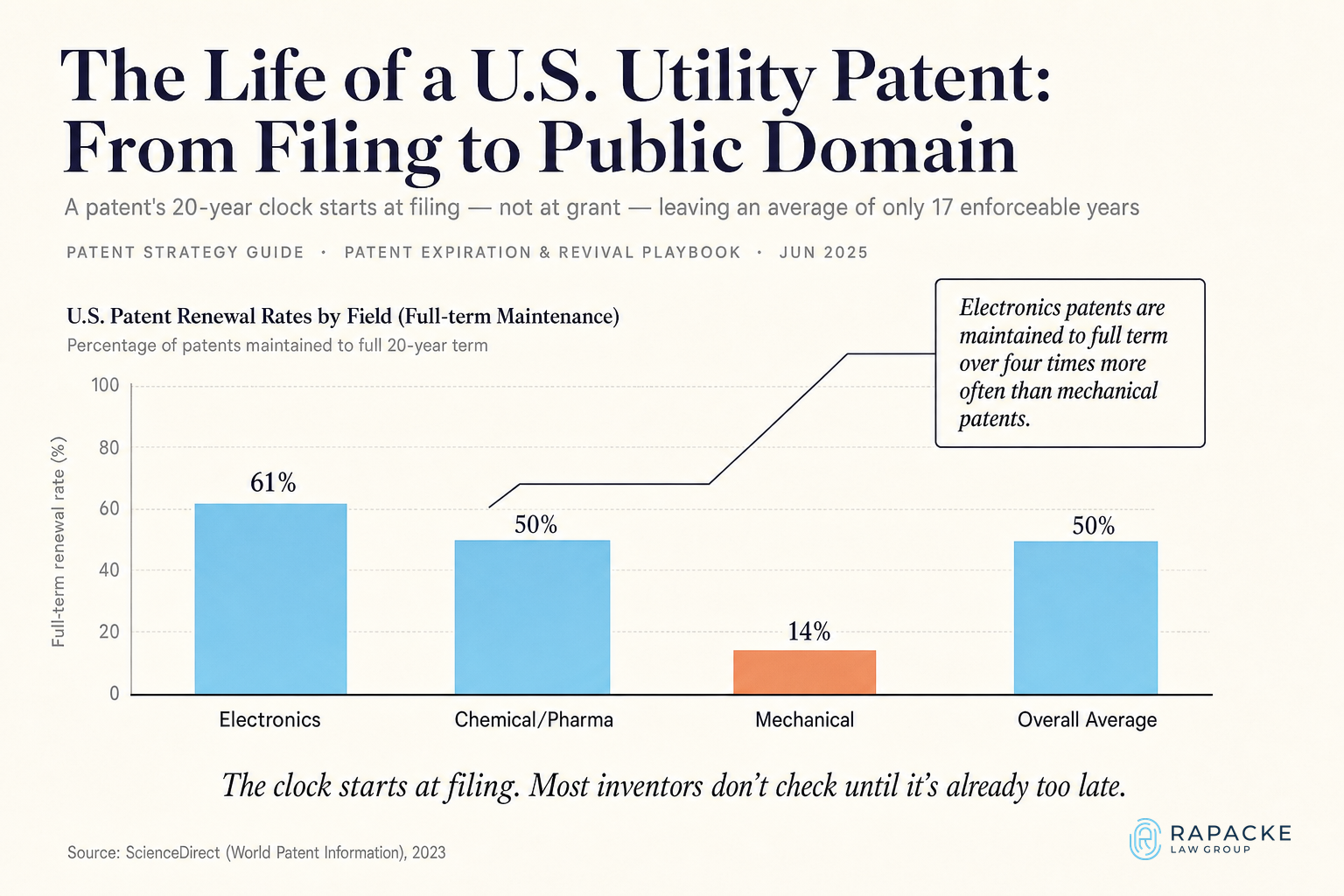 The Life of a U.S. Utility Patent, From Filing to Public Domain, Source, ScienceDirect (World Patent Information), 2023
The Difference Between a Lapsed Patent and an Expired Patent
These two terms describe entirely different legal situations. A lapsed patent is one that ended early because the owner missed a scheduled maintenance fee payment. A fully expired patent is one that completed its entire statutory term. The remedies available in each case are completely different, and conflating them is the most common mistake inventors make when researching whether any protection remains.
According to a Science Direct study on U.S. patent renewal rates, only 49% of patents issued in 1996 were maintained through all three maintenance fee stages. That means more than half of the patents in that cohort lapsed early due to non-payment, not because they ran their full 20-year term. If you are asking whether you can re patent an expired patent, your first task is to confirm which situation you actually face, because the answer diverges sharply from there.
The 20-Year Rule and What the Clock Actually Measures
Under 35 U.S.C. § 154, a utility patent in the United States is protected for 20 years from the filing date of the earliest non-provisional application. Because USPTO examination typically takes two to three years, the actual enforceable term after grant averages closer to 17 years. A patent granted after a lengthy prosecution history has significantly less enforcement time remaining than its grant date implies.
Design patents follow a different rule. Under 35 U.S.C. § 173, design patents carry a 15-year term from the date of grant. Calculate your actual remaining term from the priority filing date, not the grant date, to understand your real enforcement window. If you want to learn more about how to read a patent and identify its key dates and claims, that foundation will help you evaluate any recovery strategy more accurately.
Why This Question Matters More Now Than It Did a Decade Ago
More patents are entering expiration windows each year than at any prior point in history. In fast-moving sectors like software and AI, patents sometimes reach their 20-year limit before the underlying technology is fully commercialized. Generic drug manufacturers have long tracked the FDA Orange Book to launch competing products the day a drug patent expires. Technology competitors do the same thing with software and hardware patents. Treat patent expiration as a scheduled business event within the broader patent lifecycle, not a legal technicality to address after the fact. Founders who wait until expiration to ask can you re patent an expired patent have already lost the most valuable strategic windows available to them.
Can You Re Patent an Expired Patent? Why the Answer Is Almost Never Simple
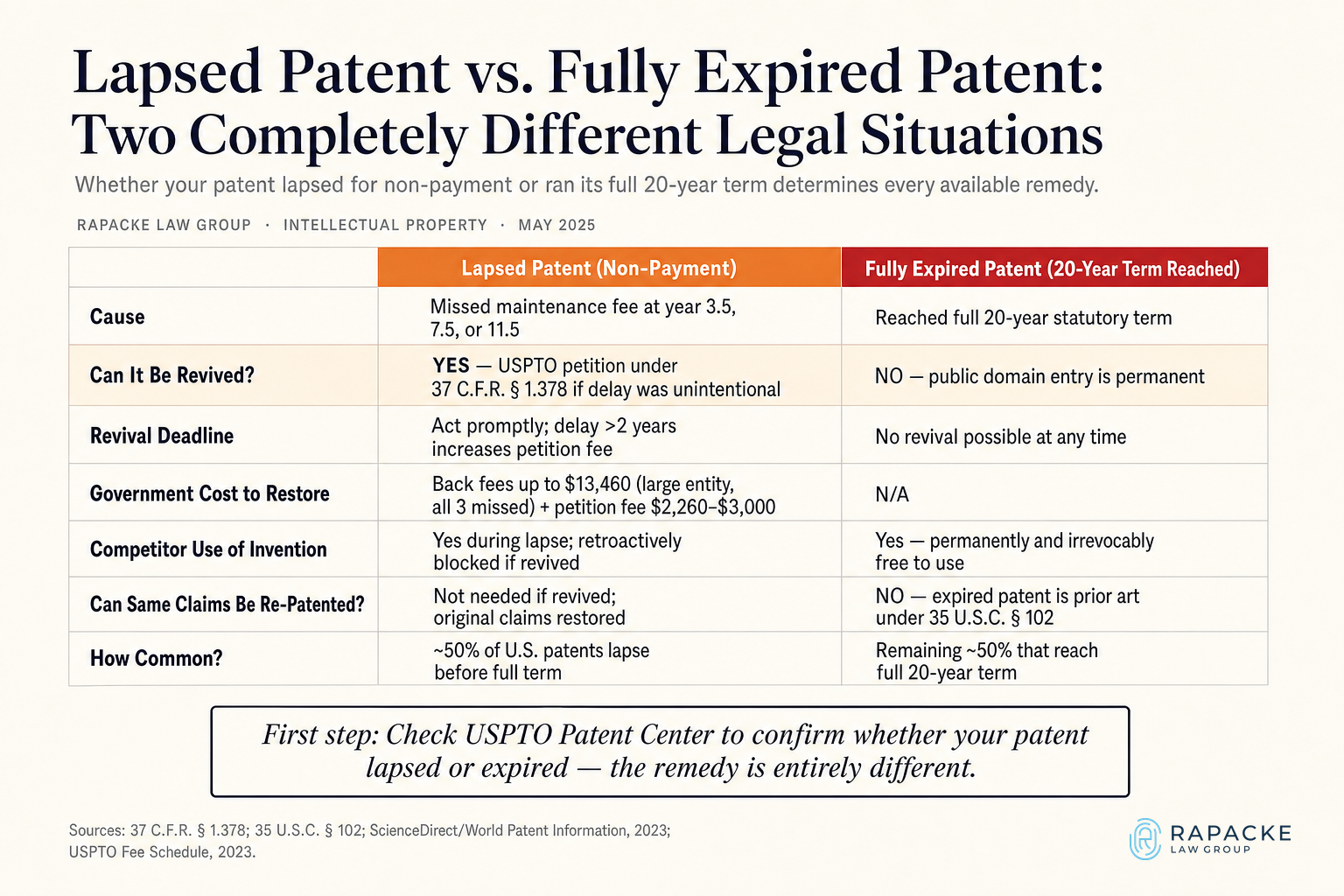 Lapsed Patent vs. Fully Expired Patent, Two Completely Different Legal Situations, Source: 37 C.F.R. § 1.378, 35 U.S.C. § 102, ScienceDirect (World Patent Information), 2023, USPTO Fee Schedule, 2025
Why the Same Claims Cannot Be Revived After Full Expiration
Once a utility patent completes its full 20-year statutory term, the invention enters the public domain permanently. Any attempt to file a new application on those same claims will be rejected because 35 U.S.C. § 102(a)(1) bars patenting any invention that was "patented or described in a printed publication" before the new filing date. Your own expired patent becomes prior art that blocks you from reclaiming those exact claims.
The Supreme Court confirmed this principle directly in Kimble v. Marvel Entertainment, 576 U.S. 446 (2015), noting that after the patent term expires, "the right to make or use the article passes to the public." Stop any effort to refile claims identical to an expired patent. The application will be rejected using your own prior patent against you.
This is a settled feature of intellectual property law, not a procedural gap that creative filing strategies can work around. The public domain entry is permanent and irrevocable for those specific claims.
What "Expired Patent Public Domain" Actually Means for Competitors
Once a patent expires and the invention enters the public domain, any person or company may manufacture, use, sell, and import the formerly patented technology without a license or royalty payment to the original holder. This is the deliberate bargain of the patent system, temporary exclusivity in exchange for full public disclosure of the invention.
The commercial consequences can be immediate. In the pharmaceutical sector, primary analyses from the Congressional Budget Office show that generic entry can reduce drug prices by 75 to 90 percent in many cases, particularly once multiple generic manufacturers are present. Bayer's U.S. patent on Aspirin expired in 1917, and within years dozens of manufacturers were producing it freely. If you are evaluating a competitor's expired patent, search pending and granted patent applications through Google Patents or the USPTO Patent Center to verify the expiration date before building any product around that technology.
Three Legal Strategies That Can Restore or Extend Your Patent Protection
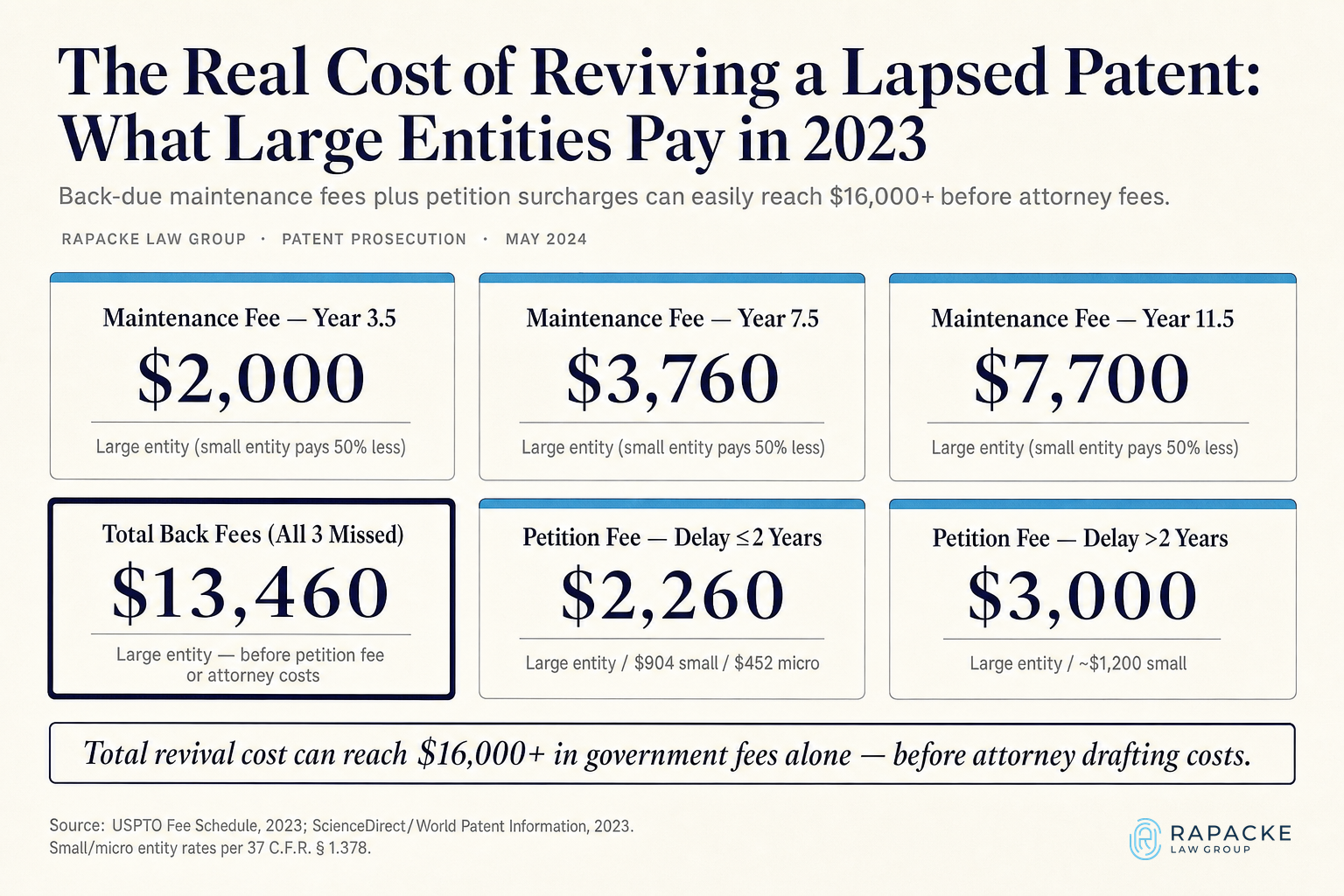 The Real Cost of Reviving a Lapsed Patent, What Large Entities Pay in 2025, Source, USPTO Fee Schedule, 2025, ScienceDirect (World Patent Information), 2023
Reinstating a Lapsed Patent Through USPTO Petition
This is the most actionable path for inventors whose patents lapsed due to missed maintenance fees. The USPTO allows petitions for revival under 37 C.F.R. § 1.378 when the delay in payment was unintentional. The petition requires a statement that the delay was unintentional, payment of all overdue maintenance fees, and a surcharge.
According to the current USPTO fee schedule, petition fees for delayed maintenance payments are tiered by entity size, with reduced rates available for small entities (50% reduction) and micro-entities (80% reduction). Delays beyond two years carry higher petition fees at the large entity rate. If your patent lapsed within the last three years due to a missed maintenance fee, file a revival petition promptly. The longer you wait, the harder the unintentional delay argument becomes. For more detail on how provisional filing timelines interact with these windows, see our guide on provisional patent extensions and how to get more time after 12 months.
Filing a Continuation or Improvement Patent on New Features
Continuation applications under 35 U.S.C. § 120 must be filed while the parent application is still pending. The key requirement is an unbroken chain of copendency back to an earlier application, since it is abandonment or issuance that ends pendency, not the patent's term. However, a new independent utility patent application can be filed on improvements or new embodiments that are meaningfully distinct from the expired claims.
For example, a SaaS founder who patented a core algorithm in 2005 and let that patent expire in 2025 could potentially patent a machine learning optimization layer developed in 2022, provided that layer is non-obvious over the original claims. The Supreme Court's ruling in KSR International Co. v. Teleflex Inc., 550 U.S. 398 (2007) set the standard, an improvement that a skilled engineer would arrive at through routine experimentation will not qualify. Document every incremental improvement to your technology. Each feature that adds genuine novelty beyond the expired patent's claims is a potential new patent application. Our guide on improvement patents walks through exactly how to evaluate whether your advances clear this bar.
Patent Term Extensions and Patent Term Adjustments for Eligible Patents
Two separate mechanisms can extend a patent's life beyond 20 years, but both must be pursued before expiration. Patent Term Adjustment (PTA) under 35 U.S.C. § 154(b) compensates patent holders when USPTO examination delays exceed statutory thresholds, with the amount varying case by case. Patent Term Extension (PTE) under 35 U.S.C. § 156 applies specifically to FDA-regulated products including pharmaceuticals, medical devices, food additives, and veterinary biological products, and can add up to five years of protection. Neither mechanism can be applied retroactively after a patent has already expired.
How Continuation and Improvement Patents Actually Work in Practice
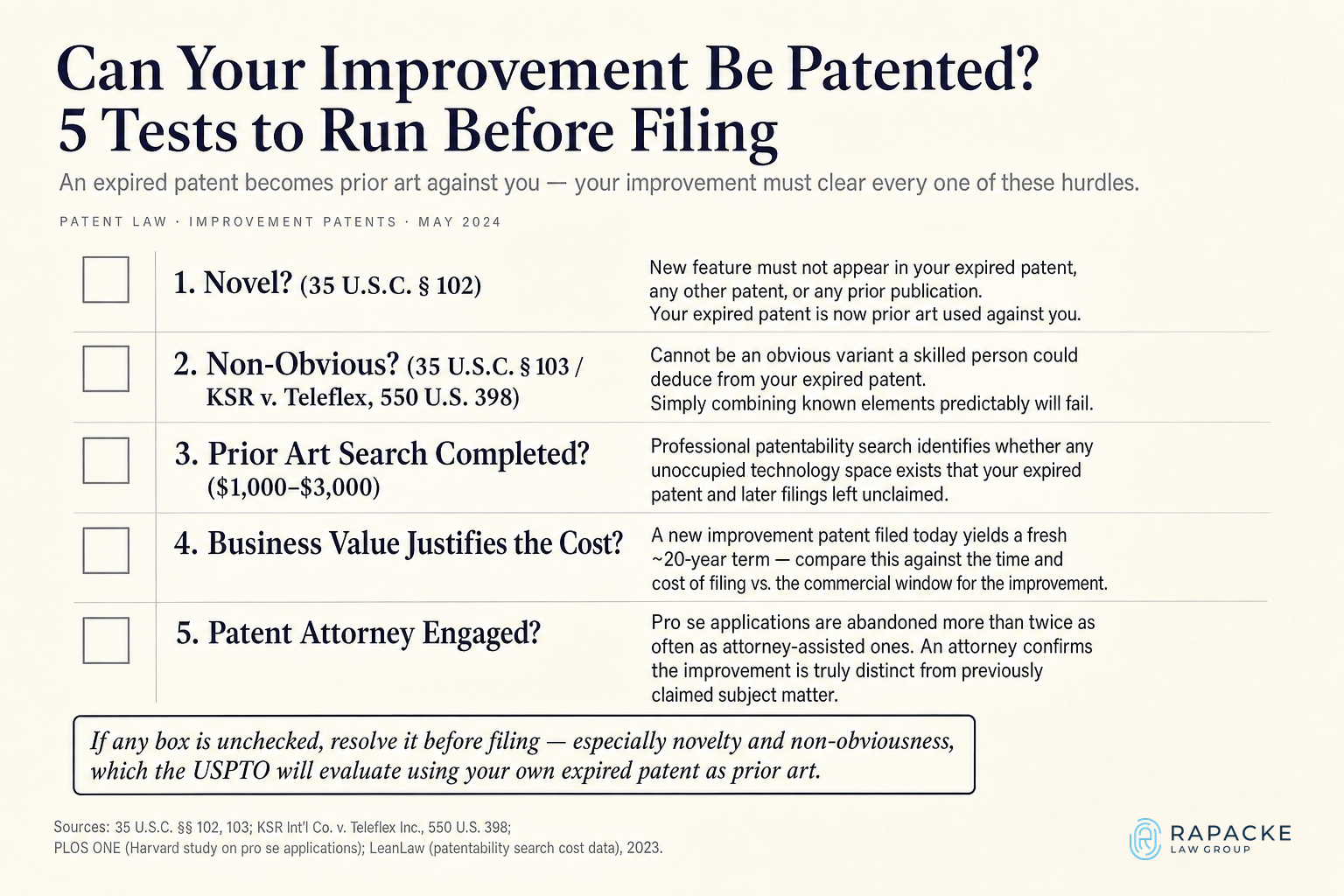 Can Your Improvement Be Patented? 5 Tests to Run Before Filing, Source: 35 U.S.C. §§ 102, 103, KSR Int'l Co. v. Teleflex Inc., 550 U.S. 398, PLOS ONE, 2012
What Qualifies as a Patentably Distinct Improvement
An improvement must satisfy three independent legal standards to support a new patent, novelty under 35 U.S.C. § 102, non-obviousness under § 103, and adequate written description under § 112, with claim amendments often needed during prosecution to satisfy each requirement. The expired patent functions as prior art in the examination of any new application, so the improvement must add something that neither the original patent nor any other prior art disclosed or suggested.
Before filing, have a registered patent attorney conduct a patentability analysis — this is not legal advice but a professional evaluation — that specifically uses your expired patent's claims as a prior art baseline. That analysis defines exactly what new territory your improvements occupy and whether a new application is worth pursuing. You can also review whether your idea can be patented when prior art already exists as a useful framing exercise before investing in a full patentability search.
Building a Patent Portfolio Around a Core Expired Patent
Sophisticated patent holders treat the expiration of a core patent as a portfolio management event, not simply a loss. The strategy involves surrounding a core patent with improvement patents, design patents on product embodiments, and continuation patents filed while the parent was still pending, creating overlapping protection with staggered expiration dates.
The pharmaceutical industry demonstrates this approach at scale. Humira, AbbVie's blockbuster drug, had over 130 related patent filings, extending effective market exclusivity well beyond the original compound patent. Research from the National Bureau of Economic Research found that startups securing patents are 55% more likely to grow in employment and attract significantly more investment from venture capital firms, banks, and public investors. Map your patent portfolio at least three years before a core patent's expiration date as part of a deliberate patent strategy. That is the minimum lead time to file continuation and improvement applications that provide meaningful post-expiration coverage. For a broader view of how portfolio depth translates into competitive advantage, see our analysis of the benefits of patent protection that most founders overlook.
What Happens When a Patent Expires and Competitors Move In
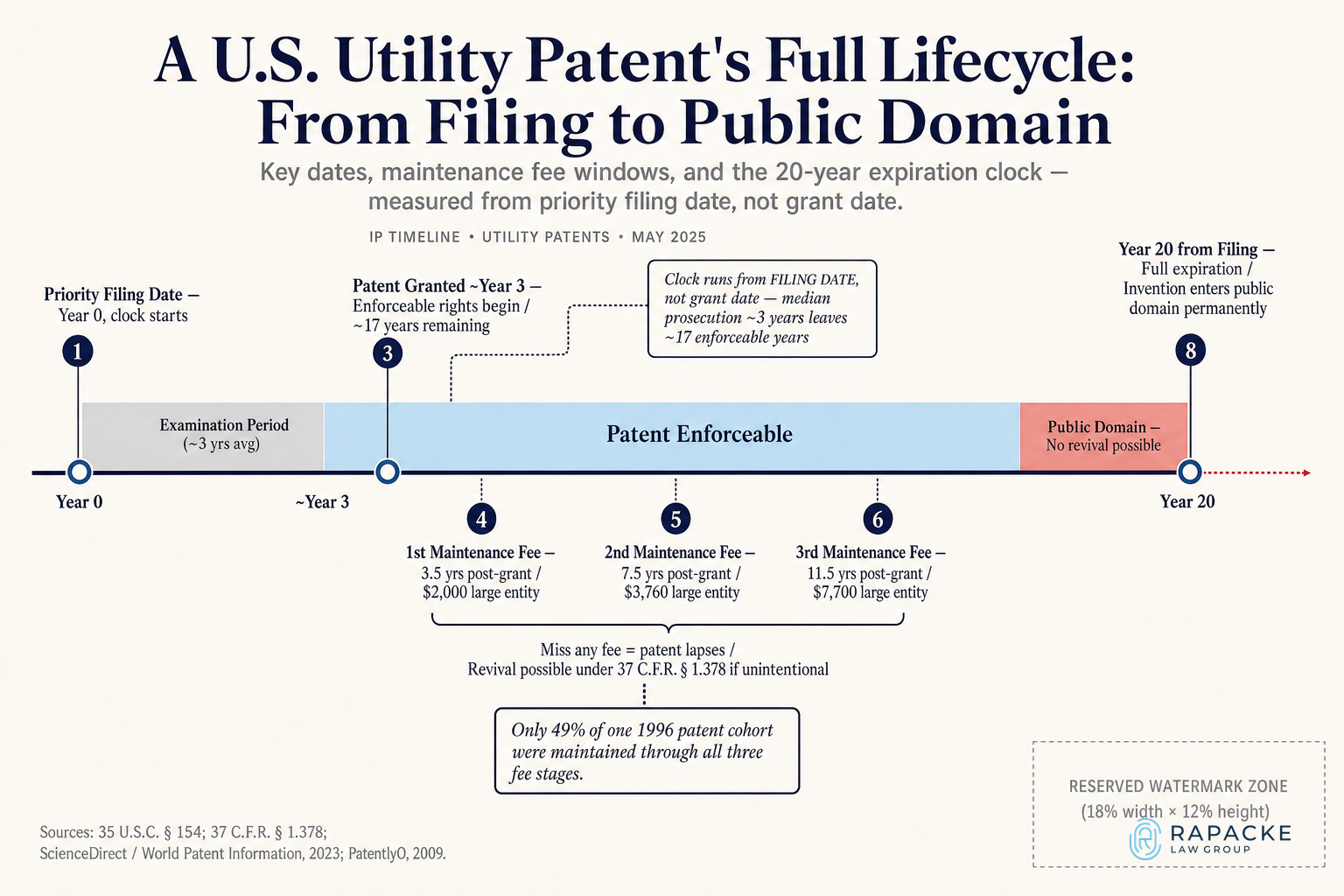 A U.S. Utility Patent's Full Lifecycle, From Filing to Public Domain, Source, ScienceDirect (World Patent Information), 2023, 35 U.S.C. § 154, 37 C.F.R. § 1.378
The Commercial Reality of Public Domain Entry
When a high-value patent expires, the market shift can be rapid. In pharmaceuticals, FDA data show that prices can fall by 80 to 95 percent once multiple generic competitors enter, eroding branded revenue rapidly after the expiration date. In technology markets, the dynamics differ because the original patent holder often retains market advantages through accumulated brand recognition, implementation expertise, and trade secrets that competitors cannot easily replicate even when the patent's claims are freely available.
The three competitive advantages that tend to outlast patent protection are brand equity, superior implementation knowledge, and customer switching costs. Identify which of those you hold before your patent expires, because those are what you protect and amplify when the statutory exclusivity ends. The broader debate between proprietary advantages and patented protection is worth understanding as you build that post-expiration strategy.
Using Trade Secrets and Trademarks to Protect What a Patent No Longer Can
Trade secrets protect know-how, processes, and implementation details that were never disclosed in the patent. Because patents require full public disclosure of the claimed invention, anything you held back from the patent applications can potentially be protected indefinitely as a trade secret as long as it remains confidential. Coca-Cola's formula is the canonical example of a trade secret that has outlasted any patent protection by more than a century.
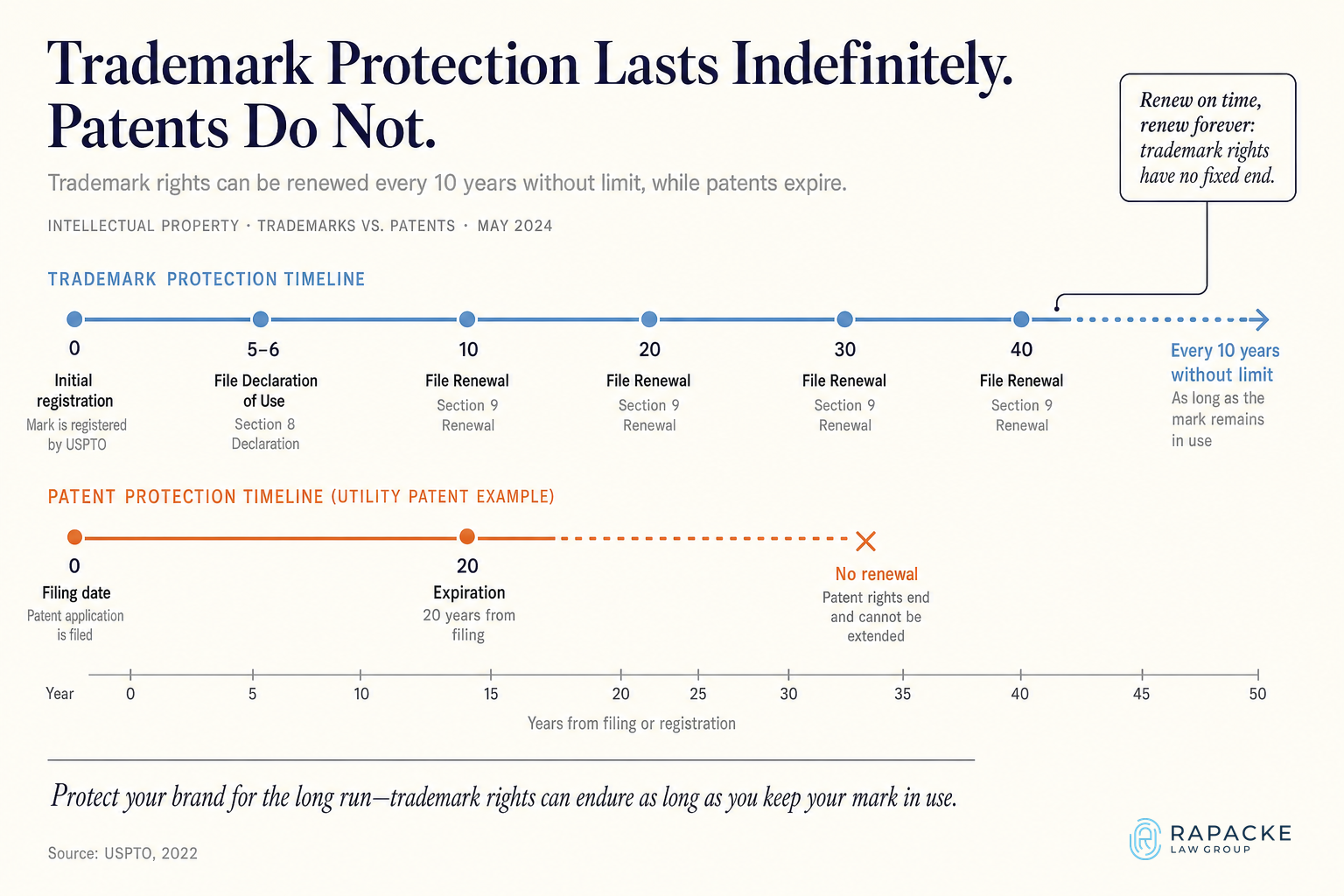 Trademark Protection Timeline vs. Patent-Infographic timeline illustrating that trademark rights can extend indefinitely through 10-year renewal periods, unlike a patent's fixed term, Source, USPTO, 2022
Trademarks protect brand equity and consumer recognition under intellectual property law, and they carry no expiration date as long as the mark remains in use and renewals are filed with the trademark office. A consumer who associates a brand name with quality and reliability does not automatically transfer that loyalty to generic competitors even after the underlying patent expires. File trademark applications for your product names, logos, and distinctive product features now, and consider trademark registration for any brand identifiers tied to your core technology. Trademark protection that outlasts your patent is a deliberate strategic choice, not an afterthought.
The Real Costs of Reinstating a Lapsed Patent Versus Filing New
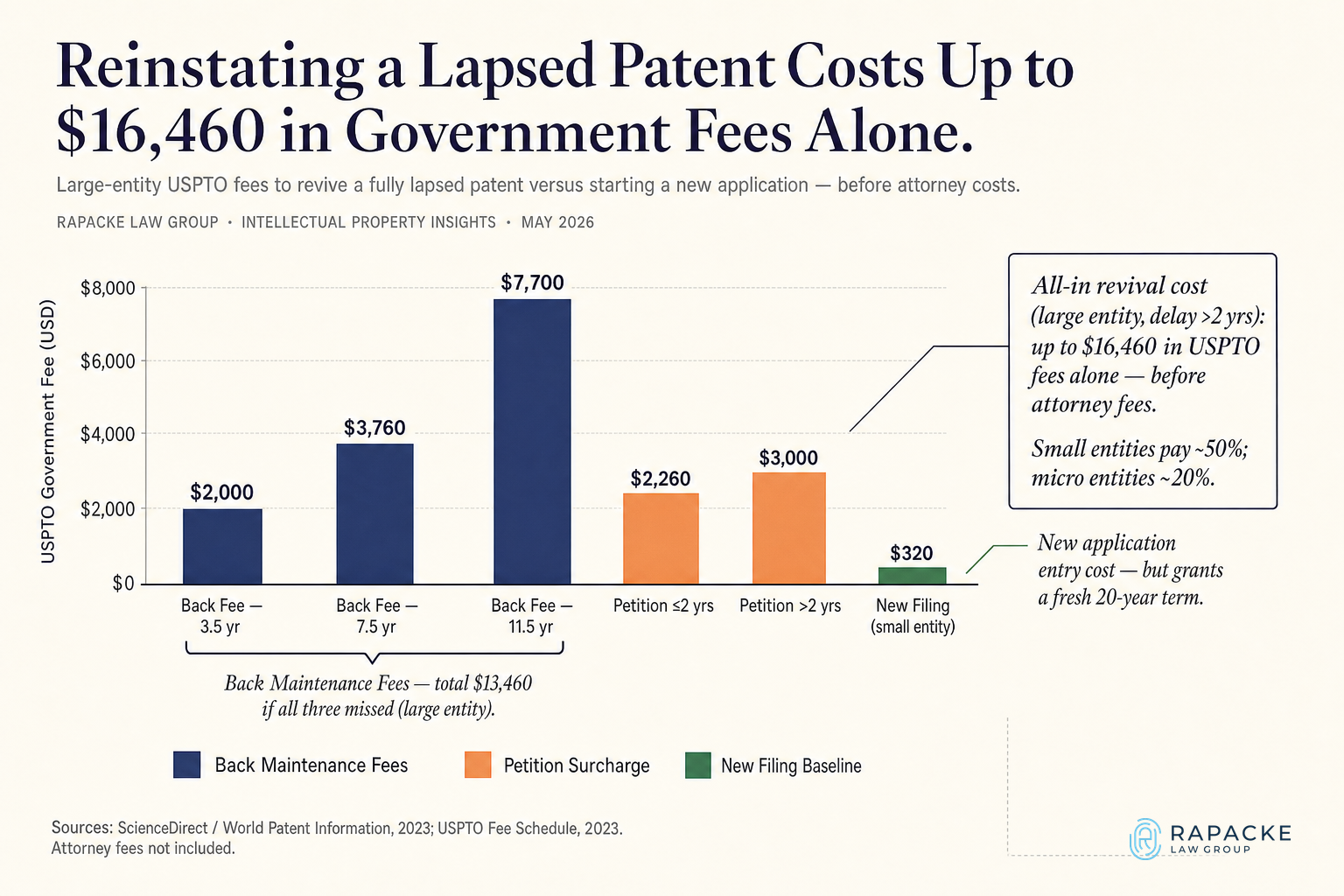 Reinstating a Lapsed Patent Costs Up to $16,730 in Government Fees Alone, Source, ScienceDirect (World Patent Information), 2023, USPTO Fee Schedule, 2025
USPTO Fees for Revival Petitions and Maintenance Fee Catch-Up
Reviving a lapsed patent requires paying all overdue maintenance fees plus petition surcharges. According to the USPTO fee schedule, maintenance fees for large entities currently run approximately $2,150 at the 3.5-year window, $4,040 at the 7.5-year window, and $8,280 at the 11.5-year window, with fees subject to periodic adjustment. Small entities receive a 50% reduction and micro-entities receive an 80% reduction on these fees. Attorney fees for preparing a properly worded unintentional delay declaration add to the total. Always verify the current fee amounts directly on the USPTO fee schedule before budgeting, as these figures are updated regularly.
Request a full fee calculation from a patent attorney before deciding between revival and a new application. In some cases, the total cost of revival exceeds the cost of filing fresh, especially when significant back fees are owed.
When a New Patent Application Makes More Strategic Sense Than Revival
Three scenarios favor starting fresh over reviving a lapsed patent. First, when the technology has advanced materially beyond the lapsed patent's claims, new claims will better protect the current commercial product. Second, when the lapse has been in place for several years and the remaining enforceable term after revival would be minimal. Third, when the market has shifted enough that the original claim language no longer maps accurately to what competitors would copy.
A new non-provisional patent application that does not claim the benefit of an earlier filing provides a full 20-year term from its own filing date, whereas one claiming priority under §120 still measures its term from the earliest claimed priority date, and working with a patent application attorney can help optimize the claims for commercial coverage. If your technology has genuinely advanced since the lapsed patent was filed, a new application on the improved invention will often deliver more commercial value than reviving claims that no longer match what you are actually selling. Reviewing recent software patent examples from top companies can help you calibrate what claim language best fits current commercial embodiments.
How to Evaluate Whether Your Expired Patent Still Has Recoverable Value
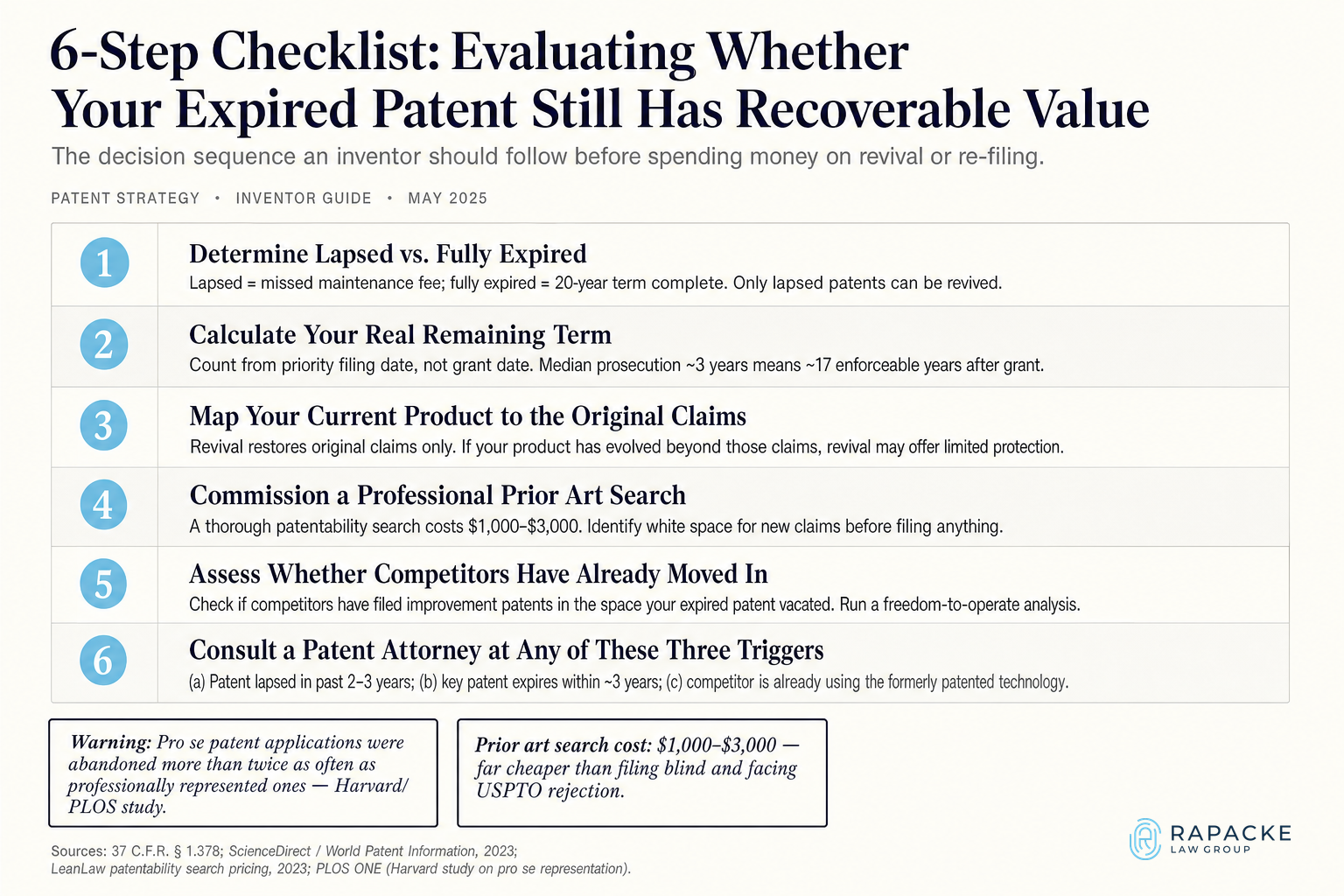 6-Step Checklist, Evaluating Whether Your Expired Patent Still Has Recoverable Value, Source: 37 C.F.R. § 1.378, ScienceDirect / World Patent Information, 2023
Conducting a Prior Art Search on Your Own Expired Patent
Before investing in any recovery strategy, run a prior art search using your expired patent as the baseline reference. Treat this as a freedom-to-operate analysis conducted from the inside out, identify what your expired claims cover as prior art, then map what new territory your current technology occupies beyond those claims. USPTO Patent Center and Google Patents are free starting points, though a professional prior art search typically costs $1,500 to $3,000 and provides the defensible documentation an attorney needs to evaluate new claim scope.
This analysis defines exactly what new claims are available to you and what a competitor could freely use from the expired patent. It is the most important due diligence step before any filing decision. For context on how to interpret what you find, our guide on how to read a patent like a pro explains how to parse claims in a way that directly informs this kind of competitive mapping.
When to Engage a Registered Patent Attorney for an IP Strategy Review
Three specific triggers warrant immediate legal consultation. Inventors who are still asking can you re patent an expired patent at these inflection points often discover that a lapsed patent is revivable — but only if they act before the petition deadline closes. A lapsed patent may still be revivable, though for petitions filed more than two years after expiration the USPTO can require additional information to support the unintentional-delay showing. A core patent expiring within 36 months is still within the window to file continuation or improvement applications while the parent remains active. Discovery that a competitor is commercializing technology from your expired patent raises improvement patent and trade dress questions that require professional analysis.
Some of these windows close permanently and cannot be reopened. A continuation application filed one day after the parent patent expires is not recoverable. An IP strategy review at these inflection points prevents permanent loss of intellectual property rights that a review six months later cannot fix, and an intellectual property law attorney can identify which deadlines are most critical. Andrew Rapacke, Managing Partner and Registered Patent Attorney at Rapacke Law Group, focuses specifically on these strategic patent portfolio decisions for SaaS founders and inventors.
Frequently Asked Questions
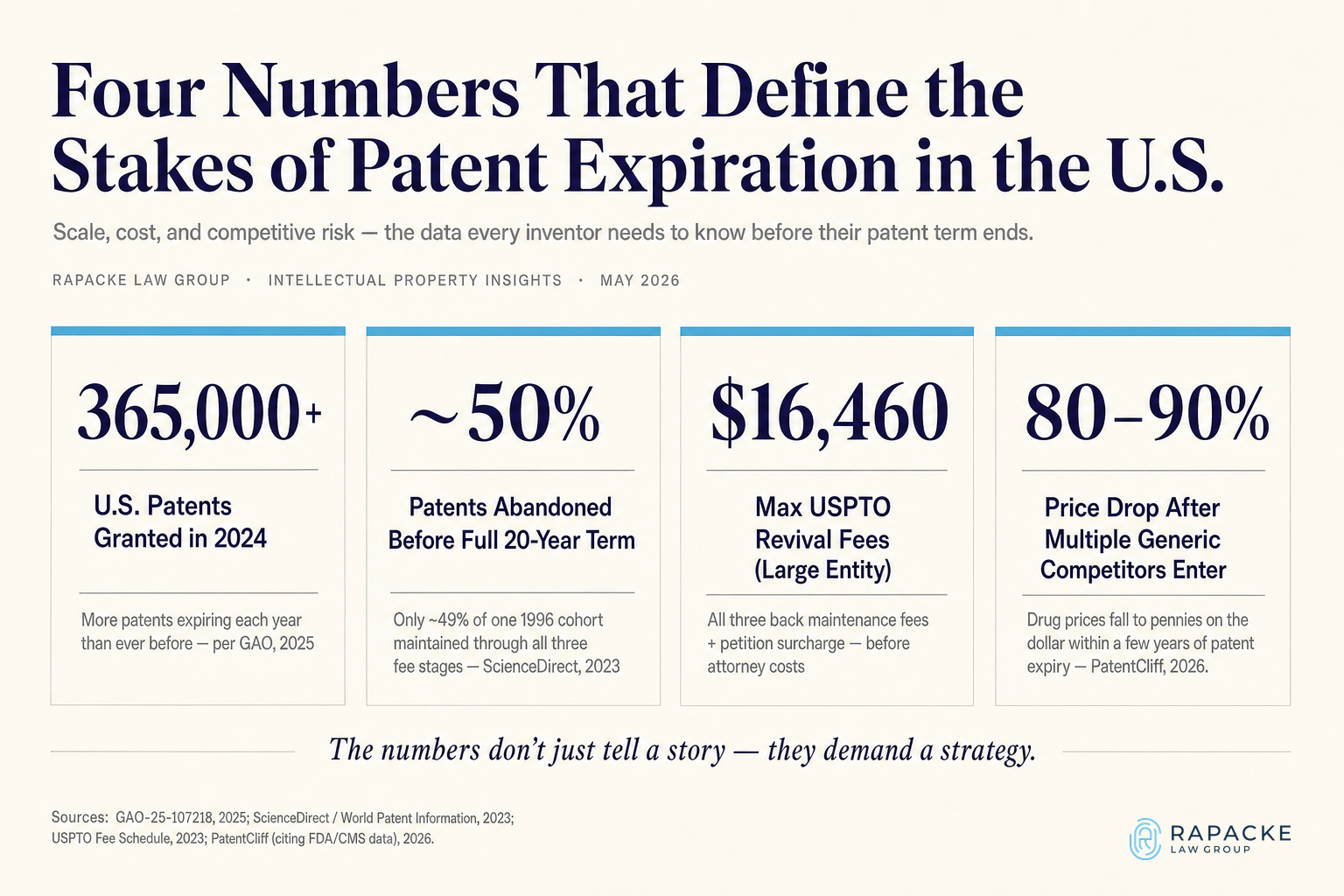 Four Numbers That Define the Stakes of Patent Expiration in the U.S., Source, GAO-25-107218, 2025, ScienceDirect / World Patent Information, 2023, USPTO Fee Schedule, 2025, PatentCliff (citing FDA/CMS data), 2026
Can you reapply for a patent after it expires?
You cannot refile for a patent on the same invention after it expires. The question of can you re patent an expired patent on identical claims has a firm legal answer: the expired patent itself serves as prior art under 35 U.S.C. § 102(a)(1) that blocks any new application covering those same claims. However, if you have made genuine improvements or developed new features that go beyond what the original patent disclosed, those advances may qualify for a new independent patent application, provided they meet the novelty and non-obviousness requirements. This is the most practical answer to whether you can re patent an expired patent, not on the same claims, but potentially on what came after.
What happens when a patent expires after 20 years?
Once a utility patent reaches its 20-year term from the priority filing date, the patented invention enters the public domain permanently, and the patent owner retains no further exclusive rights. Any person or company may then make, use, sell, or import the formerly protected technology without permission or payment to the original patent holder. The patent holder retains no enforcement rights over the expired claims, though separately held trademarks, trade secrets, and improvement patents remain fully enforceable as intellectual property.
How much does it cost to revive a patent?
The cost to revive a lapsed patent depends on how many maintenance windows were missed and the entity size. Overdue maintenance fees range from approximately $2,150 at the 3.5-year window to $8,280 at the 11.5-year window for large entities under the current USPTO fee schedule, with 50% reductions for small entities and 80% reductions for micro-entities. Petition surcharges under 37 C.F.R. § 1.378 are tiered based on how long the patent has been lapsed. Attorney fees for preparing the required unintentional delay declaration increase the total cost further. Always confirm current fee amounts directly from the USPTO before budgeting, as the schedule is updated periodically.
Can a competitor legally use an expired patent's technology?
Yes. Once a patent expires and the invention enters the public domain, competitors can freely use, manufacture, and sell products based on those expired claims without any license or royalty obligation. This is a foundational feature of the patent system, confirmed by the Supreme Court in Kimble v. Marvel Entertainment. However, competitors cannot use your trademarked product names, copy protected trade dress, or misappropriate confidential trade secrets even when the underlying patent has expired.
Is there any way to stop a competitor from copying an expired patent?
Direct enforcement of expired patent claims is not possible. However, if the competitor is copying your brand identity, trade dress, or trade secrets alongside the expired technology, separate legal claims under trademark law or trade secret law may apply. If you hold improvement patents or continuation patents that cover features the competitor is using, those rights remain fully enforceable regardless of the core patent's expiration.
Who is the only president with a patent?
Abraham Lincoln is the only U.S. president to have received a patent. He was granted Patent No. 6,469 in 1849 for a device designed to lift boats over shallow water using adjustable buoyant chambers. The patent expired long ago, placing the invention firmly in the public domain.
What is a patent term extension and who qualifies?
A patent term extension under 35 U.S.C. § 156 is available to patent holders in FDA-regulated industries including pharmaceuticals, medical devices, food additives, and veterinary biological products, where regulatory review delays reduced the patent's effective commercial life. Eligible patents can receive up to five additional years of protection, though total exclusivity cannot exceed 14 years from the FDA approval date. Patent Term Adjustment under 35 U.S.C. § 154(b) is a separate mechanism that compensates any patent holder when USPTO examination delays exceeded statutory limits during prosecution.
Your Next Steps to Patent Protection Success
The direct answer to whether you can re patent an expired patent — or, as some inventors phrase it, can you're patent an expired patent — is no. Once claims have fully entered the public domain under the 20-year rule, no legal mechanism under intellectual property law restores that legal protection. But that answer describes only one scenario. A lapsed patent can often be revived through a USPTO petition. A core patent approaching expiration can still be surrounded by improvement filings and continuation applications, and certain patents may also qualify for term extension. Technology that has genuinely advanced beyond its original invention may support an entirely new application with a fresh 20-year term.
The bottom line: a weak or expired patent leaves your invention exposed to competitors who have been monitoring the public domain for exactly this opportunity. A proactive portfolio strategy, built around continuation filings, improvement patents, and layered trade secret and trademark protection, maintains competitive moats that a single expiring patent cannot.
The difference between permanent loss of rights and a recoverable situation is almost always timing. Revival windows close. Continuation deadlines pass the moment the parent application goes abandoned. The 36 months before a core patent's expiration date is the most valuable strategic window most patent holders never use. If you wait until the window closes, no attorney can reopen it.
Action items to take now:
- Schedule a Free IP Strategy Call with a registered patent attorney to evaluate your specific situation before any deadlines pass
- Run a prior art search using your expired or lapsing patent as the baseline to map what new territory your current technology occupies
- Audit your maintenance fee schedule today to confirm no payments are overdue or approaching
- Identify every incremental improvement made since your original filing date as a candidate for a new or continuation application
- File trademark applications for any product names, logos, or distinctive features that currently rely solely on patent protection for their competitive value
- Download the SaaS Patent Guide 2.0 if you are a software or AI founder evaluating your portfolio strategy
At Rapacke Law Group, we back our work with a concrete commitment, with our patent services, you receive a full refund if the USPTO denies your provisional patent application. Our fixed-fee model means you know the total cost before any work begins, with no billable-hour surprises. That predictability matters most when you are navigating the tight deadlines that determine whether your intellectual property rights are recoverable or permanently lost.
To Your Success,
Andrew Rapacke Managing Partner, Registered Patent Attorney Rapacke Law Group