
Key Takeaways
- Software patents must claim a specific technical method or improvement to computer functionality, not a business result. A claim that describes what your software accomplishes rather than how it works technically will likely be rejected as an abstract idea.
- File a provisional patent application before any public disclosure, including investor pitches, demos, and product launches. U.S. law gives a 12 month grace period, but most foreign countries require absolute novelty and grant none.
- Budget $20,000 to $30,000 total for a typical software patent from filing to grant, including USPTO fees and attorney drafting and prosecution fees.
- Clear all three patentability gates before filing: patentable subject matter under Section 101, novelty under Section 102, and non-obviousness under Section 103.
- Software applications historically clear the patent office at lower rates than mechanical inventions, with the abstract idea test driving much of the gap, so claim strategy and prosecution matter more here than in almost any other technology area.
*Written by Andrew Rapacke, Managing Partner, Registered Patent Attorney.* Andrew Rapacke is a registered patent attorney and the Managing Partner of The Rapacke Law Group, a full-service intellectual property law firm. He helps individuals and corporations across industries with the protection, prosecution, licensing, and enforcement of their intellectual property, with deep experience in patent, trademark, and copyright matters spanning software, AI and machine learning, blockchain, medical devices, and autonomous vehicle technology. A graduate of the United States Naval Academy, Andrew served as a Naval Engineering Officer before pursuing law and remains active in the startup and inventor communities throughout Florida.
A SaaS founder spends eighteen months building a workflow automation tool, files a patent application without the right preparation, and six months later receives an Alice rejection. The money is gone. The window to fix the claims has narrowed. This is not a rare outcome. Software patents fail at the United States Patent Office far more often than founders expect, and most of those failures trace back to decisions made before the filing date, not the quality of the underlying invention.
This checklist gives you a step by step framework to evaluate whether your software qualifies for patent protection under U.S. patent law, what must be true before you file, which mistakes trigger the most common rejections, and how to build a filing strategy that holds up under examination. It is calibrated to the current legal landscape, not the one from a decade ago. If you want to go deeper after this, our Must-Have Software Patent Guide walks through each stage in detail.
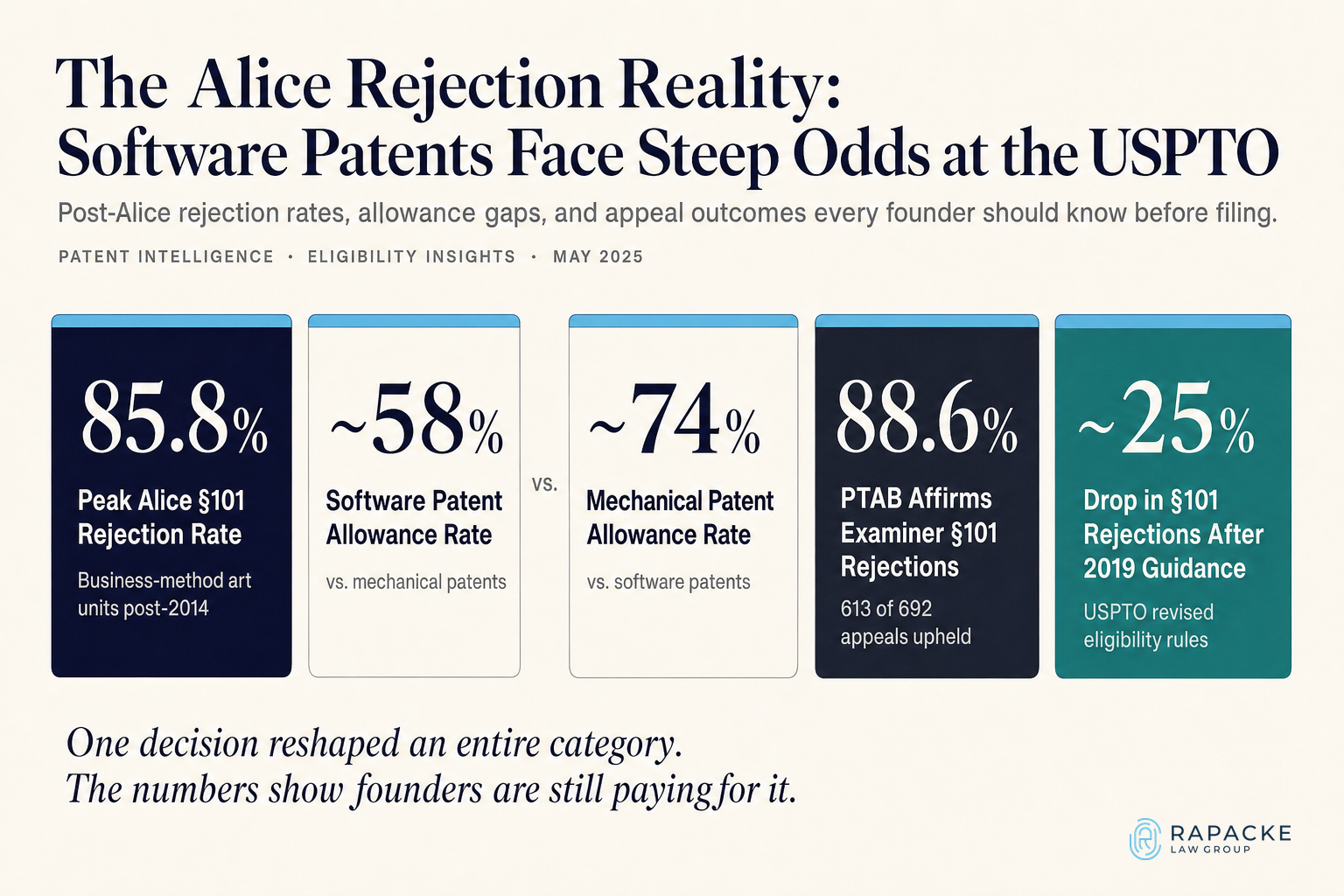
That distinction matters. The Alice Corp. v. CLS Bank International decision in 2014 reshaped patentable subject matter standards for software. Founders who approach the process the way they would file for a hardware patent are working from the wrong playbook. After Alice, one USPTO business method art unit issued abstract idea rejections at an 85.8% rate, with several other business method units above 70 percent, according to data summarizing Juristat's analysis as reported by IPWatchdog. Software is still patentable. The path is just narrower and more technical than it used to be.
Why Software Patents Are Harder to Obtain Than Most Founders Expect
Software inventions clear a lower bar at the patent office than mechanical or chemical inventions. Analysis of post-Alice data suggests lower allowance rates for software than for some mechanical technologies, with Section 101 abstract idea rejections playing a major role among business method art units, though other factors such as Section 103 obviousness rejections also contribute. The good news is that the difficulty is a claim drafting and prosecution problem, not an impossible legal barrier. If you are still weighing whether your product is even patentable, Can You Patent Code? A Tech Founders Guide to Software Patents is a useful starting point.
The Alice Problem Every Software Founder Faces
The Alice framework comes from 35 U.S.C. Section 101 and runs in two steps. Step one asks whether the claim is directed to an abstract idea such as a mathematical concept, a method of organizing human activity, or a mental process. Step two asks whether the claim adds something significantly more than that abstract idea implemented on a generic computer. In the years immediately following the decision, one business method art unit issued Section 101 rejections at a rate that peaked at 85.8 percent, with several units sitting above 70 percent, according to data summarized by IPWatchdog. The drop in first-action eligibility rejections later eased somewhat after the USPTO issued updated guidance, as documented in the USPTO Chief Economist study. Before drafting a single claim, confirm your invention clears both Alice steps, not just one. If you want a deeper data view, see Are Software Patents Enforceable? Data-Driven Analysis for Tech Founders in 2025.
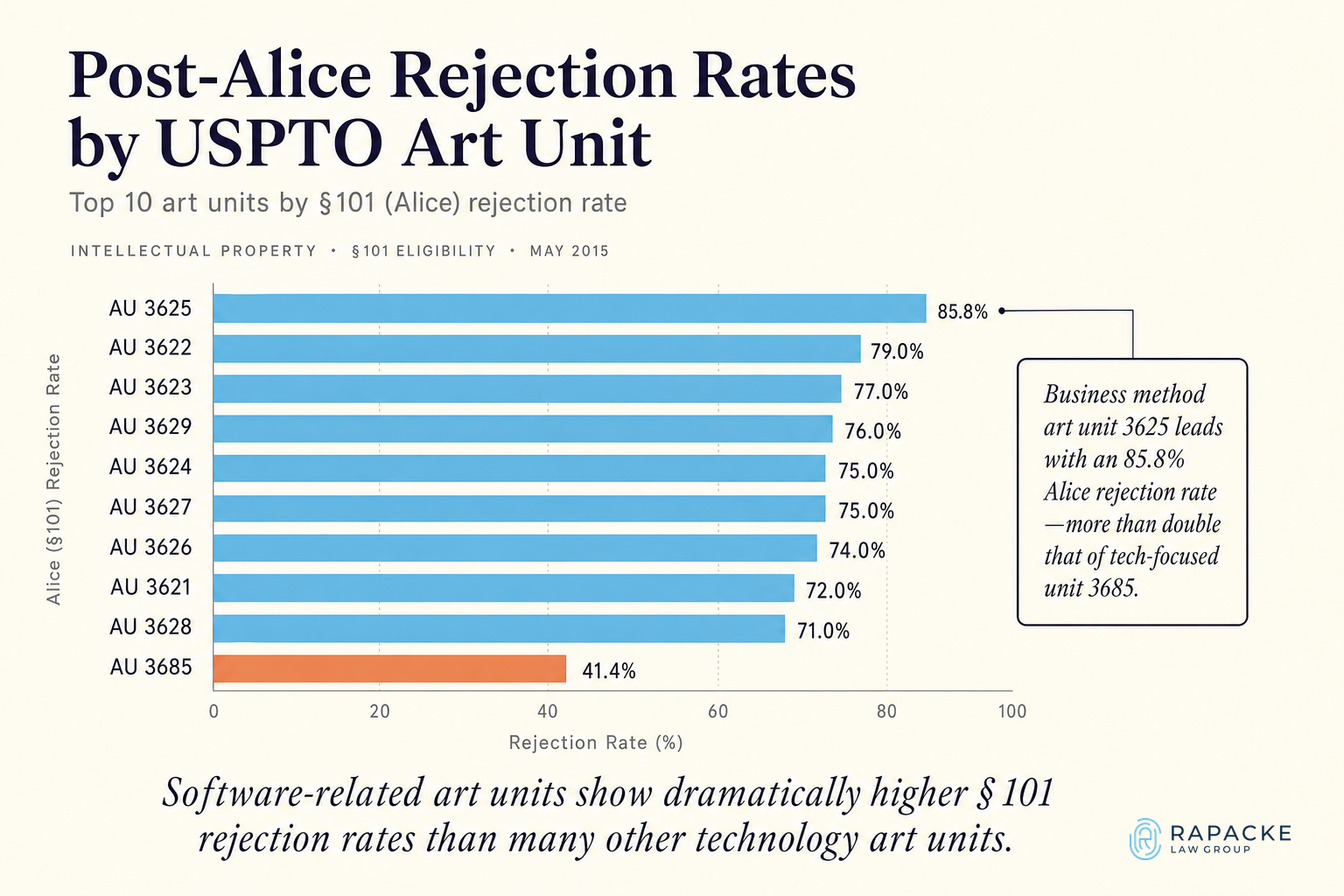 Post-Alice Rejection Rates by USPTO Art Unit – Graph showing the top 10 USPTO art units with the highest §101 rejection rates after the Alice decision. The worst is Art Unit 3625 ( — Source: IPWatchdog (data via Juristat), 2015
The Difference Between Patenting Software and Patenting What the Software Does
Courts and the United States Patent Office do not allow patents on software code or algorithms in the abstract. They do allow patents on a specific technical process, system, or improvement to computer functionality that the software implements. Think of it as the difference between patenting a manufacturing process and patenting the concept of efficiency. In Enfish, LLC v. Microsoft Corp. (2016), the Federal Circuit held that a self-referential database table was patent eligible because it improved how the computer stored and retrieved data, a concrete technical gain rather than an abstract goal, per the court's decision. Frame your invention around the technical problem it solves and the mechanism it uses, not around what users experience. Our guide on How To Identify Patentable Key Features in Your Software walks through this framing in practice.
Why Copyright and Trade Secrets Are Not Substitutes Here
Copyright protection covers software code as creative expression but does not protect the underlying method or functionality. Trade secret protection vanishes the moment a competitor independently discovers the same solution. Patent protection is the only form of intellectual property that grants an exclusive right to the method itself for up to 20 years. Most serious software IP strategies use layered protection, with the Copyright Office and the patent office covering distinct aspects. For a full breakdown of the tradeoffs, see Software Patent vs Copyright, Choosing The Best Protection. Determine which aspect of your software you most need to protect before choosing a strategy.
How to Tell Whether Your Software Invention Is Eligible for Patent Protection
The most common reason software patent applications stall is that the claimed invention reads as an abstract idea without sufficient concrete application. Once an examiner issues a Section 101 rejection, the odds of overturning it on appeal are slim. In one study of Patent Trial and Appeal Board outcomes, the board affirmed the examiner's eligibility rejection in 613 of 692 cases, an 88.6 percent affirmance rate, according to data reported by Obviously.ai. Getting eligibility right before filing is far cheaper than fighting it later.
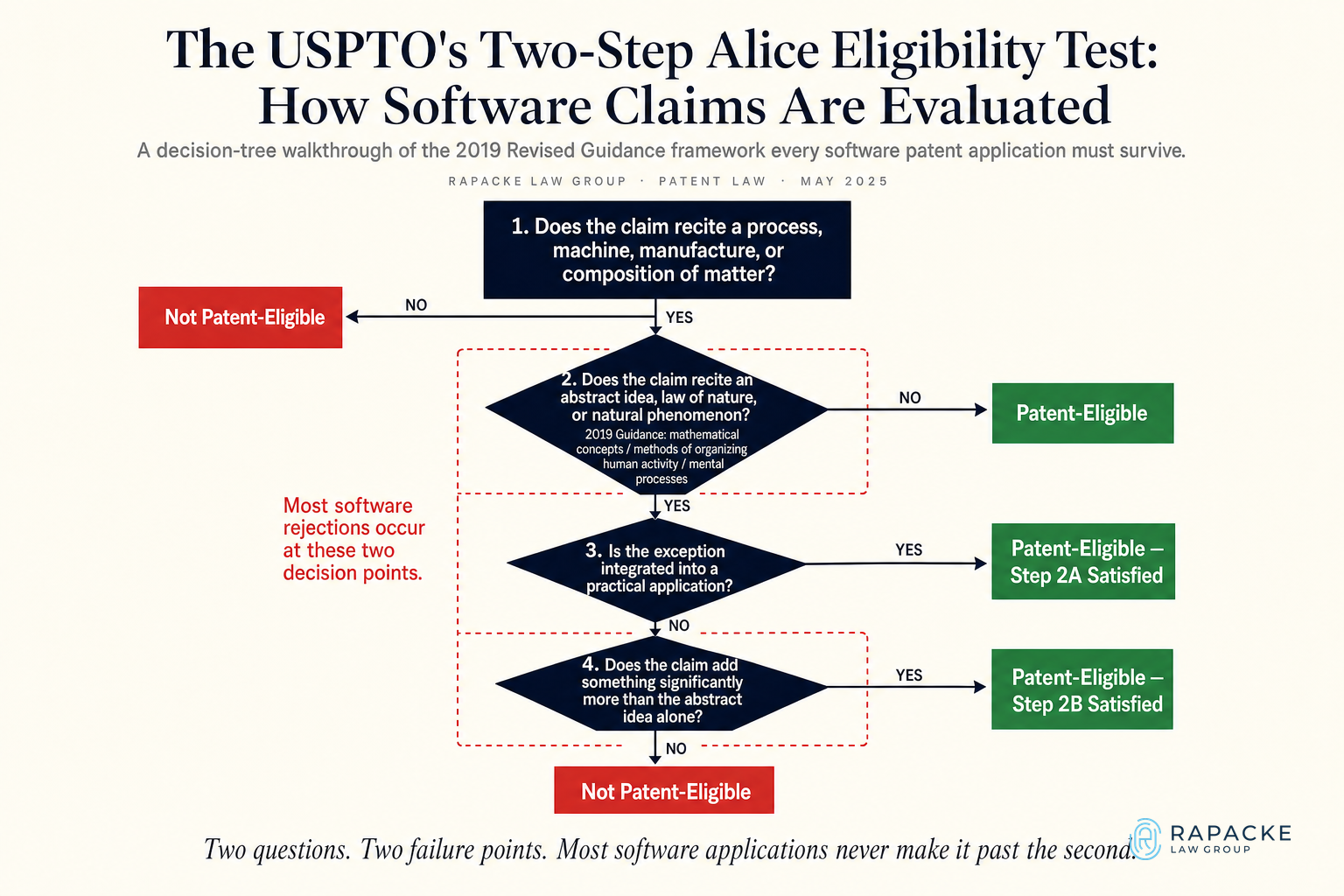 The USPTO's Two-Step Alice Eligibility Test: How Software Claims Are Evaluated — Source: USPTO 2019 Revised Subject Matter Eligibility Guidance, Federal Register, 2019
The Abstract Idea Test in Plain English
Organizing data, applying a mathematical formula, and performing a fundamental business practice on a generic computer are consistently ruled abstract. The USPTO's 2019 Revised Guidance defined three categories of abstract ideas, namely mathematical concepts, certain methods of organizing human activity, and mental processes, and instructed examiners that a claim is not directed to an abstract idea if the idea is integrated into a practical application, per the Federal Register notice. Write a one sentence plain English summary of what your invention does. If it sounds like a business rule, a math equation, or a mental process, dig into the technical implementation before filing.
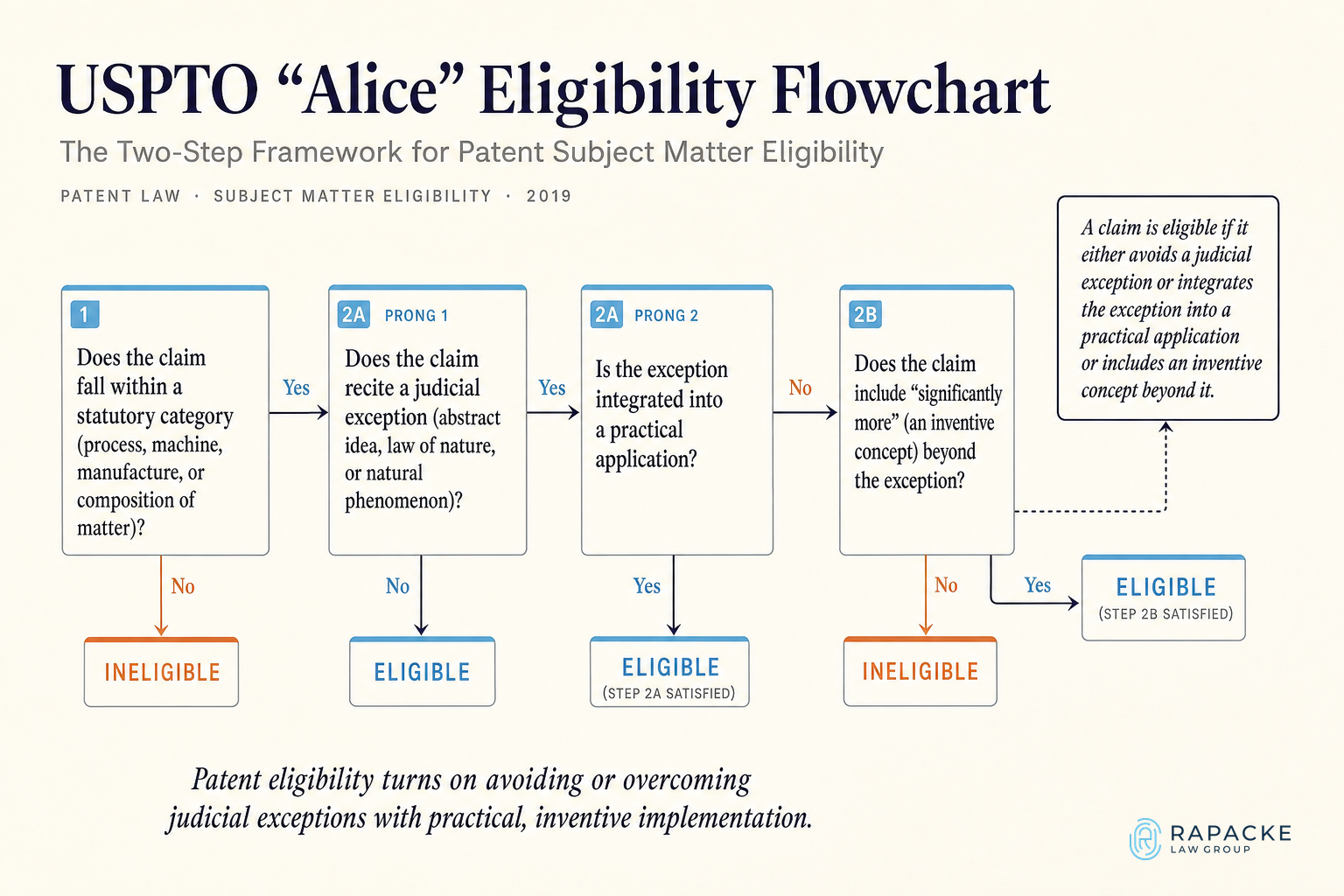 USPTO “Alice” Eligibility Flowchart (2019) – A decision flowchart summarizing the two-step analysis for patent subject matter eligibility. Step 1: Is the claim to a process, machin — Source: USPTO, 2019
What Significantly More Actually Means for Software Claims
Alice step two requires the claim to add an inventive concept beyond a generic computer running conventional steps. Courts find this met when the claim specifies an unconventional technical arrangement or an improvement to how the computer functions. In BASCOM Global Internet Services v. AT&T Mobility (2016), the Federal Circuit found an inventive concept in the specific ordered combination of known filtering elements arranged in a non-conventional way on a remote server, according to the court's opinion. Map each claim element to a specific technical function. A generic computer plus conventional steps will not survive.
Computer-Implemented Inventions That Consistently Qualify
Certain categories regularly clear Section 101: improvements to network security architecture, novel data compression methods, specific machine learning training processes tied to technical outcomes, and software that controls physical hardware in a new way. The USPTO's own examples illustrate the point. One published example describes a digital halftoning image processing method that uses a particular mask to reduce memory use and speed computation, and that concrete improvement made the claim eligible even though it involved a math operation, per the USPTO subject matter eligibility examples. Benchmark your software inventions against the USPTO's published eligible subject matter examples before you invest in full application drafting. Studying recent software patent examples from top companies and startups is another quick way to calibrate.
The Pre-Filing Checklist Every Founder Should Complete
Patentability has three independent gates, and a software invention must clear all of them before a patent application is worth drafting. Skipping any one of them is how founders spend money on filings that were never going to issue.
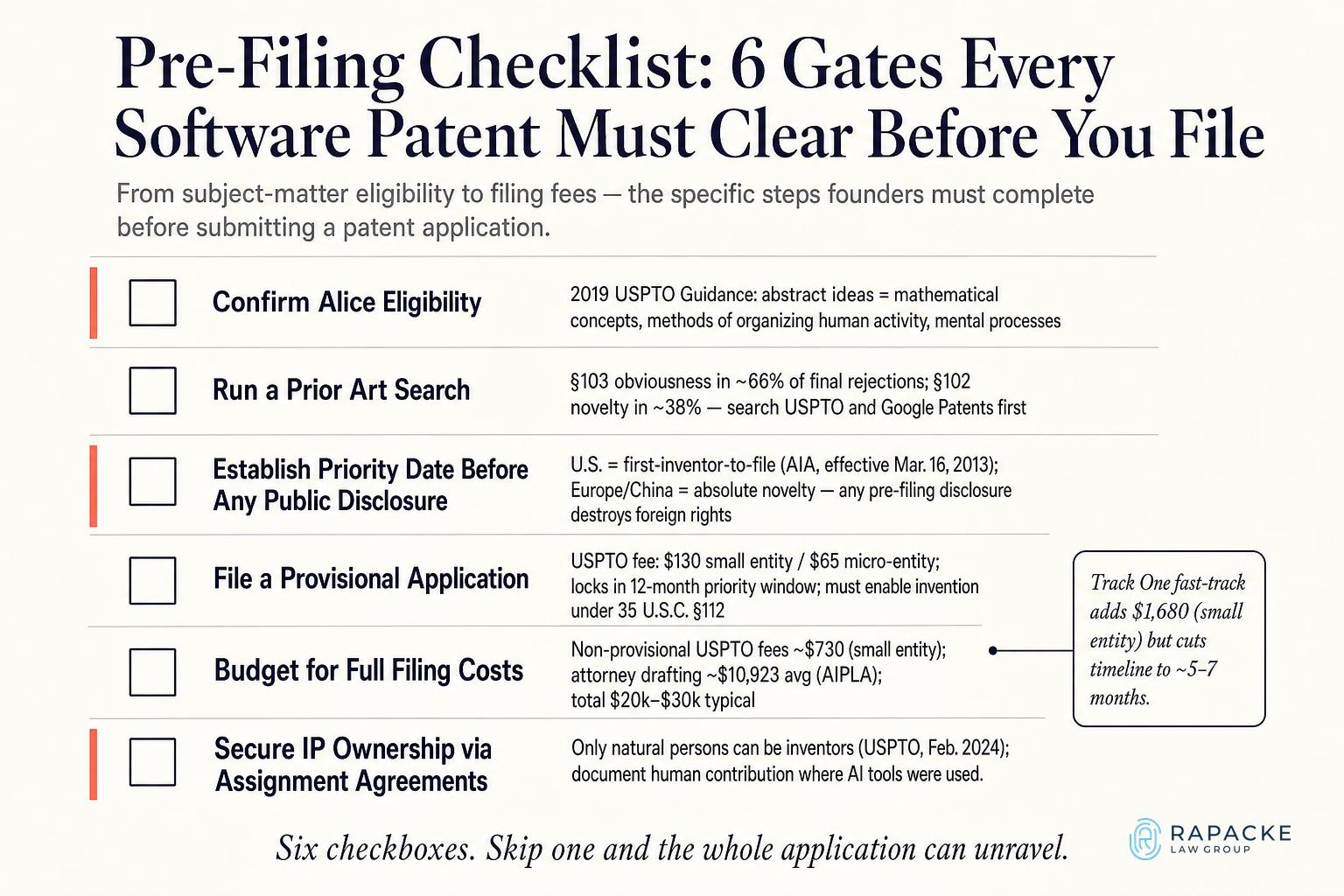 Pre-Filing Checklist: 6 Gates Every Software Patent Must Clear Before You File — Source: USPTO Fee Schedule, 2024; USPTO AIA Resources; AIPLA Economic Survey / BlueIron, 2023; USPTO Feb. 2024 AI Inventorship Guidance
Steps One Through Three, Eligibility, Novelty, and Non-Obviousness
Patentable subject matter under Section 101 was covered above. Section 102 requires novelty, meaning the invention cannot already exist in the prior art. Section 103 requires non-obviousness, meaning a person of ordinary skill could not have combined existing prior art to reach the same invention. Obviousness is the workhorse rejection. USPTO data shows Section 103 rejections appeared in roughly 66 percent of first final rejections over 2005 to 2014, with novelty rejections under Section 102 at about 38 percent, according to IPWatchdog. Do not skip a prior art search. Even a preliminary search reveals whether the filing investment is likely to yield a defensible patent.
Steps Four Through Six, Prior Art Search, Provisional Versus Non-Provisional, and Documentation
A prior art search scans issued patents, published patent applications, academic papers, open source software repositories, and public product releases to map what already exists. After the search, you decide between a provisional patent application, which is less formal, secures a priority date, and gives 12 months to file the full application, and a non-provisional application, which begins formal examination. The cost gap is large. A provisional filing fee is just $150 for a small entity and $65 for a micro entity, per the USPTO fee schedule. File a provisional to lock in your priority date before any public disclosure, investor pitch, or product launch.
Steps Seven Through Nine, Claim Drafting, Inventor Records, and Disclosure Timing
Claim drafting is where most founders lose control of their patent protection. Independent claims set the broadest scope, and dependent claims add layers of specificity that survive if broader claims are challenged. Document the invention thoroughly. Lab notebooks, version histories, and internal communications establish the inventive contribution of each named inventor. This matters because the America Invents Act switched the United States to a first-inventor-to-file system effective March 16, 2013, per the USPTO. Whoever files first has priority. Start an invention disclosure document the day you confirm your core technical architecture works.
What Strong Software Patent Claims Look Like in Practice
The difference between a granted software patent and a rejected one usually lives in the claim language. A strong claim describes how a result is achieved. A weak claim describes the result itself. PTAB trial data underscores why this matters, in post-grant proceedings, 67.5 percent of instituted patents had all claims struck down, while only about 17 percent had all claims upheld and roughly 15 percent ended in a mixed outcome, according to a Congressional Research Service report. Well-built claim sets are what keep at least some claims standing.
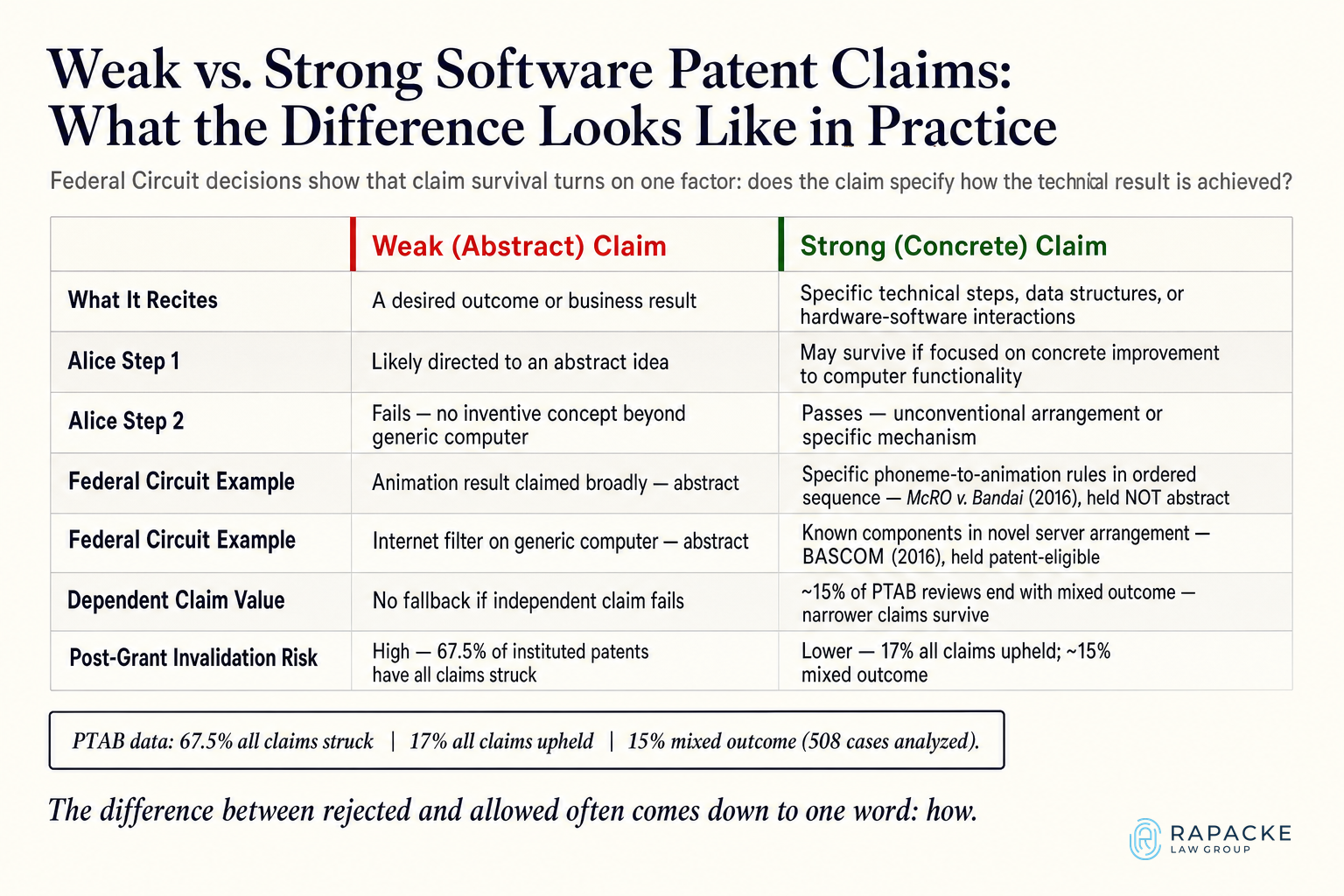 Weak vs. Strong Software Patent Claims: What the Difference Looks Like in Practice — Source: McRO v. Bandai Namco, Fed. Cir. 2016; BASCOM v. AT&T Mobility, Fed. Cir. 2016; CRS Report R48016, everycrsreport.com
Independent Claims That Survive Alice Review
A strong independent claim for a software invention describes a specific technical method or system, identifies the hardware involved in non-generic terms where possible, specifies the sequence of steps, and links the process to a concrete technical result rather than a business outcome. Compare two claims. A method for improving customer retention using a computer is a business goal dressed up as a claim, and it will likely fail. A method for dynamically reallocating server resources in response to predicted traffic patterns using a trained classification model is closer to a defensible claim. In McRO, Inc. v. Bandai Namco Games America Inc. (2016), the Federal Circuit held that claims reciting specific rules to automate lip synchronization in animation were not abstract because they improved on a prior manual technical process, per FindLaw. Every independent claim should answer one question, what specifically is the machine doing differently, and why is that technically non-obvious?
The Role of Dependent Claims in Building a Defensible Patent
Dependent claims are not decoration. They are the safety net that preserves patent protection when a broad independent claim is narrowed or invalidated during examination or post-grant review. Each dependent claim should add a specific technical limitation that gives an alternative basis for infringement. Given that roughly one third of post-grant challenges end with some claims surviving and others falling, the patents with deep, well-constructed dependent claim sets are the ones that retain enforceable scope. Budget your claim count deliberately. U.S. patent applications include up to 20 total claims and 3 independent claims before extra claim fees apply.
How Real Companies Have Claimed Software Inventions Successfully
The companies that win do not claim outcomes. Salesforce holds patents on specific database query optimizations rather than broad CRM automation. Google holds patents on particular machine learning model architectures rather than artificial intelligence in general. The common thread across these granted software patents is a specific technical innovation described in concrete terms. For a closer look, see 10 Powerful Software Patent Examples Every SaaS Founder Should Study. Study granted patents in your technology class at Google Patents before your attorney drafts your claims. Seeing what has cleared the patent office gives you a working template for your own claimed invention.
How the Provisional Patent Application Fits Into a Software Startup's Strategy
A provisional patent application is the cheapest insurance policy in IP. It gives a startup 12 months from the filing date to refine the invention, raise capital, test the market, and prepare a full non-provisional application, all while holding the earlier priority date. For software companies that iterate fast, that window is strategically valuable.
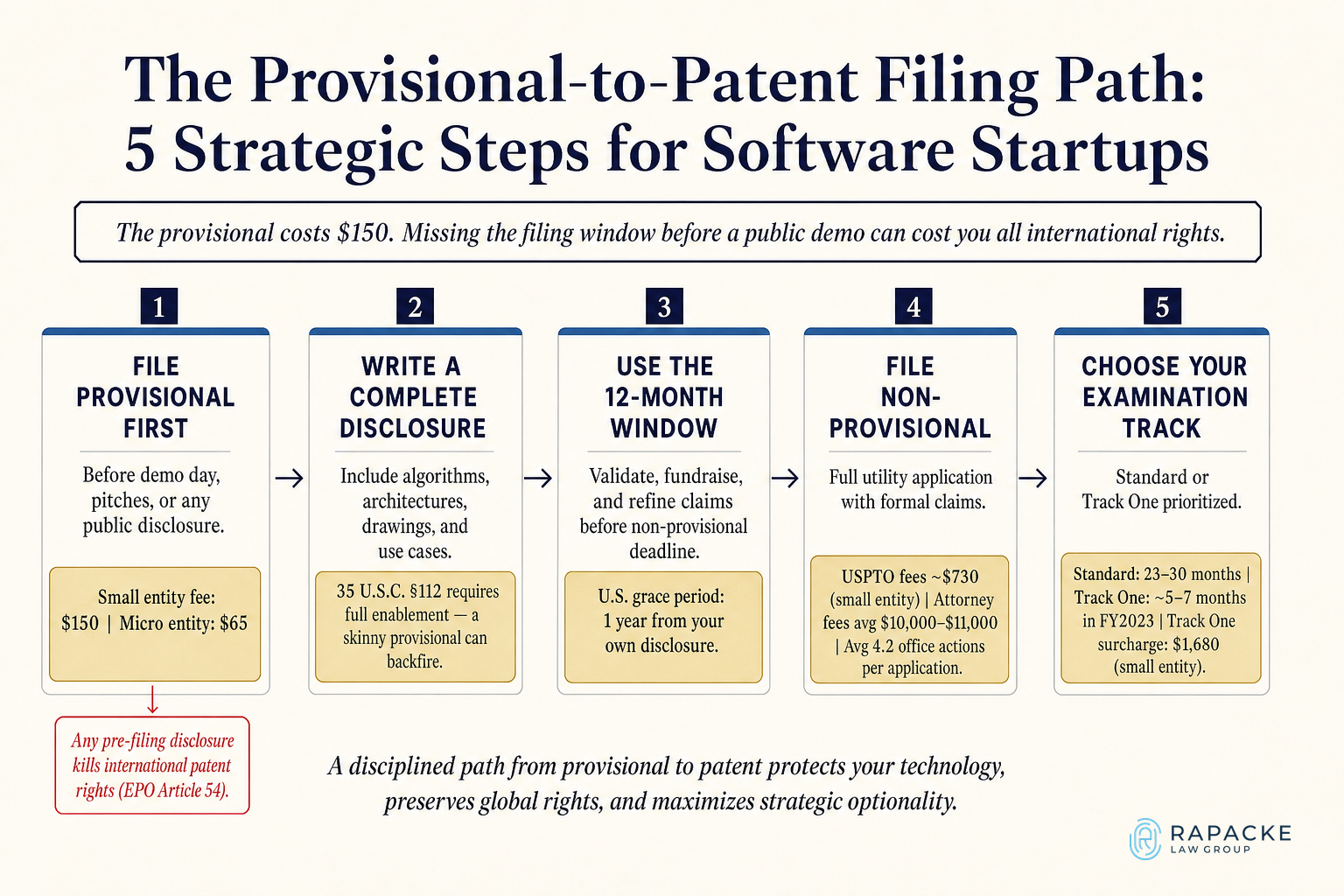 The Provisional-to-Patent Filing Path: 5 Strategic Steps for Software Startups — Source: USPTO Fee Schedule 2024; AIPLA Economic Survey via BlueIron IP, 2023; IPWatchdog / USPTO Track One data, FY2023
Why Filing Provisional First Is Almost Always the Right Move for Founders
The provisional never gets examined and never issues as a patent on its own. What it does is establish the critical first-to-file date at a fraction of the cost. USPTO fees for a provisional run $150 or less for small entities, while a non-provisional filing pulls in roughly $930 in USPTO fees for filing, search, and examination for a small entity, per the USPTO fee schedule. Use the 12 month provisional window to validate commercial traction before committing to the full non-provisional cost.
What Must Be in the Provisional Application to Protect Your Future Claims
A provisional that is too thin will not support the claims in your non-provisional application, and that mismatch creates priority gaps that can invalidate your filing. The provisional must describe the invention with sufficient detail, including the technical architecture, the problem being solved, and the manner of operation. Under 35 U.S.C. Section 112, the specification must enable a person skilled in the art to make and use the invention without undue experimentation, per USPTO guidance. Treat the provisional like a dress rehearsal. Include drawings, use cases, and implementation specifics rather than filing a bare-bones placeholder.
Public Disclosure Before Filing and the Grace Period Rule
Under the America Invents Act, U.S. law gives an inventor a 12 month grace period for the inventor's own public disclosures made before filing, per 35 U.S.C. Section 102. That grace period does not protect against third-party disclosures and is not recognized in most other countries. The European Patent Office requires absolute novelty, so any public disclosure before filing destroys patent rights there, per Article 54 EPC. Many founders create prior art against themselves by publishing blog posts, demos, or investor decks before filing. File at least a provisional patent application before any public product launch, conference presentation, or media coverage.
What the Software Patent Application Process Costs and How Long It Takes
A typical software patent runs $20,000 to $30,000 from filing to grant when you account for USPTO fees, attorney drafting, and the office action responses that nearly every application requires. This range is a typical estimate, not a fixed price, and it tracks with practitioner cost summaries and AIPLA Economic Survey data for electrical and computer technologies. Founders who budget only for the initial filing are setting themselves up for a cash surprise during prosecution.
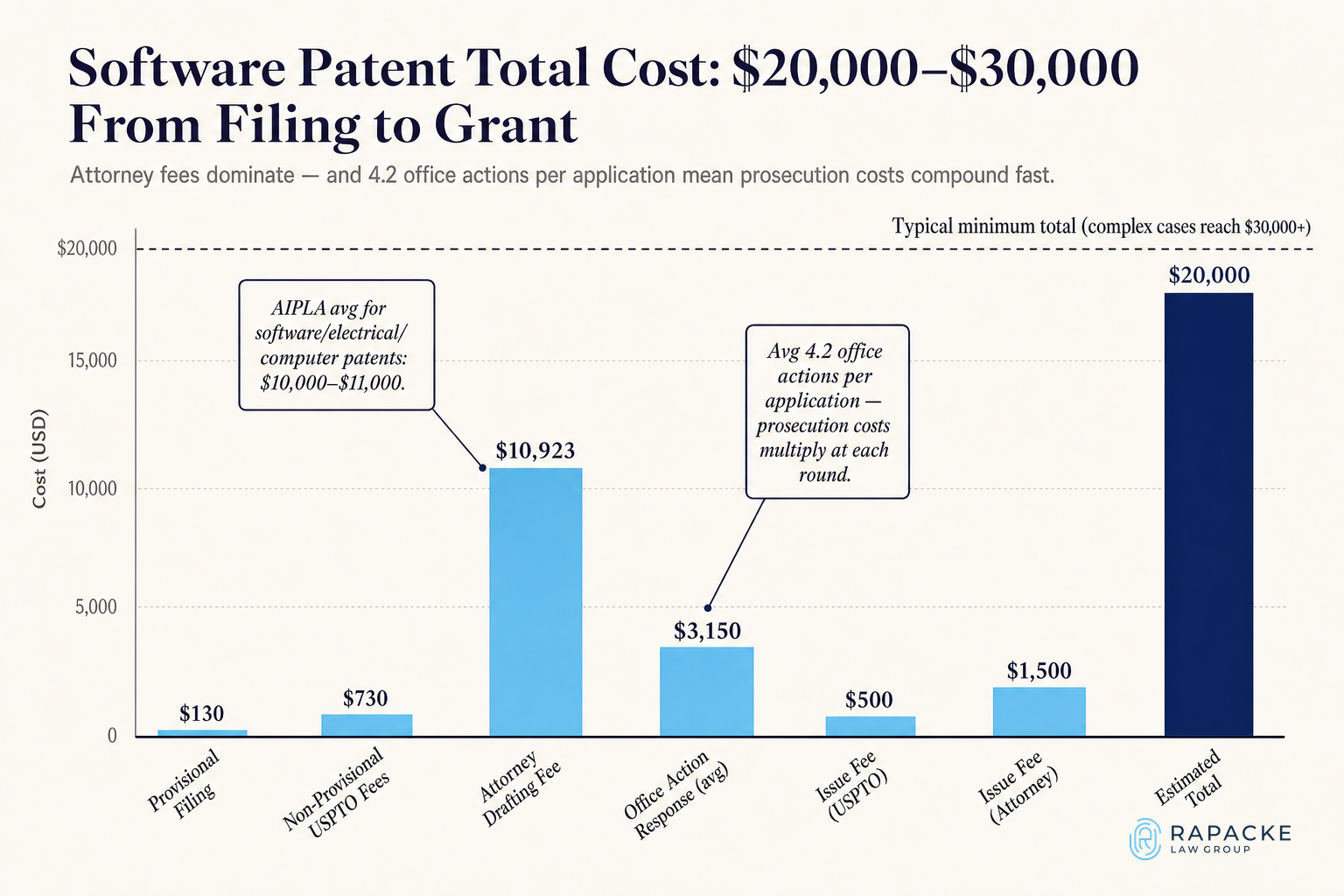 Software Patent Total Cost: $20,000–$30,000 From Filing to Grant — Source: AIPLA Economic Survey via BlueIron IP, 2023; USPTO Fee Schedule, 2024
USPTO Fees, Attorney Fees, and Total Investment Ranges
AIPLA Economic Survey data puts attorney fees for drafting and filing an electrical or computer patent in the range of roughly $10,000 to $11,000 for a typical application. Add USPTO filing, search, and examination fees depending on entity size, and your initial filing lands around $11,000 to $12,000. Then prosecution adds up. Applications commonly receive multiple office actions during examination, each potentially costing a few thousand dollars in attorney time. Budget the full range, USPTO fees plus attorney fees plus office action response costs, before committing to a filing strategy. Understanding how long software patents last helps you weigh that spend against the asset's lifetime value.
Timeline From Filing to Issuance and What Happens In Between
The USPTO's average time to first office action sits in the 16 to 18 month range, and total pendency to issuance runs about 23 to 30 months in recent years. Software-heavy classes such as 705, 706, and 707 often skew to the high end because of backlog. If office actions issue, each response extends the timeline further. Factor a two to four year prosecution timeline into your IP strategy. A provisional secures your date while you prepare, but patent protection is not immediate.
Accelerated Examination Options for Startups
The USPTO offers Track One Prioritized Examination, which aims to reach a final disposition within roughly 12 months for an additional fee of about $2,340 for small entities, through the Prioritized Patent Examination Program. In recent years, the average Track One application has reached final disposition far faster than standard examination, often within roughly a year, and a substantial share of Track One applications are allowed without a final rejection. If competitive timing matters, for example ahead of a fundraising round or product launch, consider Track One as part of your filing strategy.
How Software Patents Interact With Other IP Protection Layers
Patents are one layer in a software IP stack, and the strongest founders use all three layers deliberately. Four numbers frame the landscape. By 2019 to 2020, about 73 percent of federal trade secret lawsuits included a Defend Trade Secrets Act claim, angel-round startups holding patents saw materially higher valuations than those without, U.S. patents run for 20 years, and the Google v. Oracle decision in 2021 reshaped how copyright applies to software interfaces.
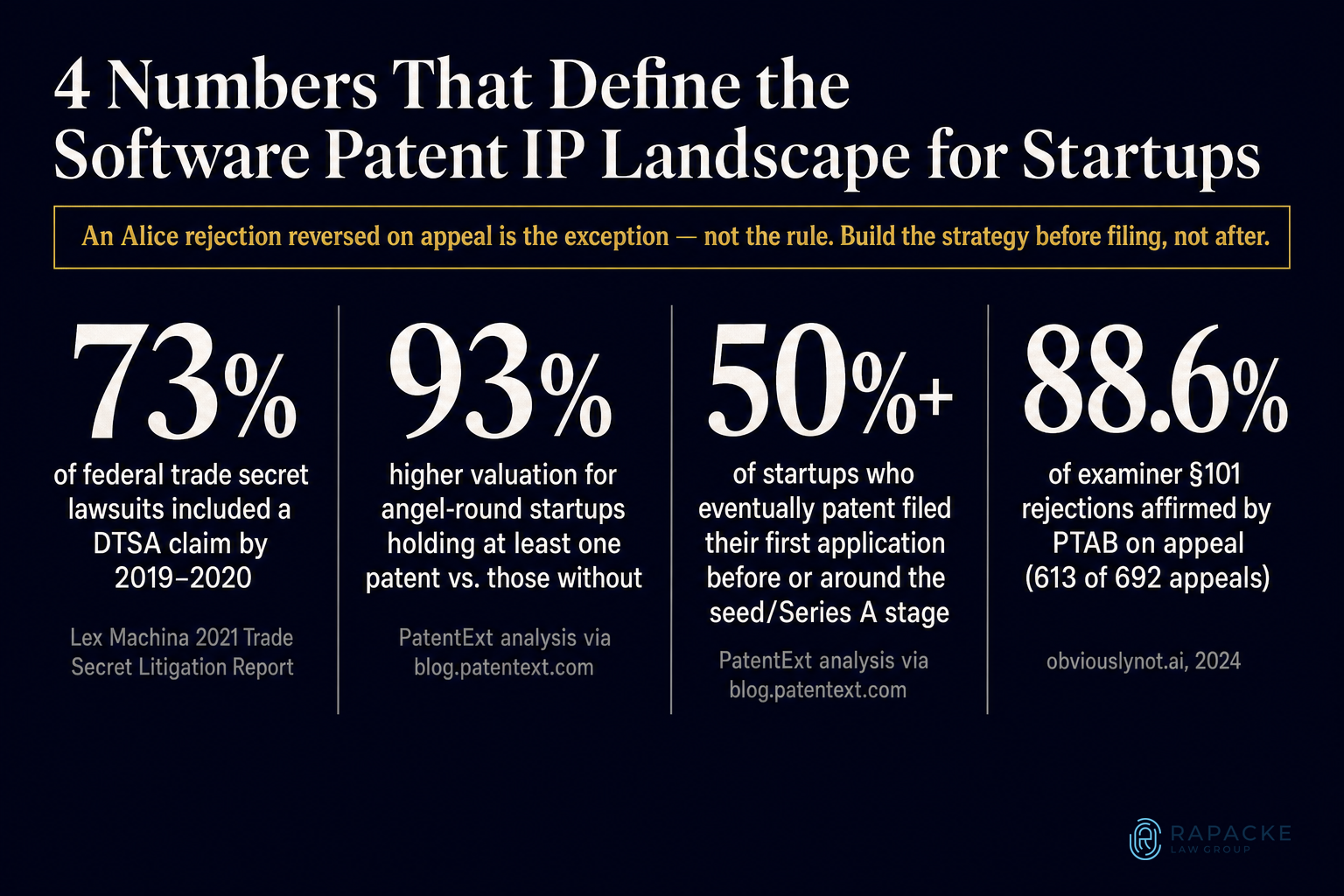 4 Numbers That Define the Software Patent IP Landscape for Startups — Source: Lex Machina 2021 Trade Secret Litigation Report; PatentExt (blog.patentext.com); obviouslynot.ai, 2024
When to Use Trade Secrets Instead of or Alongside Patents
Trade secret protection lasts indefinitely as long as the information stays confidential and you take reasonable steps to protect it. For algorithms that cannot be reverse-engineered from product output, a trade secret may be more durable than a patent, which requires public disclosure. The tradeoff is real. A patent gives an exclusive right even against independent invention, while a trade secret gives nothing if a competitor legitimately discovers the same solution. The Defend Trade Secrets Act of 2016 created a federal cause of action, and by 2019 to 2020 about 73 percent of federal trade secret suits included a DTSA claim, according to LexisNexis. For core algorithmic logic not exposed in your product output, evaluate whether a trade secret serves you better than patent disclosure. If you do hold patents, our guide on how to monetize software patents covers turning them into revenue.
Copyright's Role in a Software IP Stack
Copyright protection attaches automatically to original software code at the moment of creation, and registration strengthens your enforcement rights. Copyright protects the specific expression, the code itself, but does not stop a competitor from writing different code that achieves the same functional outcome. Registration with the U.S. Copyright Office unlocks statutory damages and attorney fee recovery. In Google LLC v. Oracle America, Inc. (2021), the Supreme Court assumed Oracle's Java API declarations were copyrightable but held Google's reimplementation was fair use, per Oyez, illustrating both the scope and the limits of copyright for software. Register copyright in your source code as a baseline. It is low cost, immediate, and complements patent protection without replacing it.
Building an IP Portfolio Strategy Before a Fundraising Round
Investors running IP due diligence look for filed patent applications, a clean ownership chain with assignments from all founders and contractors, and a coherent portfolio strategy. A single application shows IP awareness. A portfolio shows IP strategy. The payoff can be measurable. One internal analysis by PatentExt found angel-round startups holding at least one patent reported about 93 percent higher valuations than those without, according to PatentExt's own dataset. Treat that as a directional signal from a single source rather than a hard external benchmark. File at least one patent application, complete IP assignments for all contributors, and prepare a one-page IP summary before your Series A process begins. The SaaS Patent Guide 2.0 walks through building that portfolio step by step.
Common Software Patent Mistakes That Founders Make Before Hiring an Attorney
Most fatal patent mistakes happen before a founder ever talks to an attorney. They are cheap to avoid and expensive to fix. Three of them account for the bulk of lost rights and abandoned applications.
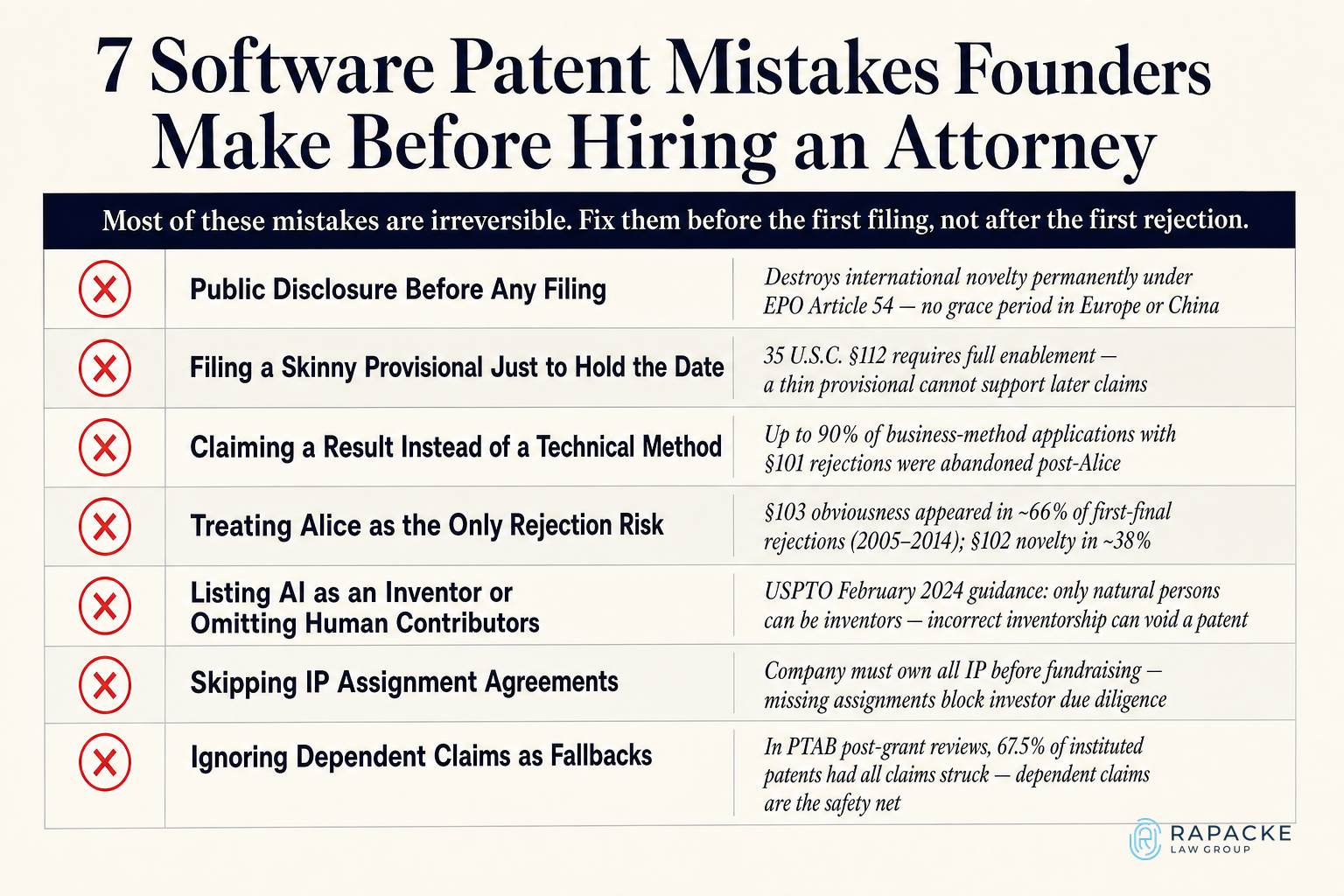 7 Software Patent Mistakes Founders Make Before Hiring an Attorney — Source: USPTO AI Inventorship Guidance Feb 2024 (Ars Technica); CRS Report R48016 (everycrsreport.com); IPWatchdog 2015; GMU CIP2 AliceStorm 2015; EPO Article 54; 35 U.S.C. §102, §103, §11
Filing Too Late After Public Disclosure
The most expensive mistake is disclosing the invention publicly before filing anything. U.S. law gives a 12 month grace period from your own disclosure, but the clock starts immediately and international rights are typically forfeited the moment a public disclosure occurs without a prior filing. Under the European Patent Convention, any pre-filing disclosure destroys novelty entirely, per Article 54 EPC. Demo days, crowdfunding campaigns, and investor pitch decks all count. Treat any investor pitch, blog post, or product demo as a potential public disclosure that requires a provisional filing first.
Writing Claims That Describe a Result, Not a Technical Method
Founders who draft their own claims, or work with attorneys who do not specialize in software, often describe what their software accomplishes rather than how. A method for improving e-commerce conversion rates is a business goal, not a patent claim. A computer-implemented method for dynamically adjusting product display order based on real-time session behavior signals using a trained ranking model is closer to defensible. This is not a stylistic point. After Alice, the overwhelming majority of business method applications that received a Section 101 rejection were ultimately abandoned, with abandonment rates running well above 90 percent in some units, according to George Mason University's CPIP. Run the "how does it work technically" test on every independent claim before submitting it.
Assuming an AI-Generated Invention Has a Clear Inventor of Record
The patent office requires patents to list human inventors who conceived the claimed invention. With AI-assisted development, you must document which aspects a human conceived, whether the founder, the engineers, or both. In February 2024, the USPTO issued guidance stating that using AI is allowed but a natural person must have made a significant inventive contribution, and AI systems cannot be listed as inventors, per the USPTO Inventorship Guidance for AI-Assisted Inventions. Simply prompting an AI tool is not enough. Document human inventive contribution at each stage of development, especially when AI tools assist with design or prototyping. For a deeper dive on this fast-moving area, see our AI Patent Mastery resource.
How to Choose the Right Patent Attorney for a Software Application
Patent prosecution is a specialized skill, and software prosecution is a specialty within that specialty.
What Technical Background Actually Matters for Software Patent Counsel
A registered patent attorney or agent must hold a technical degree recognized by the patent office to sit for the patent bar. For software patents, an attorney with a background in computer science, electrical engineering, or software engineering brings far more value than one rooted in chemistry or mechanical engineering. The patent office maintains a public roster of tens of thousands of registered practitioners, but the subset with both software-specific technical backgrounds and real Federal Circuit software patent experience is much smaller. The attorney needs to understand claim construction in software contexts and the Alice framework in depth. Ask any candidate directly how many software patent applications they have prosecuted and what their response rate is to Section 101 rejections.
The Flat-Fee Versus Hourly Model and What It Means for Budget Control
Hourly billing for patent prosecution creates unpredictable costs. Every office action, call, and amendment adds to the bill, and a difficult case can add several thousand dollars in prosecution on top of drafting. Flat-fee patent services, like the model used at Rapacke Law Group, give predictable costs and align the attorney's incentive with efficient prosecution. For founders managing runway, that cost predictability is directly relevant to IP strategy. The firm also backs its work with The RLG Guarantee, including a full refund if the USPTO denies a provisional patent application and a 100 percent refund if a patentability search finds your invention is not novel. Request an all-in cost estimate that includes likely office action responses before engaging any patent attorney for a software application.
Questions to Ask Before Signing an Engagement Agreement
Treat the selection conversation as a technical interview, not a fee comparison. Ask whether the attorney specializes in software and tech IP, what their Section 101 rejection response strategy is, whether they can show you granted software patents they have prosecuted, what their fee structure covers, and what their turnaround time is for application drafting. A practitioner who welcomes these questions and points to relevant granted patents in your technology class is the partner you want. A patent is a 20-year asset, so choosing prosecution counsel who understands your technology is as important as any key engineering hire.
Frequently Asked Questions About Software Patents
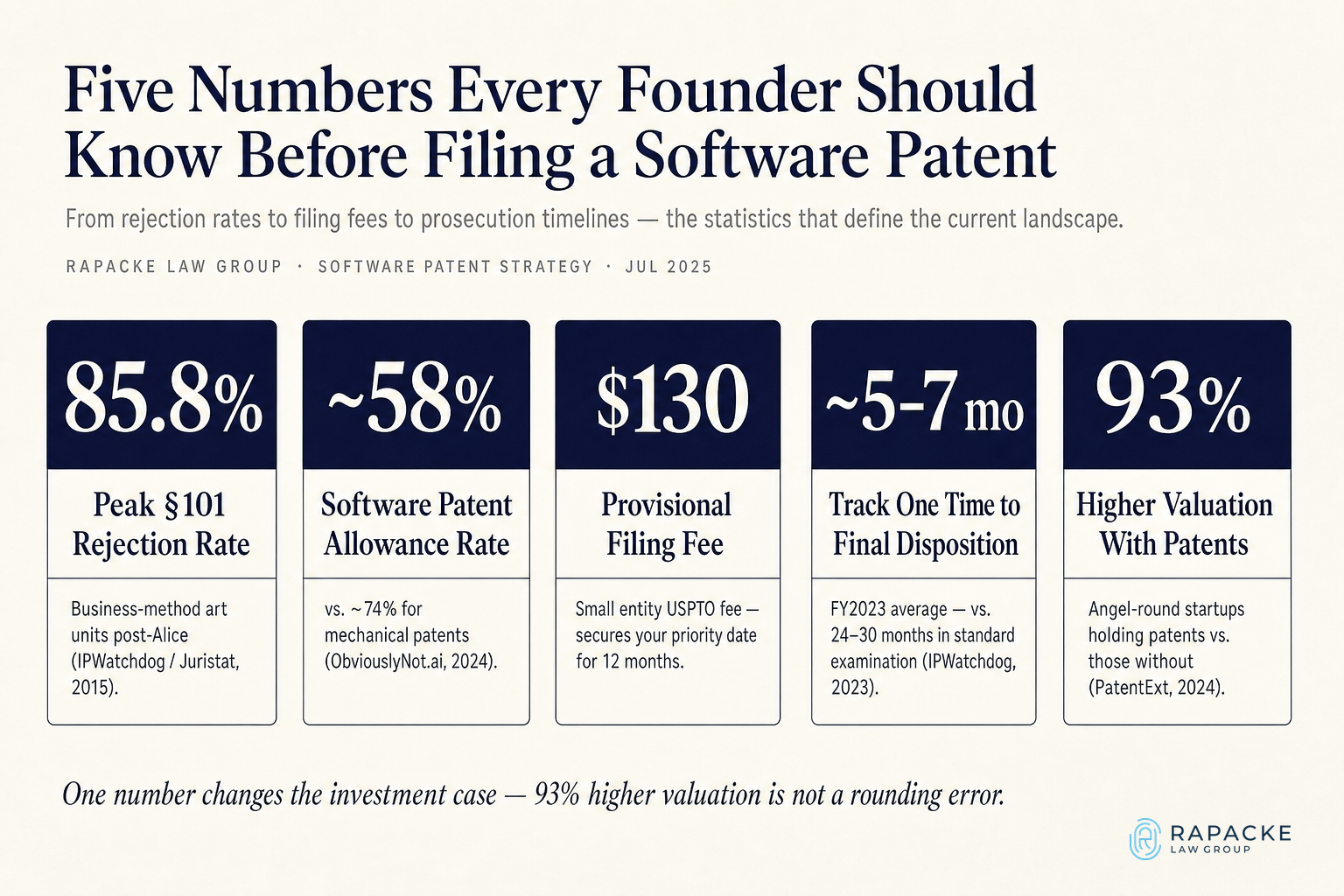 Five Numbers Every Founder Should Know Before Filing a Software Patent — Source: IPWatchdog/Juristat 2015; ObviouslyNot.ai 2024; USPTO Fee Schedule; IPWatchdog 2023; PatentExt Blog 2024
What is an example of a software patent?
A classic example is Amazon's "1-Click" patent, U.S. Patent No. 5,960,411, which claimed a method for placing an online order with a single user action by storing prior customer payment and shipping information. Filed in 1997 and granted in 1999, it was valuable enough that Apple licensed it in 2000, per Retail Dive. More recent examples include Google's patents on machine learning model components and Salesforce patents on specific CRM data processing methods. The common thread is that each claims a specific technical implementation, not an abstract outcome.
Can you have a patent for software?
Yes, you can patent software-based innovations in the United States, but the patent must claim more than code or an algorithm in the abstract. It has to be framed as a process, system, or method that produces a concrete technical result and adds something beyond what a generic computer already does. Thousands of software patents issue every year. The USPTO granted roughly 348,000 patents in fiscal year 2023, and software-related inventions make up a meaningful portion of recent grants based on patenting trend analyses such as Anaqua's review of USPTO statistics. The key is claim strategy, not avoiding the patent office.
Can software be patented in the USA?
Software can be patented in the USA under 35 U.S.C. Section 101 when it is claimed as a method, system, or article of manufacture that meets the requirements for patentable subject matter, novelty under Section 102, and non-obviousness under Section 103. The primary hurdle is the Alice framework, which requires that the claim either not be directed to an abstract idea or, if it is, that the claim add an inventive concept beyond routine computer implementation. Claims framed around technical improvements to computer functionality or specific data processing architectures are the most reliable path to a granted software patent.
Is it hard to get a software patent?
Getting a software patent is harder than getting a mechanical or chemical patent, but it is not impossible with the right claim strategy. In the years right after Alice, some business method units rejected over 80 percent of applications on Section 101 grounds, so many applicants face at least one refusal and must amend claims. A meaningful share of those initially rejected applications eventually issue after one or more office action responses that add detail about how the software achieves its results. The difficulty is real, but it is primarily a claim drafting and prosecution problem, not an insurmountable legal barrier.
Why can't software be patented?
Software can be patented, just not in every form. What you cannot patent is software in the abstract, meaning an algorithm or business idea standing alone. The limits come from Alice and the abstract idea doctrine, under which abstract ideas, mathematical algorithms, and purely mental processes are not patentable subject matter even when run on a computer. The concern is that overly broad software patents could lock up basic computational concepts that should stay freely available. For founders, the practical takeaway is that claims must be grounded in a specific technical improvement rather than a general idea, and inventions that fail the patent test are often better protected through trade secrets or copyright.
Your Next Steps to Software Patent Success
A software patent application filed without clearing the Alice eligibility test, completing a prior art search, and building claims around a specific technical improvement is likely to face rejection, and the cost of responding to multiple office actions often exceeds the cost of getting the strategy right before filing.
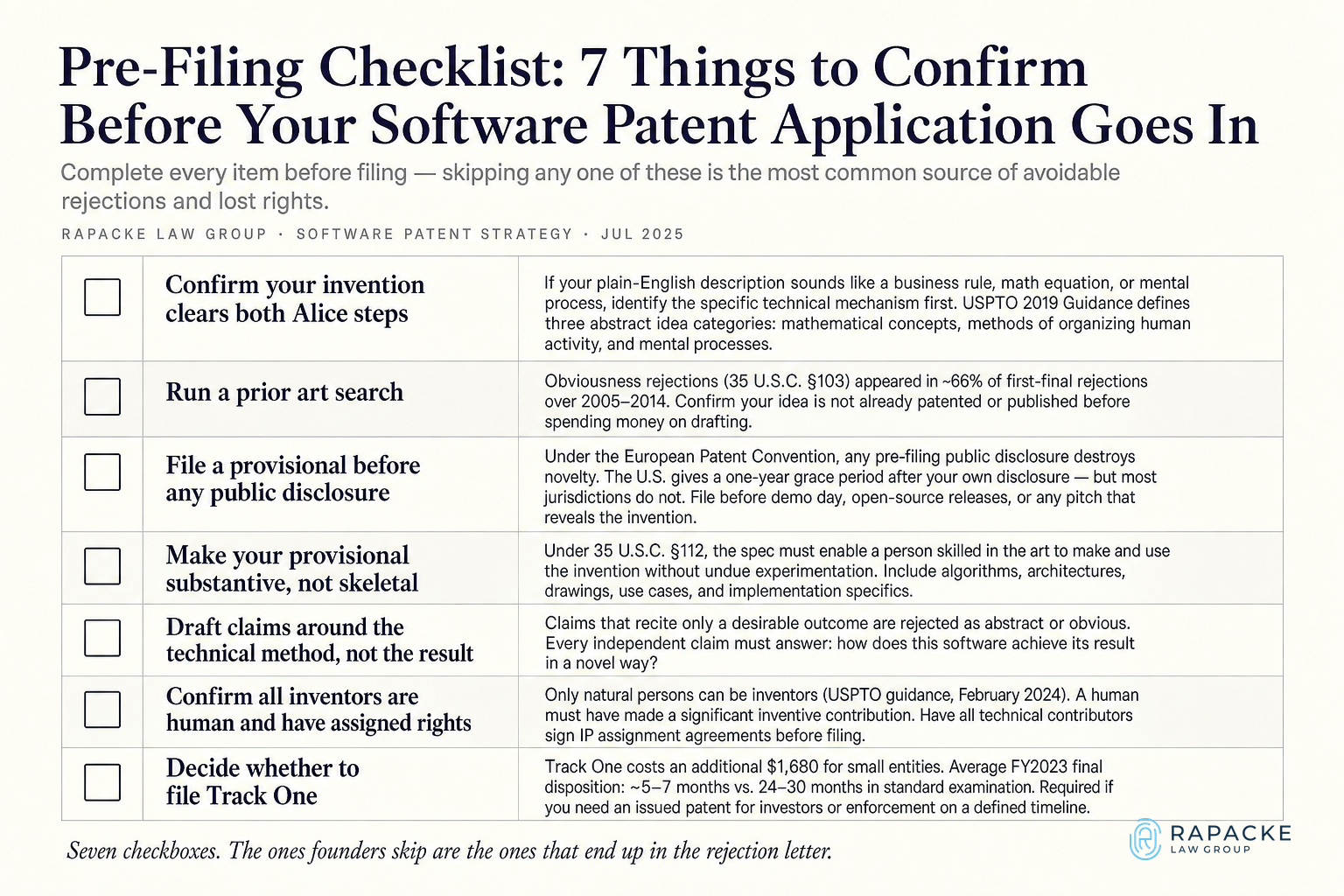 Pre-Filing Checklist: 7 Things to Confirm Before Your Software Patent Application Goes In — Source: USPTO; IPWatchdog; EPO; Ars Technica / USPTO AI Inventorship Guidance, February 2024
The checklist logic is straightforward. Screen for eligibility under Section 101. Run a prior art search to test novelty and non-obviousness. File a provisional patent application before any public disclosure. Draft claims anchored in a technical method rather than a business outcome. Choose an attorney whose software expertise matches your technology class. Each step is a gate, and the application that clears all of them is the one that issues.
The bottom line, a weak software patent describes what your product does and collapses under the abstract idea test, while a strong software patent describes a specific technical method and holds up through examination and any later challenge. The difference is almost always a strategy decision made before the filing date, not a function of how good the invention is.
Every month you wait to file is a month a competitor can reach the patent office first under the first-inventor-to-file rule, or a public disclosure can quietly destroy your international rights. Founders who treat patent strategy the way they treat product architecture, with deliberate design, early testing, and the right technical team, consistently produce better outcomes.
Here is where to start:
- Schedule a Free IP Strategy Call to assess whether your software clears Alice and where the strongest claims sit.
- Run a prior art search before you spend a dollar on drafting.
- File a provisional patent application before your next demo, pitch, or launch.
- Review the Must-Have Software Patent Guide to map out your full filing strategy.
A well-built software patent is a 20-year asset that can anchor your valuation, deter competitors, and open licensing revenue. Getting the strategy right before you file is the highest-ROI decision in your entire IP plan, and Rapacke Law Group's flat-fee model keeps that cost predictable from eligibility assessment through prosecution.
To Your Success,
Andrew Rapacke Managing Partner, Registered Patent Attorney Rapacke Law Group