

Key Takeaways
- An ITU trademark application locks in your priority date before you launch, giving you a legal head start over any competitor who starts using a similar name after your filing date.
- "Bona fide intent" is a legal requirement, not a formality. Courts have voided ITU applications with no real business plans, as in *M.Z. Berger & Co. v. Swatch AG* (Fed. Cir. 2015).
- After receiving a Notice of Allowance, you have six months to file a Statement of Use or request an extension. Missing that deadline abandons your application and your priority date.
- You can extend the deadline up to five times in six-month increments, for a maximum of three years beyond the Notice of Allowance.
- Government fees for a single-class ITU application run $475 through registration (TEAS Plus); total cost with attorney representation typically falls between $1,750 and $3,500.
Filing an intent to use trademark application with the United States Patent and Trademark Office the day you commit to a brand name is almost always smarter than waiting until your product ships. Founders who intend to use trademark protection as a competitive tool understand that the priority date, not the launch date, is what matters most in a dispute. Under Lanham Act Section 1(b), your filing date becomes your nationwide priority date the moment you submit, even if you haven't sold a single unit yet. That priority advantage can be the difference between owning your brand and defending it in a costly dispute.
What an Intent to Use Trademark Application Actually Is
The Core Legal Concept Behind Filing Before You Launch
An intent to use trademark application, filed with the United States Patent and Trademark Office (USPTO), reserves priority rights to a mark before you begin selling products or services under it. When you intend to use trademark rights as a foundation for your brand, filing before launch is the most effective way to establish nationwide priority. Unlike a use-based trademark application, which requires proof of actual use in commerce at filing, a Section 1(b) filing only requires a bona fide intent to use the mark in the future. For founders building a brand before their product ships, this distinction is critical. If you want to understand how this fits into the broader registration process, our step-by-step guide to getting a federal trademark walks through every stage from search to certificate.
The United States Patent Office processes both intent trademark application filings and use-based trademark applications through the same TEAS portal, but the documentation requirements and downstream deadlines differ significantly depending on which basis you choose.
How the Filing Basis Shapes Every Step That Follows
When you submit a trademark application to the united states patent office, you declare a filing basis: Section 1(a) (use in commerce) or Section 1(b) (intent to use). That choice controls every subsequent deadline, fee, and document required before the Trademark Office issues a registration certificate. Choosing Section 1(b) means you will eventually file either an Allegation of Use or a Statement of Use before trademark registration can issue. Understanding this early prevents costly missteps later in the process.
What "Bona Fide Intent" Actually Requires
The USPTO does not accept vague aspirations as a valid filing basis. Every applicant who intends to use trademark rights must be able to demonstrate a genuine, documented plan to bring the mark to market. In M.Z. Berger & Co. v. Swatch AG (Fed. Cir. 2015), the applicant's intent trademark application for "iWatch" was invalidated because the company had no genuine plan to launch and was found to be attempting to warehouse the mark. The Federal Circuit confirmed that an opposer may challenge an application by alleging the applicant lacks a bona fide intent, and that the determination is an objective one based on the totality of the circumstances. The Opposer bears the initial burden of demonstrating by a preponderance of the evidence that such intent is absent.
Business plans, investor decks, product prototypes, and supplier agreements all serve as evidence of bona fide intent. Applicants should maintain written records including promotional materials, website screenshots, packaging artwork, emails documenting manufacturing steps, purchase orders, business plans, and licensing agreements.
Why Founders Who Intend to Use Trademark Protection Early Gain a Priority Advantage Competitors Cannot Easily Overcome
Your Filing Date Becomes Your Priority Date Nationwide
Under Lanham Act Section 7(c), an ITU application's filing date functions as the mark's constructive use date across the entire United States once it registers, even in markets where you have never operated. This means anyone who starts using a confusingly similar name after your filing date is behind your priority position, regardless of geography. For SaaS founders preparing a national launch, this is one of the most powerful protections available. For a deeper look at how to trademark your business name and lock in that priority from day one, our dedicated guide covers the full strategy.
How ITU Applications Protect Brands During Funding and Pre-Launch
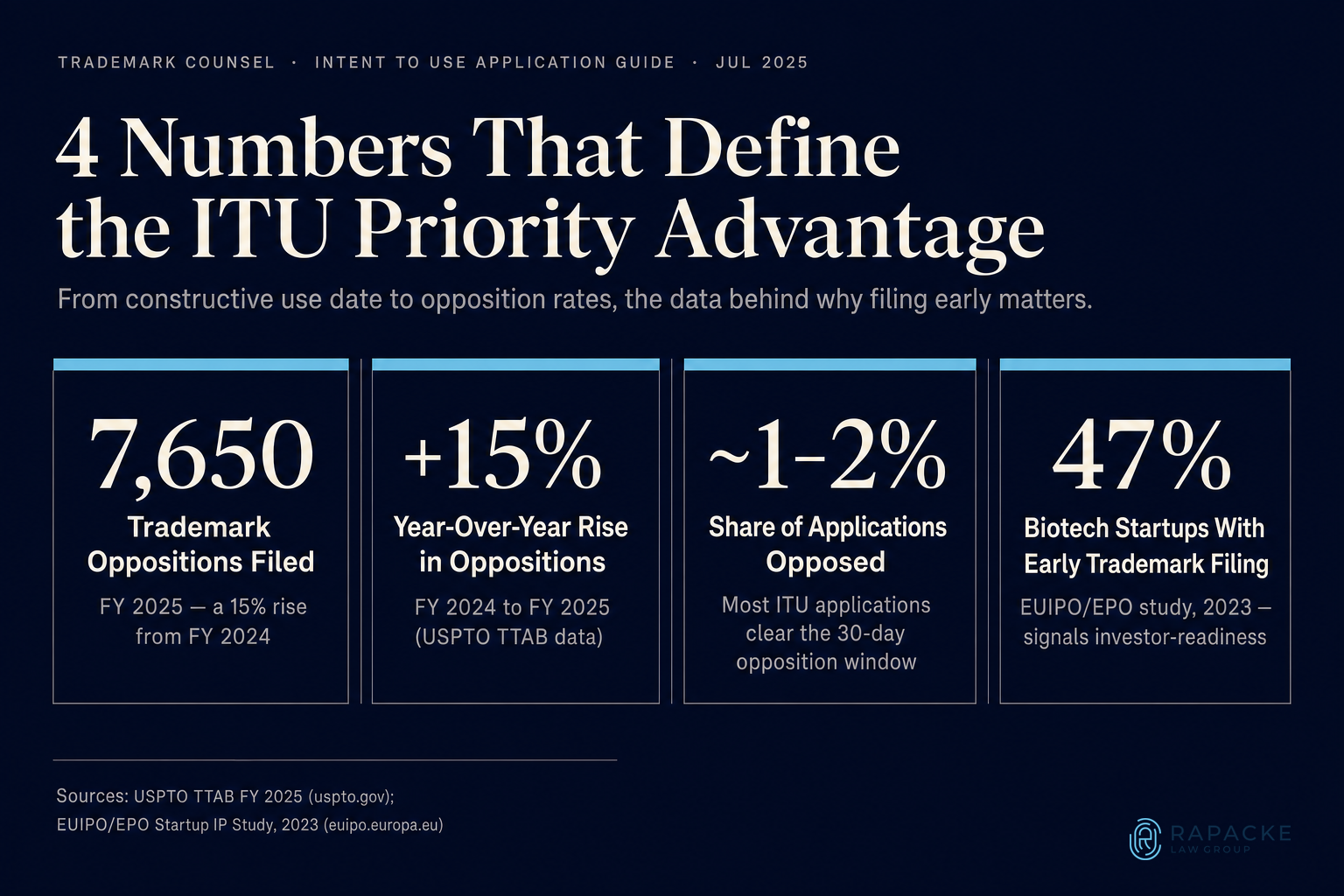
Investors conduct IP due diligence, and a pending trademark application signals that a startup has taken brand protection seriously. Startups that intend to use trademark filings as part of their IP strategy consistently present stronger portfolios during funding rounds. According to a 2023 EUIPO/EPO study, startups with formal IP rights showed higher rates of obtaining funding compared to those without registered or pending IP. A filed ITU application appears in USPTO records, establishes your priority claim to the market, and can be assigned to an acquiring entity with the goodwill of the business. Waiting until launch to file means your brand is unprotected during the exact period when competitors, copycats, and squatters can preempt your name.
The 30-Day Opposition Period After Approval
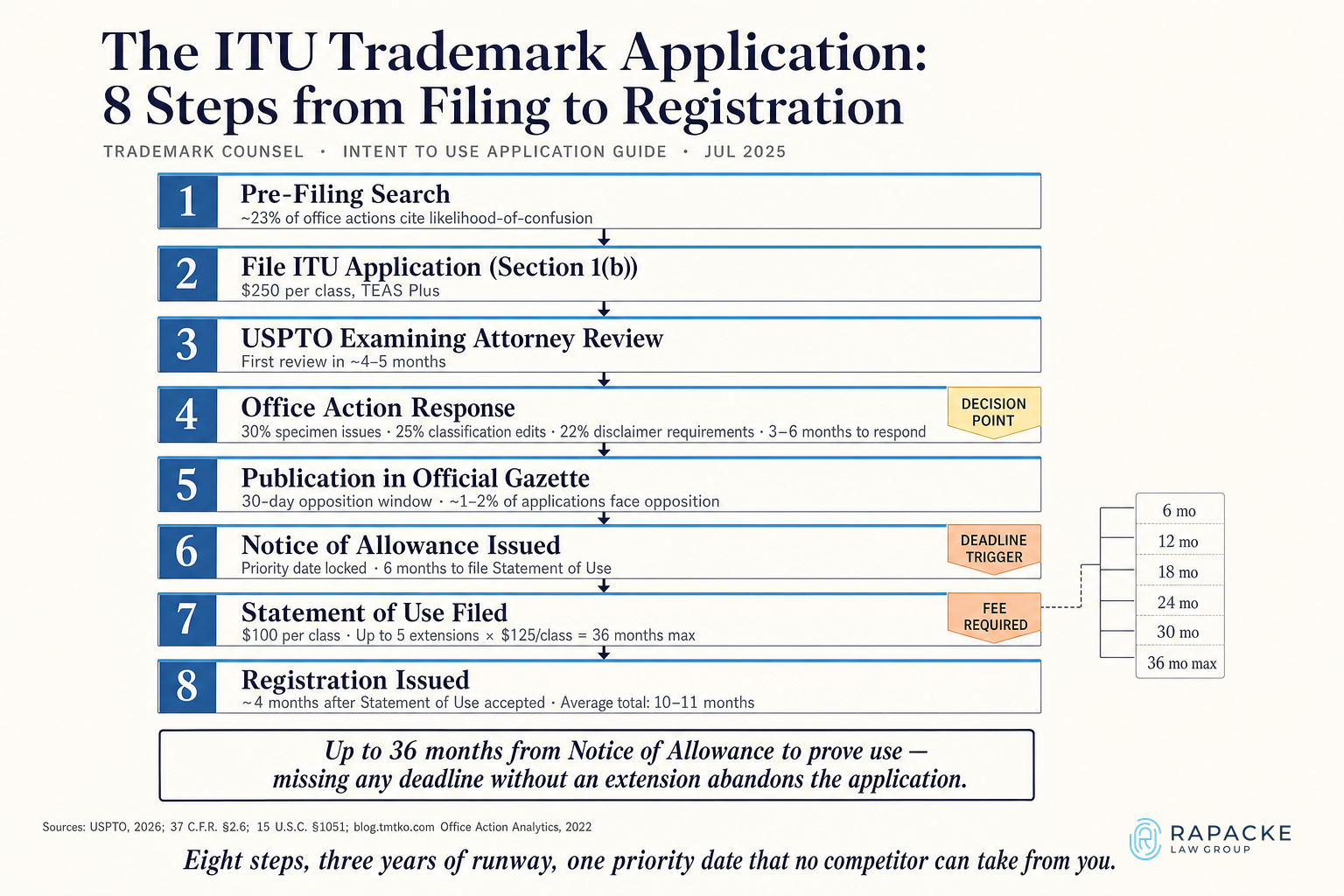
After an examining attorney approves an intent trademark application, it is published in the Official Gazette for a 30 day opposition period during which any third party who believes they would be harmed by the registration can file an opposition at the Trademark Trial and Appeal Board (TTAB). According to USPTO data, approximately 7,650 trademark oppositions were filed in FY 2025, representing roughly 1 to 2% of the hundreds of thousands of applications filed annually. That figure sounds large, but the vast majority of published marks clear the 30 day opposition period without challenge. If no opposition is filed, the USPTO issues a Notice of Allowance and your timeline to demonstrate actual use begins. Understanding the full trademark timeline helps you track every phase from publication through final registration.
The Deadlines Every ITU Applicant Must Track After Receiving a Notice of Allowance
Six Months From the Notice of Allowance to File a Statement of Use
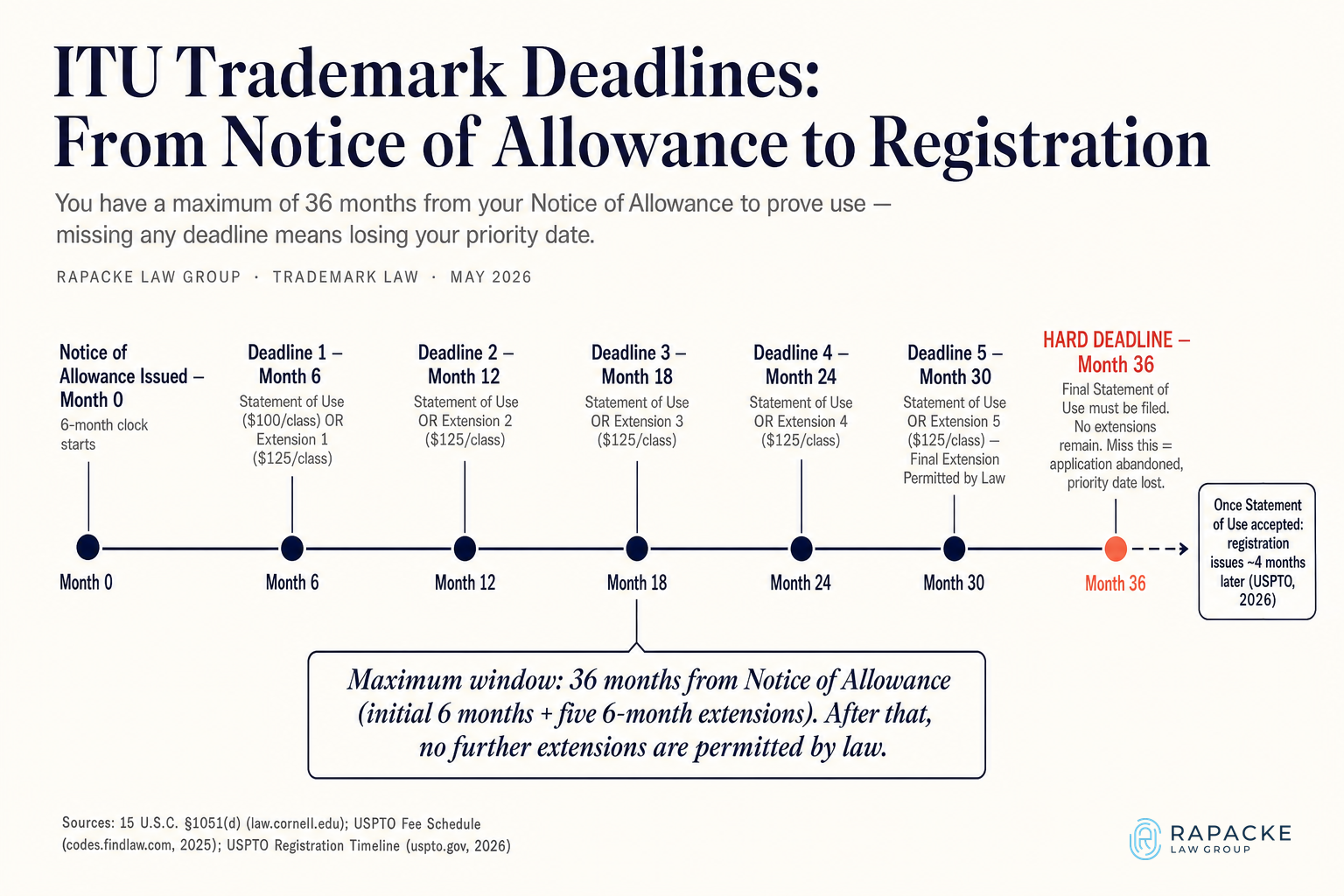
Once the united states patent office issues a Notice of Allowance, you have six months to file a Statement of Use proving you have begun using the mark in commerce, or to file an Extension Request for more time. As established under 15 U.S.C. § 1051, missing this deadline without requesting an extension results in abandonment of your trademark application and the loss of your original priority date. Set a calendar reminder the day the Notice of Allowance arrives.
Extension Requests Buy Up to Three Years of Additional Time
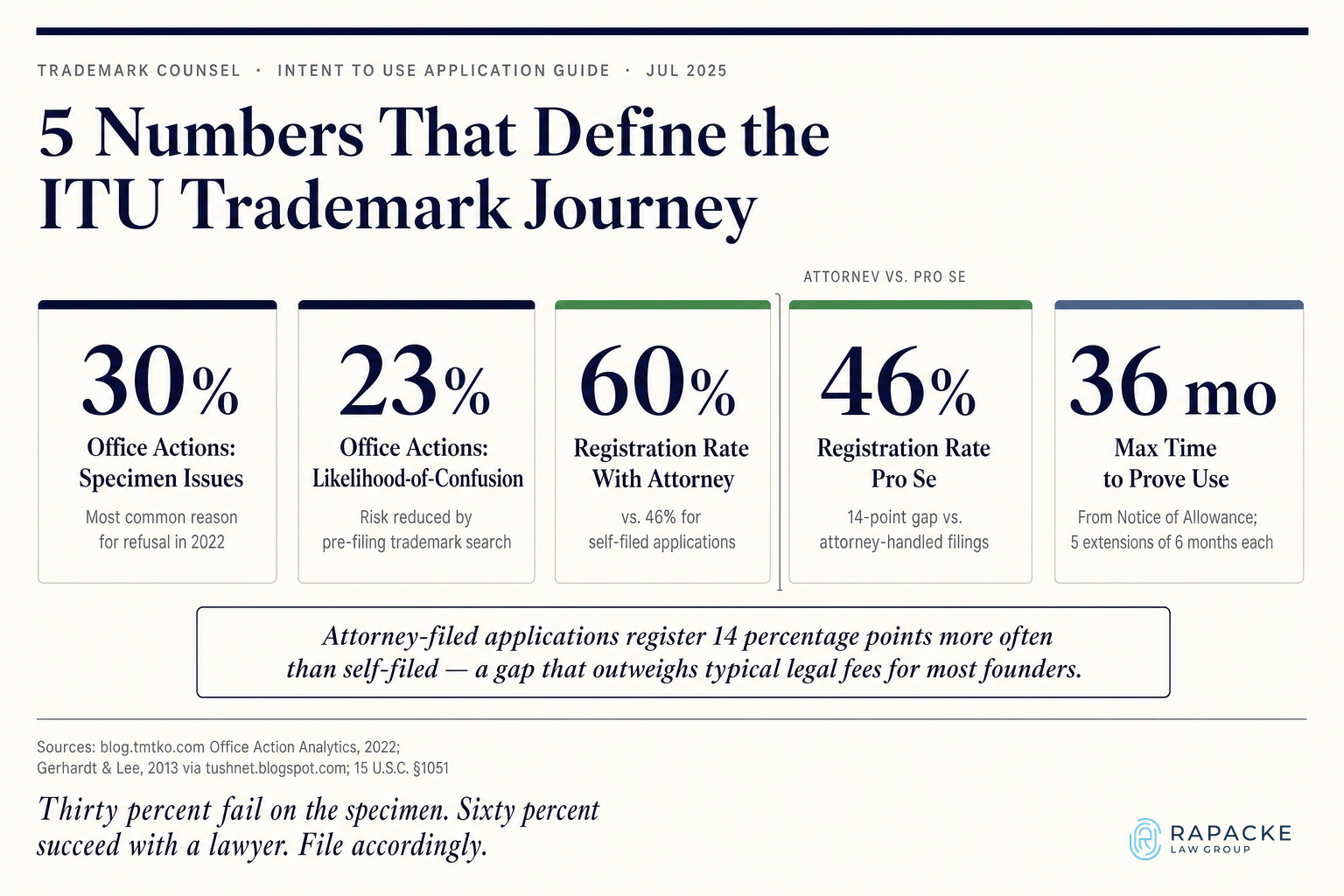
If your product is not ready within the initial six months, you can request up to five extensions, each granting six additional months, for a maximum of three years beyond the Notice of Allowance date. Each Extension Request costs $125 per class and requires a sworn statement that you still have a bona fide intent to use the mark. Beyond the three-year maximum, no further extensions are available under the Lanham Act, and the application will be abandoned if no Statement of Use has been filed.
What a Valid Statement of Use Must Include
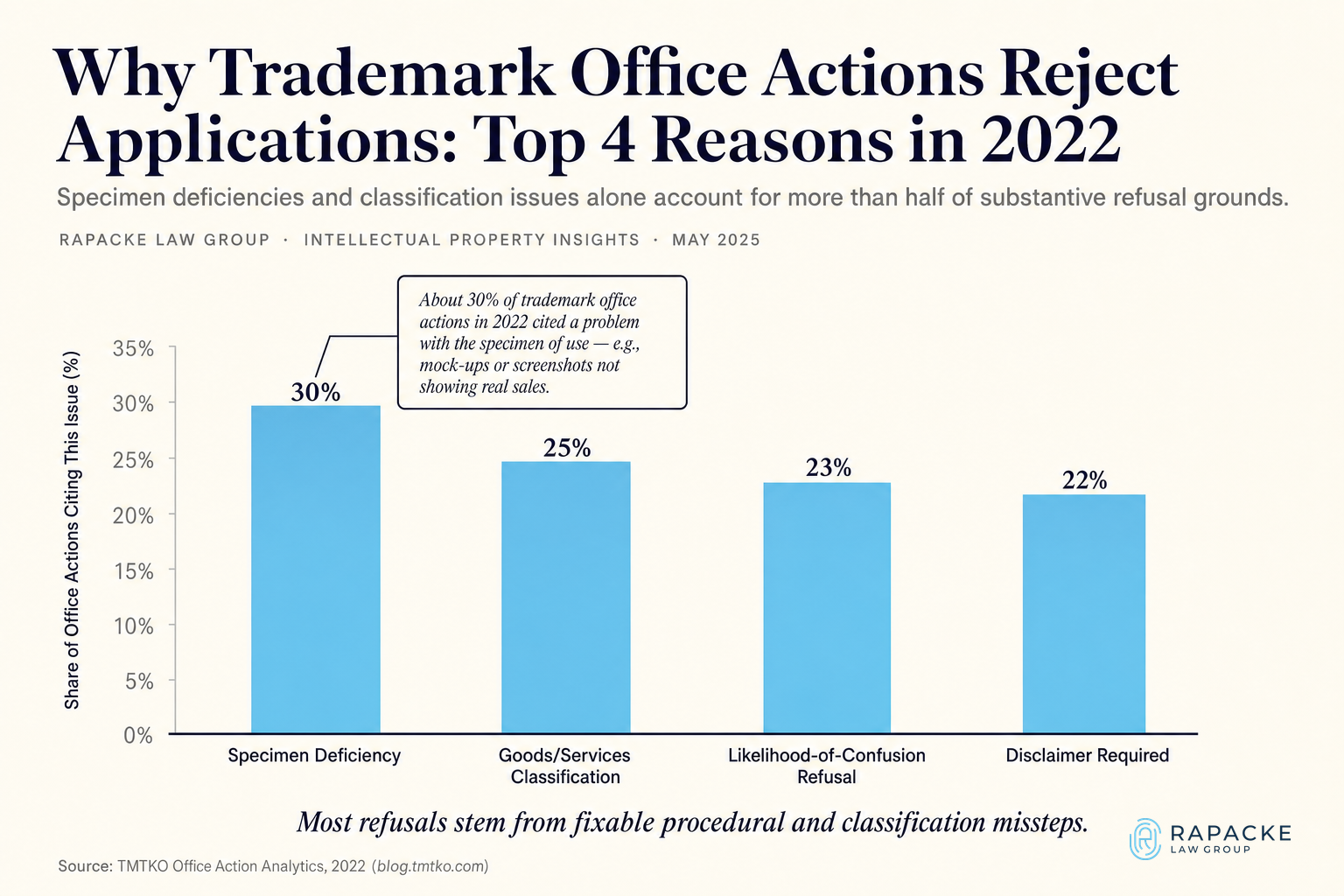
A Statement of Use must include a verified declaration that the mark is in use on the listed goods or services, the date of first use anywhere, the date of first use in commerce, and at least one specimen showing real-world use. Acceptable specimens include product labels, website screenshots, and app interface screenshots, but they must clearly depict the mark in connection with the identified goods or services. Specimen deficiencies are the single leading cause of SOU rejection, accounting for approximately 30% of office actions in 2022, according to USPTO office action data. Errors in the specimen or mismatches between the specimen and the identified goods are among the most common reasons an examining attorney issues an office action in response to an SOU filing.
How ITU Trademark Applications Compare to Use-Based Applications for Tech Startups
When a Use-Based Application Is the Stronger Choice
If your software product or SaaS platform is already live and generating revenue, use-based trademark applications (Section 1(a)) eliminate the Statement of Use step entirely because you submit your specimen at initial filing. According to USPTO's application timeline data, average time from application to registration runs approximately 10 to 11 months as of 2026. Use-based trademark applications often complete faster because they skip the Notice of Allowance phase that stalls ITU applications. For founders who have already launched and simply delayed their trademark filing, this is the correct and more efficient path.
The core difference between intent-to-use trademark application filings and use-based trademark applications comes down to timing: one protects you before revenue, the other confirms protection after you've already launched. Neither is inherently superior; the right choice depends entirely on where your product or business are in their development cycles.
Why SaaS and App Founders Disproportionately Benefit From ITU Filings
SaaS products routinely enter beta testing or soft-launch phases that do not qualify as "use in commerce" under the Lanham Act. For these founders, who intend to use trademark protection well before any qualifying commercial transaction, the ITU basis is the only viable path to locking in priority during development. Actual use must be "bona fide use in the ordinary course of trade, and not made merely to reserve a right in a mark," as defined under 15 U.S.C. § 1127. Closed beta access typically does not meet that standard. Filing on an ITU basis during development protects the brand from the moment you commit to the name, which for most tech founders is six to eighteen months before any qualifying commercial transaction occurs.
The bar chart above reinforces why getting the specimen right from the outset matters: goods/services classification edits account for 25% of office actions, and likelihood-of-confusion refusals account for 23%. Selecting the correct trademark class at filing is equally important whether you are filing on an ITU or use-based basis. Our complete guide to getting a trademark covers how to make that determination before you submit anything to the official government organization that reviews your application.
What the ITU Application Process Looks Like Step by Step
Filing Your Initial ITU Application Through TEAS
The trademark application process begins on the USPTO's Trademark Electronic Application System (TEAS), the official government organization portal for all federal trademark filings. You select TEAS Plus or TEAS Standard, identify your mark, specify the international class of goods or services, declare your filing basis as Section 1(b), and pay the required government fee. A thorough trademark search before filing is essential: approximately 23% of USPTO office actions involve a likelihood-of-confusion refusal with an existing mark. Before you file, review the top questions to ask a trademark attorney to make sure your application is structured correctly from the start.
What Happens During USPTO Examination
After filing, the united states patent office assigns an examining attorney who reviews the application for compliance with trademark law, including likelihood of confusion with prior marks and descriptiveness issues. The USPTO currently completes a first examining action in approximately 4 to 5 months. If problems arise, the examining attorney issues an office action requiring a response, typically within three months (extendable to six months for a fee). If the application clears examination without issues, it moves to publication and the 30 day opposition period begins.
Responding to an Office Action Without Losing Your Filing Date
An office action is not a rejection. It is a request for clarification, amendment, or legal argument. Responding within the deadline preserves your original filing date and keeps the trademark application alive. Applicants who intend to use trademark rights commercially must treat every office action deadline as a hard cutoff, since missing it can erase the priority date entirely. Roughly 50% of applications facing a major refusal are abandoned without ever reaching publication. Engaging a trademark attorney for office action responses significantly improves outcomes, particularly for intent trademark application filings where the identification of goods and services must precisely match what you plan to sell.
How Much an Intent to Use Trademark Application Actually Costs
Government Fees From Filing Through Registration
The USPTO charges a per-class fee at every major stage of an ITU application. As of 2025, TEAS Plus filing costs $350 per class, a Statement of Use costs $150 per class, and each Extension Request costs $125 per class. A single-class ITU application with one extension and a Statement of Use totals $500 in United States government fees, compared to $350 for a use-based application requiring no extensions. These government fees are mandatory regardless of whether you use a trademark attorney. For a full breakdown of current USPTO rates, see our updated guide to trademark filing costs.
Attorney Fees and the Total Investment
Professional fees for a straightforward single-class filing through registration typically run $1,500 to $3,000. That investment pays off in registration rates: research by Gerhardt and Lee found that applications handled by counsel register at roughly 60%, compared to approximately 46% for pro se (self-filed) applications. Total cost for a single-class ITU with professional representation commonly falls between $1,750 and $3,500, including USPTO fees.
Rapacke Law Group offers flat-fee trademark filings, so you know exactly what you're paying before work begins. Under the RLG Guarantee, if your trademark application is not approved, you pay nothing. That transparency makes the decision to file sooner rather than later much easier to justify.
FAQ: Intent to Use Trademark Questions Answered
What does intent to use a trademark mean? Intent to use a trademark means filing a trademark application with the USPTO before you have begun selling products or services under the mark, with a genuine, documented plan to do so. In other words, when you intend to use trademark rights for a brand that hasn't launched yet, Section 1(b) is the filing basis designed specifically for your situation. The Lanham Act requires bona fide intent, meaning your plans must be real and verifiable. This Section 1(b) filing gives you a priority date from the moment you file rather than the moment you launch.
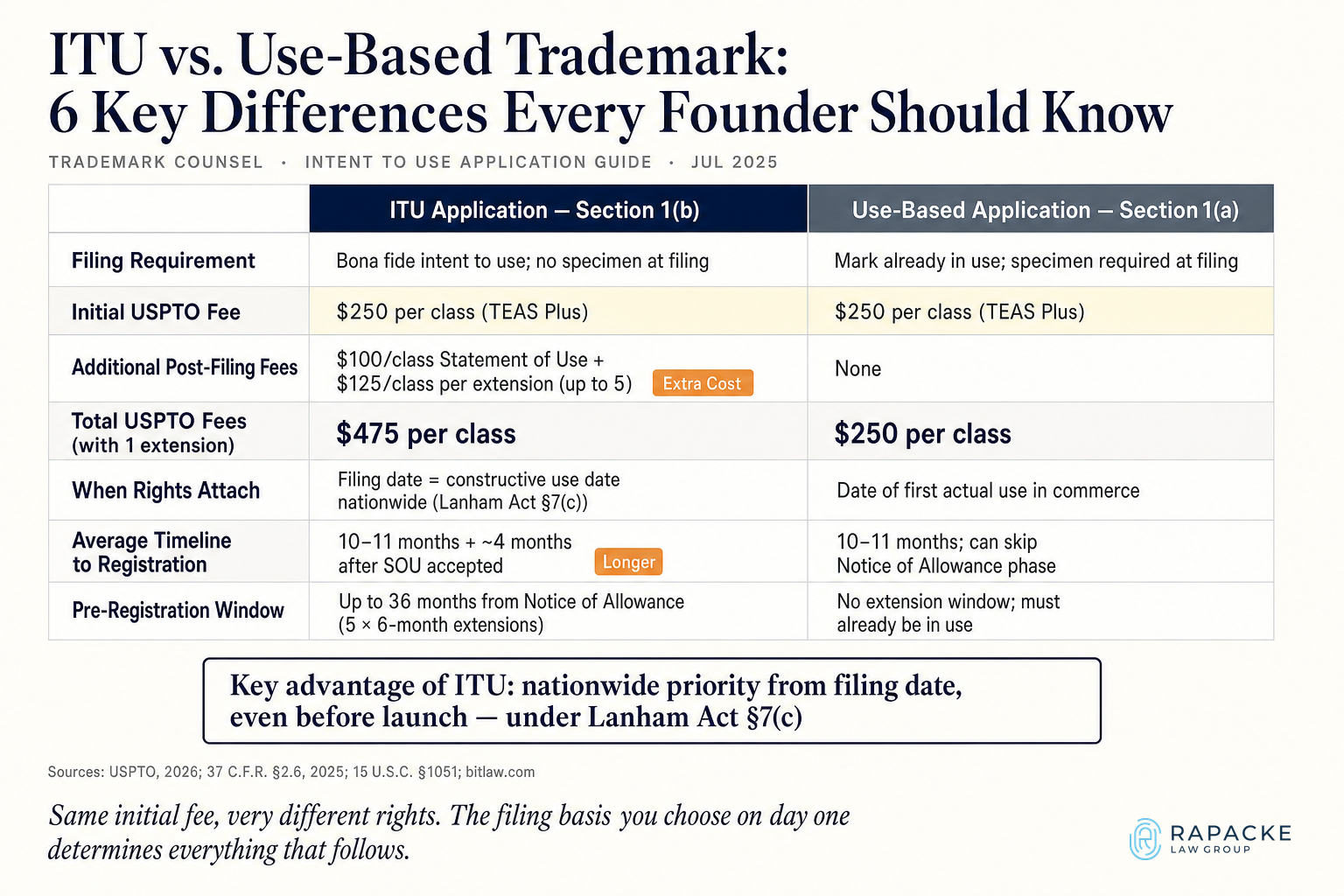
What is the difference between intended use and actual use in a trademark application? An intent trademark application is filed before the mark is in commercial use, with a sworn statement that you plan to use it. An actual use application under Section 1(a) requires that the mark already be in commerce at filing, supported by a specimen showing real-world use. Use-based trademark applications reach trademark registration faster because there is no Statement of Use step, while ITU applications protect your priority date during the pre-launch period. See our full comparison of what trademarking involves for additional context on both paths.
How long is an intent to use trademark application good for? After the USPTO issues a Notice of Allowance, you have an initial six months to file a Statement of Use. You can request extensions in six-month increments, up to a maximum of three years beyond the Notice of Allowance. Beyond that three-year maximum, extensions are no longer available under 15 U.S.C. § 1051(d), and the application will be abandoned if no Statement of Use has been submitted.
How much does an intent to use trademark application cost? Government fees for a single-class ITU application start at $350 (TEAS Plus) at filing, plus $150 for the Statement of Use and $125 per Extension Request. Attorney fees typically add $1,500 to $3,000 for a straightforward filing. A single-class ITU with one extension and professional representation commonly runs $1,750 to $3,500 in total.
Can you sell or transfer an ITU application before registration? An ITU application can be assigned to another entity, but only in connection with the business or portion of the business with which the mark is associated. It cannot be freely sold to an unrelated party as a standalone asset prior to registration, a rule that prevents trademark trafficking. Once a Statement of Use is approved and trademark registration issues, the mark can be assigned more freely.
What happens if you never start using the mark after filing? If you do not file a Statement of Use or a timely Extension Request after receiving a Notice of Allowance, the USPTO will abandon your application. You lose your filing date, your priority position, and all fees paid. A new application would carry a later priority date, and any marks filed between your original filing date and your refile date could now block registration.
Your Next Steps to Intent to Use Trademark Success
An intent to use trademark application is one of the most strategically important filings a startup founder can make before launch. Whether you intend to use trademark protection to deter competitors, attract investors, or secure your brand through an acquisition, the ITU framework gives you tools that a use-based filing simply cannot provide before launch. It locks in your priority date, protects your brand through development and funding rounds, and gives you up to three years of additional runway to bring your product to market under the Trademark Office's extension framework. The deadlines are trackable, the costs are manageable, and the downside of not filing is a brand you may not be able to protect at all.
The bottom line: A weak trademark strategy means watching a competitor file the same name after you've already built equity in it, then spending far more in legal fees defending a dispute than you would have paid to file on day one. A strong strategy means your intent trademark application is on file with the united states patent office before your product page goes live, your priority date is locked, and your brand is protected through every stage of growth.
The ITU process has real legal complexity. Specimen errors, office action deadlines, and proper identification of goods and services are all points where self-filed applications frequently go wrong. Every week you delay is a week a competitor could file first and claim priority over your brand name.
Action items:
- Schedule a Free IP Strategy Call to confirm the right filing basis for your brand, whether that is an intent trademark application or a use-based application
- Download our SaaS Patent Guide 2.0 for a complete picture of IP strategy across patents and trademarks
- Review current trademark filing costs so you can plan your budget before the first conversation
Rapacke Law Group offers flat-fee trademark filings backed by the RLG Guarantee: get your trademark approved or pay nothing. If your trademark application is not approved, you owe us nothing — guaranteed. You'll know your exact investment before work begins, and you'll have a registered patent attorney managing every deadline from the initial filing through the 30 day opposition period and beyond.
To Your Success,
Andrew Rapacke Managing Partner, Registered Patent Attorney Rapacke Law Group