


Startups that file patents are 35 times more likely to succeed through funding or exit than those that don’t, according to research published by IAM Media. That number isn’t about a single patent — it reflects the compounding advantage of building patent portfolios that cover technology from multiple angles before competitors can catch up.
Why a Single Patent Rarely Protects a Tech Business the Way Founders Expect
A single granted patent protects one specific implementation of an invention, not the business idea, the market position, or future iterations of the product. A competitor with skilled patent counsel can engineer around a lone patent legally and effectively. As Elon Musk noted in 2014, patents offer only “small protection indeed against a determined competitor.” The U.S. Patent Office grants roughly 50% of tech patent applications, meaning the one patent a founder is banking on may never issue at all.
For founders thinking about when and how to file their first patent, the single-patent mindset is the most common and costly mistake. A solitary granted patent is a starting point, not a moat and treating it as a finished IP strategy leaves the entire competitive landscape open to imitation.
How Patent Portfolios Change the Competitive Math
When a company holds multiple related patents covering different claims, embodiments, and implementation methods, engineering around the IP becomes exponentially more expensive. In the telecommunications sector, cross-licensing between portfolio holders, where large companies trade access to their respective IP rather than paying one-way royalties, is a dominant deal structure, and that dynamic is only accessible to companies with meaningful portfolio depth. Startups with patents raise 40–60% larger funding rounds on average than peers without IP. Qualcomm’s licensing arm generated $5.3 billion in FY2023 by leveraging its portfolio, a figure that illustrates what portfolio depth actually enables.
Understanding the full benefits of patent protection goes well beyond litigation defense. Securing robust patent protection through a layered portfolio means premium pricing, VC signaling, and competitive moat-building all compound when a portfolio covers technology from multiple angles simultaneously.
Why AI and Software Businesses Face Unique Exposure Without Multiple Patents
AI and software inventions face heightened eligibility scrutiny under Alice Corp. v. CLS Bank International, one of the landmark Supreme Court decisions shaping modern patent law. After that 2014 U.S. Supreme Court decision, software patent rejections at the U.S. Patent Office jumped 31%, and even with the USPTO’s 2019 Revised Guidance reducing rejections by approximately 25%, the eligibility risk has not disappeared. AI-related patent filings have grown significantly in recent years, and quality patent filings covering multiple claim types are essential, yet a single broad AI claim can be invalidated on abstract-idea grounds, stripping all protection at once. A portfolio that layers utility patents, continuation applications, and design patents across different claim types converts that single point of failure into a distributed, resilient structure.
A defensive patent strategy built around portfolio redundancy is particularly critical in AI and software, where the legal landscape shifts faster than prosecution timelines.
What the Most Valuable Tech and AI Patent Portfolios Actually Look Like
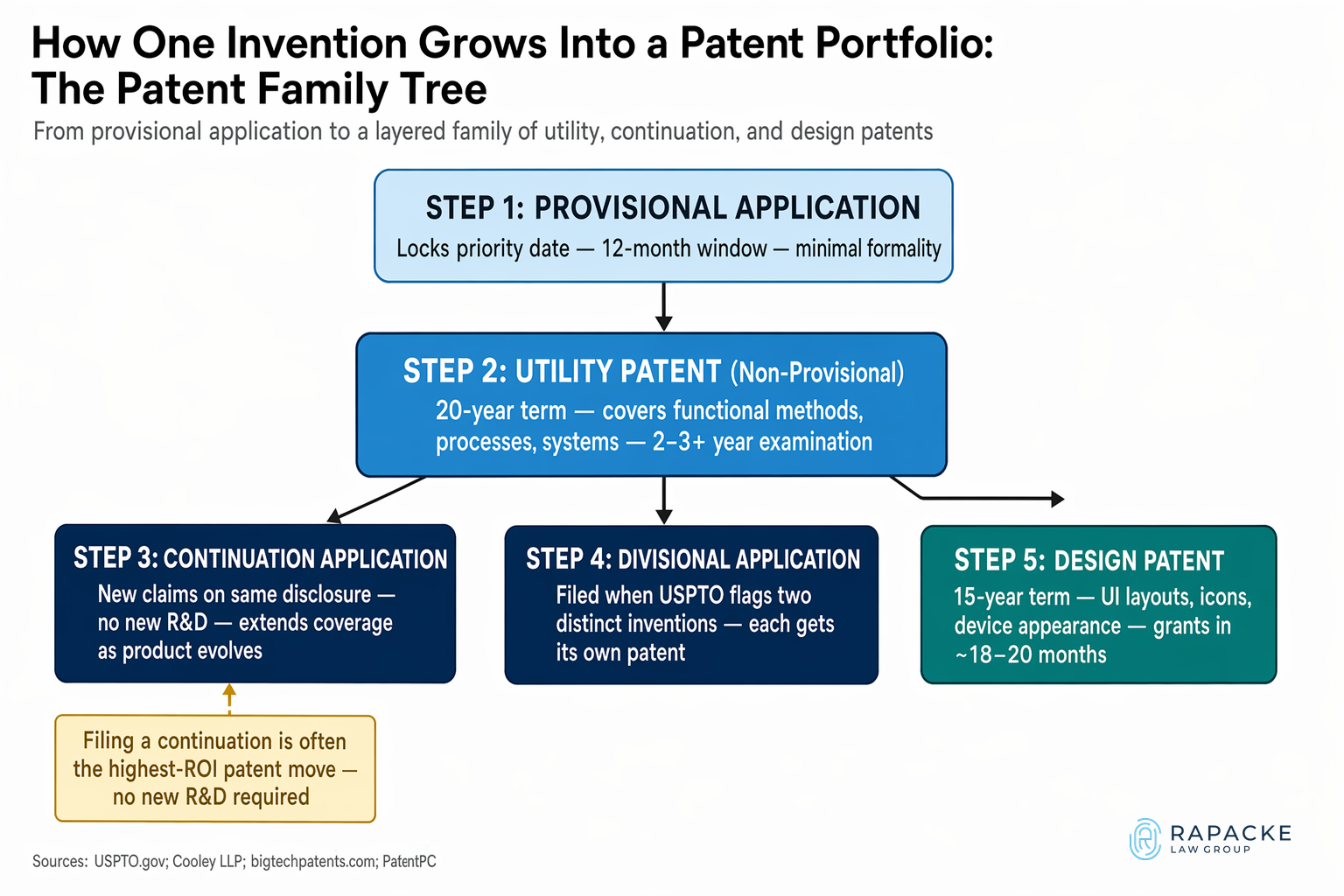
Breadth vs. Depth: How the Best Portfolios Balance Both Dimensions
High-value patent portfolios combine broad foundational claims, utility patents on core methods, with narrower continuation patents that lock down specific commercial implementations. Apple received 2,536 U.S. patents in 2023 alone, layering foundational inventions with incremental improvements across hardware, software, and interface design. IBM led in AI-specific filings, with 1,591 U.S. AI-related applications filed between 2019 and 2024. A portfolio heavy on breadth but weak in claims can be challenged via Inter Partes Review (IPR); one heavy on depth but thin on breadth can be bypassed entirely. The strongest portfolios are built on both axes simultaneously.
For a closer look at how this architecture plays out in practice, recent software patent examples from top companies show exactly how layered filings protect different aspects of the same core product.
The Role of Continuation and Divisional Applications in Portfolio Growth
Continuation applications allow a company to pursue new claims on the same original disclosure, effectively extending portfolio reach without new R&D spend. A parent patent issues with a set of claims, and the company immediately files continuations to capture additional claims that were narrowed during patent prosecution or that cover features the product later commercializes. Divisional applications separate distinct inventions flagged by a USPTO examiner during prosecution. As the USPTO’s guidance on continuation applications makes clear, continuations carry the same priority date as the original filing under 35 U.S.C. § 120, meaning they inherit years of seniority while covering entirely new ground.
How Provisional Patent Applications Function as Portfolio Seeds
A provisional patent application establishes a priority date for 12 months at a fraction of the cost of a full utility filing, allowing tech startups to plant multiple portfolio seeds simultaneously before committing to prosecution costs. The critical caveat: a provisional with thin disclosure does not guarantee a strong priority date. Quality determines downstream value. A detailed provisional that fully describes the invention creates a legitimate foundation for multiple follow-on patent applications; a placeholder does not.
For early-stage founders navigating startup patent strategy, using provisionals to stake multiple priority claims across parallel innovation tracks, before any public disclosure, is one of the most cost-effective moves available.
How Patent Portfolio Value Is Measured and Why It Matters for Fundraising
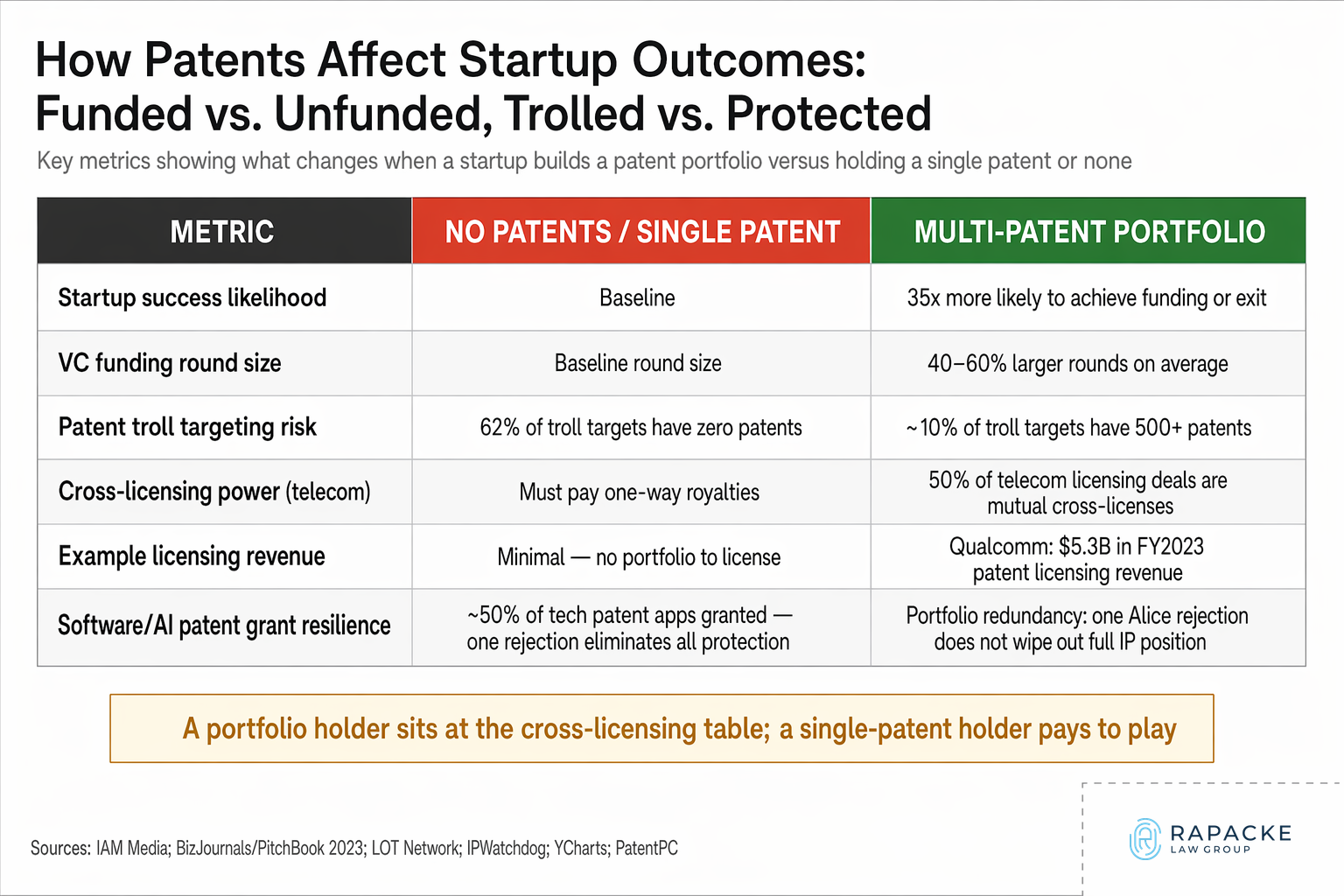
The Metrics Investors and Acquirers Use to Evaluate IP Portfolios
Investors evaluate patent portfolios on citation frequency, claim breadth, remaining patent term, freedom-to-operate clarity, and geographic coverage not raw patent count. Forward citations, meaning how often your patents are cited by others’ applications, signal foundational innovation value. According to NBER research, securing a first patent raises a startup’s probability of receiving VC funding by approximately 53%. Since intangible assets can represent 80–90% of a tech startup’s total value, the quality of a patent portfolio directly affects pre-money valuation at Series A and beyond.
A thorough understanding of how patent valuation works — across citation metrics, claim breadth, and geographic scope gives founders a significant advantage in any due diligence conversation.
Patent Portfolio Audits and Patent Mapping as Pre-Raise Essentials
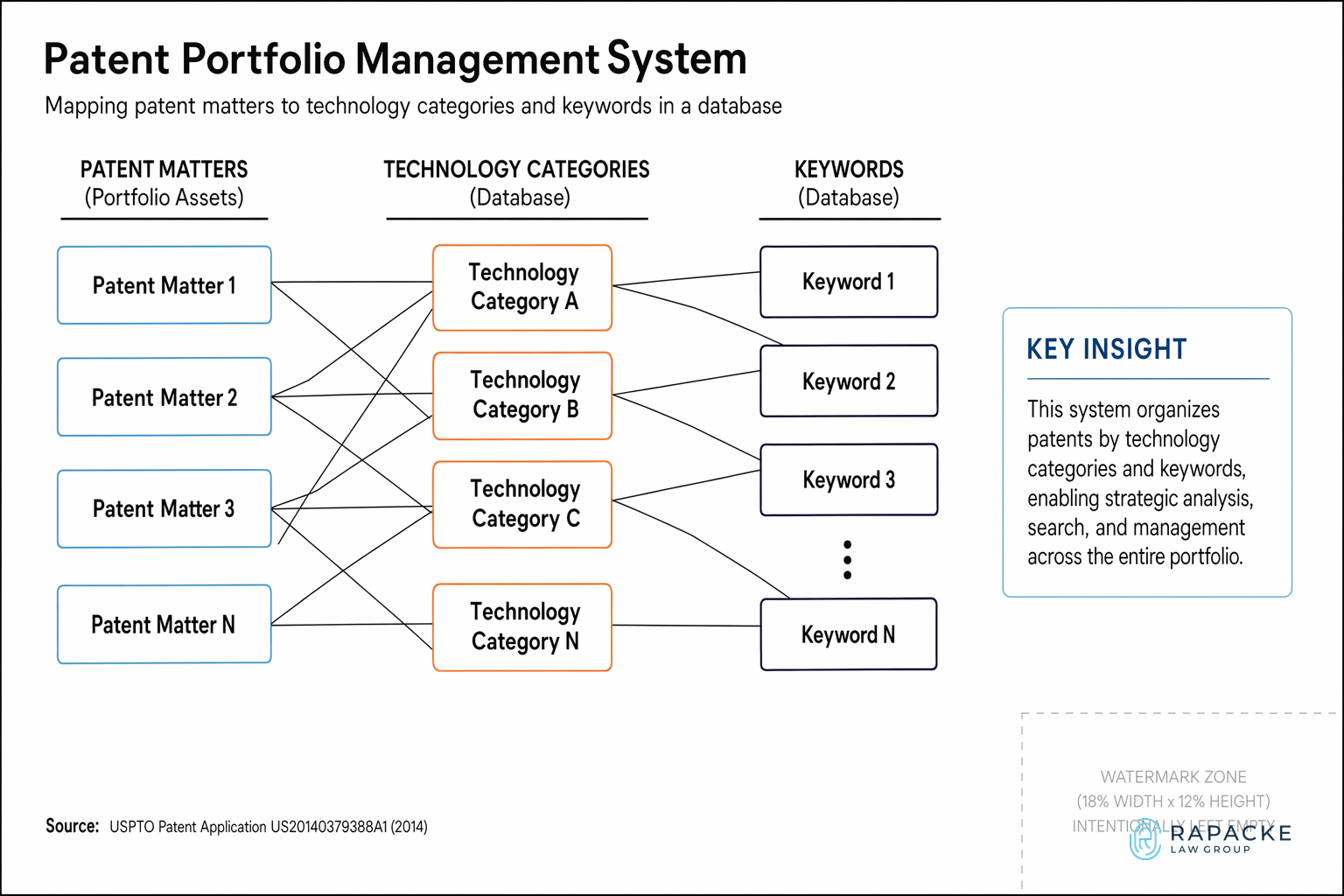
A patent audit systematically reviews each asset in a portfolio for validity, claim strength, maintenance fee status, and competitive relevance. Patent mapping overlays claims against the competitive landscape to identify white space and prosecution gaps, inventions not yet filed that represent unprotected commercial differentiation. As early-stage VC advisors have noted, even seed-stage investors now ask detailed IP questions before committing. Running a patent audit before any fundraise, M&A process, or licensing negotiation is no longer optional for tech companies as patent cases won and lost in due diligence confirm it is table stakes.
Geographic Portfolio Value: When International Coverage Multiplies IP Worth
A patent granted only in the United States has zero direct enforceability in the EU, China, or Japan. According to WIPO’s official PCT filing statistics, technology inventions represent one of the largest categories of international PCT patent applications, a reflection of how aggressively tech companies pursue global protection. When Google acquired Motorola for $12.5 billion, analysts attributed $5.5 billion of that value to Motorola’s patented technology across its 17,000 worldwide patents. PCT filings and European Patent Office applications extend protection internationally, with national-phase entry decisions made based on market priority. If competitors operate internationally, a U.S.-only portfolio leaves most of the competitive map unprotected.
The Types of Patents That Belong in a High-Value Tech and AI Portfolio
Utility Patents: The Foundation of Any Serious IP Portfolio
Utility patents protect the functional method or process behind an invention and carry a 20-year term from the filing date at the United States Patent and Trademark Office. For AI companies, utility patents cover model architectures, training methodologies, data processing pipelines, and inference systems developed by computer science and engineering teams. Any novel, non-obvious technical method qualifies if claim language is drafted to survive Alice scrutiny, specifically, by tying abstract concepts to concrete technical improvements rather than describing results alone. The Federal Circuit decisions in Enfish, LLC v. Microsoft Corp. and McRO, Inc. v. Bandai Namco Games America Inc. reinforced that claims framed around specific improvements to computer functionality consistently outperform broader method claims in prosecution.
Design Patents: The Underused Asset in Software and AI Interface Protection
Design patents protect the ornamental appearance of a functional item, including software interfaces and AI dashboards. They are faster to obtain than utility patents, typically 18 to 24 months versus 3 or more years through the U.S. Patent Office, carry lower prosecution costs, and are substantially harder to challenge via IPR. Apple has used design patent portfolios alongside utility patents to create layered, redundant protection across its product lines. For any AI product with a distinctive user interface, design patent applications represent low-cost, high-value portfolio additions that competitors frequently overlook.
Software Patents and AI-Specific Patent Strategy Post-Alice
Software patents remain viable but require careful claim drafting that ties abstract ideas to concrete technical improvements. The standard established in Alice and refined through subsequent Federal Circuit decisions, including Enfish and McRO , confirms that claims framed around specific technical improvements to computer functionality, rather than abstract ideas alone, consistently outperform broader method claims in prosecution. The USPTO’s 2019 Revised Guidance on subject matter eligibility provided additional clarity that has improved allowance rates for well-drafted AI-specific claims. Claim language not just the underlying invention determines whether an AI patent application survives prosecution.
How to Build a Patent Portfolio Strategy Around Your Technology Roadmap
Aligning Patent Filings with Product Development Milestones
The most efficient patent portfolios are built proactively, filing applications when core functionality is first developed rather than reactively after a product launch. A product roadmap review with patent counsel, at minimum quarterly for active development companies, identifies inventions to patent before they are publicly disclosed and before the 12-month U.S. grace period begins. Treat patent filing deadlines as product milestones, not legal afterthoughts.
Planning a rock solid patent portfolio strategy means integrating IP counsel into the product development cycle early, not engaging after a launch has already created prior art problems.
Patent Portfolio Management: Maintenance, Pruning, and Strategic Abandonment
Maintaining a patent portfolio requires paying maintenance fees to the U.S. Patent Office at 3.5, 7.5, and 11.5 years after grant, legal fees that compound quickly as a portfolio scales. Portfolio management means actively deciding which patents justify renewal based on competitive relevance, licensing income, and remaining term, and strategically abandoning patents that no longer align with business direction. An unmanaged portfolio is not an asset it is a cost center with diminishing returns.
Licensing, NDAs, and Monetization Strategies for Patent Portfolios
A patent portfolio generates revenue through licensing agreements, cross-licensing arrangements, and in some cases outright assignment of patent rights. NDAs protect undisclosed innovations during licensing negotiations, ensuring that disclosure does not create prior art problems or expose trade secrets. Patent trolls are entities that acquire patents solely to assert them in litigation without practicing the technology and exploit weak portfolios, targeting patent owners with thin IP, making portfolio strength a defensive economic necessity as well as an offensive revenue opportunity.
Marketing patents to companies requires a structured, data-driven approach to patent monetization that matches portfolio strengths to the right licensing targets, a strategy that begins with knowing exactly what claims you hold and how they map to commercially active technology.
The Biggest Patent Portfolio Mistakes Tech Founders Make and How to Avoid Them
Filing Too Narrowly and Leaving Claim Space for Competitors
Narrow claims are easier to get granted but provide thin protection. A competitor can make a small design change and avoid infringement entirely. The strongest patent portfolios file both broad independent claims and multiple dependent claims covering specific commercial implementations, creating a nested protective structure. Claim breadth is a prosecution strategy decision made during drafting pushing for the broadest defensible scope from the start is significantly easier than attempting to broaden claims through later continuation applications after a narrow patent has already issued.
When prosecution pushes back, knowing how to navigate a patent office action response effectively determines whether broad claims survive or get narrowed beyond commercial utility.
Neglecting Portfolio Diversity Across Patent Types and Jurisdictions
Over-reliance on a single patent type creates predictable gaps. A portfolio composed entirely of utility patents with no design patents or continuation applications leaves interface elements unprotected and prosecution evolution frozen at a single disclosure. Similarly, a U.S. only portfolio is commercially unprotected in the markets where AI and SaaS competition is growing fastest. Approximately 60% of well-funded tech startups have secured patents as part of their strategy, according to data from bplan.ai and the most competitive among them hold IP across multiple patent types and jurisdictions.
Waiting Too Long to Engage Patent Counsel During Product Development
Public disclosure of an invention such as a conference demo, a published paper, a product launch, or even a social media post describing the technology, starts the clock on filing deadlines. U.S. law provides a 12-month grace period after public disclosure; most international patent systems provide zero. Filing patent applications reactively, after public disclosure or competitive pressure, narrows available claim scope and introduces prior art risk. The best time to engage patent attorneys is before the first demo, not after the launch.
What a Strong Patent Portfolio Strategy Signals to Investors, Acquirers, and the Market
IP Portfolios as Proof of Technical Differentiation in Due Diligence
Investors in AI and SaaS businesses increasingly treat patent portfolio quality as a proxy for genuine technical differentiation, evidence the company built something non-obvious, not just assembled existing tools. A portfolio with granted utility patents, pending continuation applications, and a documented prosecution strategy signals that the founding team understands both the technology and the competitive landscape. Before any Series A conversation, founders should know their patent story: what is filed, what is pending at the U.S. Patent Office, what claim coverage exists, and what the prosecution roadmap looks like.
Why patents are important to investors goes beyond signaling as a credible portfolio directly influences pre-money valuation, term sheet leverage, and acquirer interest in any exit scenario.
How Patent Portfolio Strategy Reduces Litigation Risk and Defense Costs
Companies with robust patent portfolios are statistically less likely to be targeted by patent assertion entities, commonly called patent trolls, because a counter-portfolio creates leverage in any patent litigation scenario. A freedom-to-operate analysis, a formal legal opinion on whether a product faces patent infringement claims based on existing third-party patents, complements portfolio building on the defensive side. Together, a strong patent portfolio and a current freedom-to-operate opinion give tech companies both a competitive sword and a litigation shield.
Frequently Asked Questions About Patent Portfolios
What is a patent portfolio?
A patent portfolio is a collection of patent applications and granted patents held by a single company, inventor, or institution, typically covering multiple aspects of a core technology or product line. Unlike a single patent, a portfolio creates layered protection by covering different methods, implementations, and claim types, making it significantly harder for competitors to operate in the same technical space without licensing or risking infringement.
What are the 4 types of patents that belong in a strong tech portfolio?
The four patent types most relevant to tech and AI companies are utility patents (protecting functional methods and processes), provisional patent applications (establishing priority dates at low cost), continuation patents (extending claim coverage from existing disclosures), and design patents (protecting the ornamental appearance of software interfaces and products). The most valuable patent portfolios use all four deliberately rather than relying on any single type.
What are the 4 pillars of IP?
The four core pillars of intellectual property are patents, trademarks, copyrights, and trade secrets. Properly managing intellectual property rights ensures that patents protect technical innovations; trademarks protect brand identity; copyrights protect original code and creative output; and trade secrets protect confidential processes not publicly disclosed. Patent portfolio development is typically the highest-priority pillar for companies with patentable technical differentiation.
Why did Elon Musk make Tesla’s patents open-source?
In 2014, Musk announced Tesla would not initiate patent lawsuits against good-faith users of its technology, framing the decision as accelerating EV industry adoption. The underlying calculation was that Tesla’s real competitive moat was manufacturing capability and talent density, not patent exclusivity. For most tech startups, particularly in AI and SaaS, that calculus does not apply. The legal system provides patent portfolios as essential competitive assets, and companies without Tesla’s manufacturing scale and talent infrastructure rarely benefit from open-sourcing their IP, making them indispensable investor signals for the vast majority of the market.
How many patents does it take to constitute a meaningful patent portfolio?
There is no universal threshold, but most IP practitioners consider three to five granted utility patents covering distinct aspects of a core technology to be a functional portfolio baseline. For AI and SaaS startups seeking VC funding or preparing for M&A, a portfolio that includes at least one granted patent, pending continuation applications, and a documented prosecution strategy typically satisfies investor due diligence. Building quality patents requires attention to claim breadth, validity, and relevance to the commercial product matters more than raw patent count.
How long does it take to build a patent portfolio from scratch?
Building a meaningful patent portfolio is a multi-year process representing a significant investment of time and resources. A provisional patent application can be filed within weeks to establish a priority date, but a granted utility patent typically takes 2 to 4 years through the U.S. Patent Office. International filings via PCT extend timelines further. Companies that begin portfolio development at the earliest stages of product development consistently achieve stronger, broader claims than those that file reactively after public disclosure or competitive pressure.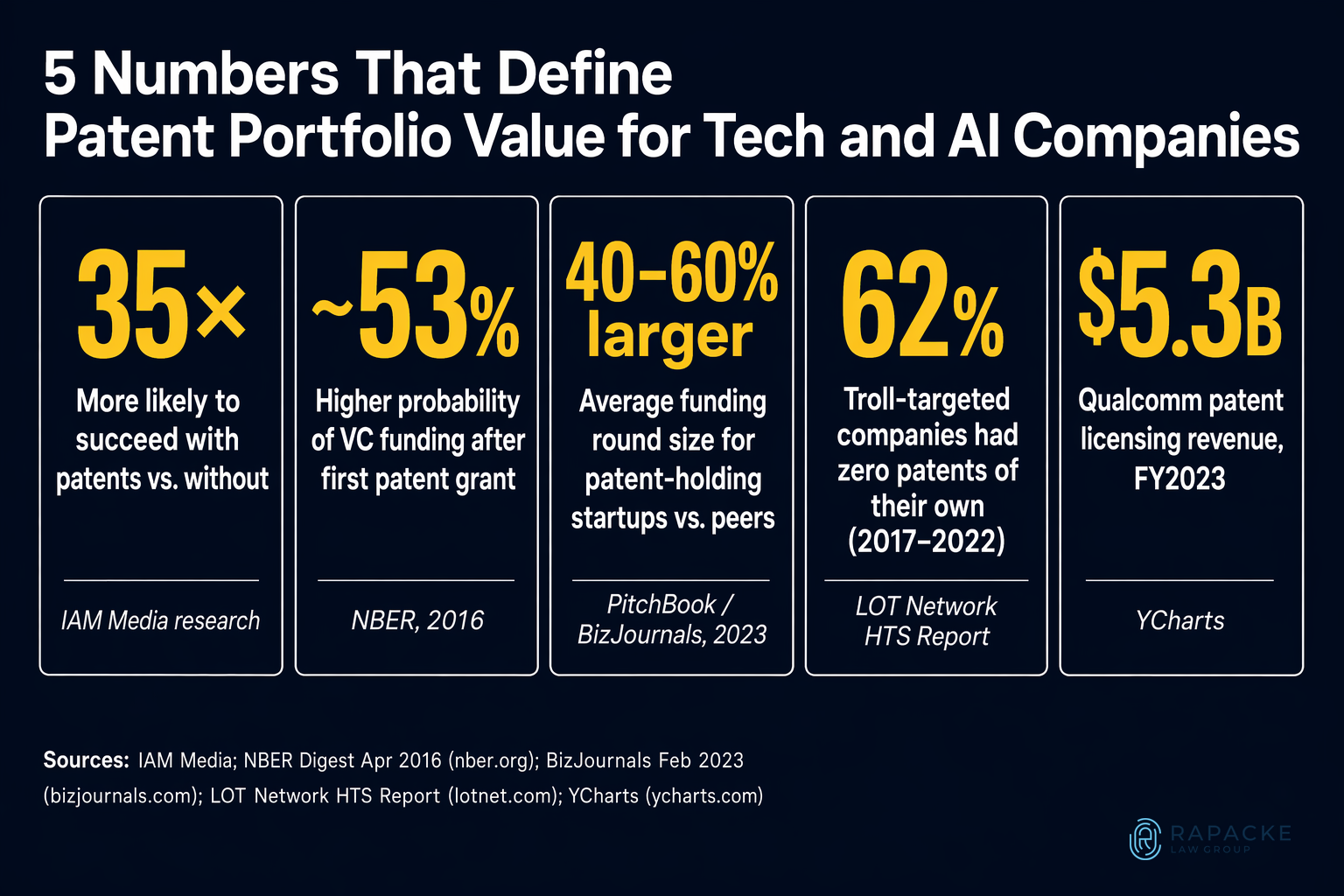 5 Numbers That Define Patent Portfolio Value for Tech and AI Companies — Source: IAM Media; NBER Digest, Apr 2016 (nber.org); BizJournals, Feb 2023 (bizjournals.com); LOT Network HTS Report (lotnet.com); YCharts (ycharts.com)
Your Next Steps to Patent Portfolio Success
For tech and AI companies, a patent portfolio is not a legal formality it is a strategic business asset that determines competitive position, fundraising leverage, licensing income, and litigation resilience. The question is never whether to build a portfolio, but how to build one with the right mix of utility patents, provisional filings, continuations, and design patent applications matched to your product roadmap and competitive landscape.
The bottom line: a single narrow patent leaves most of your technology exposed and gives competitors a clear path to engineer around your IP. A well-constructed portfolio with layered claim types, continuation applications, and international coverage converts your innovation into a durable competitive moat that compounds in value over time.
Every month without a filing strategy is a month where public disclosures, competitor filings, and product launches narrow your available claim scope. For AI and software companies operating in fast-moving markets, that erosion happens faster than most founders realize and the cost of catching up almost always exceeds the cost of getting ahead.
- Schedule a Free IP Strategy Call to review your existing IP, identify patentable innovations, and map out a filing strategy aligned with your funding timeline
- Download the AI Patent Mastery resource for a deeper look at AI-specific patent strategy before your call
- Explore the SaaS Patent Guide 2.0 if your product is software-based and you want a structured framework for portfolio development
- Review recent software patent examples from top companies to benchmark your portfolio strategy against what leading tech firms are actually filing
At Rapacke Law Group, every engagement starts with a practical diagnostic and not a sales conversation. You will leave the call with a concrete picture of your portfolio gaps, your strongest patentable innovations, and the next steps to protect them. Rapacke Law Group offers fixed-fee patent services so you know exactly what IP protection costs before committing, with no billing surprises as your portfolio grows.
To Your Success,
Andrew Rapacke
Managing Partner, Registered Patent Attorney
Rapacke Law Group