


Key Takeaways
- Supplemental registration is a legitimate federal trademark registration, but it does not provide constructive notice, presumption of ownership, or a path to incontestability.
- The ® symbol is available to Supplemental Register holders, but the legal protection behind it is substantially weaker than a Principal Register mark.
- A Supplemental Register mark can qualify for the Principal Register after demonstrating five years of substantially exclusive use in commerce under Lanham Act Section 2(f).
- Supplemental registration is most useful as a tactical bridge for international filings under the Madrid Protocol, not as a long-term enforcement foundation.
- Filing fees are identical to a Principal Register application: $250 per class for TEAS Plus and $350 per class for TEAS Standard, with current USPTO first-action wait times around 4.4 months.
Andrew Rapacke** **is a registered patent attorney and the Managing Partner of The Rapacke Law Group, a full-service intellectual property law firm. He helps individuals and corporations across industries with the protection, prosecution, licensing, and enforcement of their intellectual property rights, including trademark, patent, and copyright law matters spanning software, AI and machine learning, blockchain, medical devices, and autonomous vehicle technology. A graduate of the United States Naval Academy, Andrew served as a Naval Engineering Officer before pursuing law and remains active in the startup and inventor communities throughout Florida.
A founder files a trademark application, receives an office action calling the mark "merely descriptive," and assumes federal protection under united states trademark law is off the table. It is not. Supplemental trademark registration exists precisely for this situation, offering real federal registration with meaningful limitations that every brand owner needs to understand before relying on it. This article explains what the Supplemental Register is, how it differs from the Principal Register, what protections it actually provides, and when it makes strategic sense to use it; it is not a substitute for legal advice from a qualified trademark attorney.
What Supplemental Trademark Registration Actually Is and Why the USPTO Created It
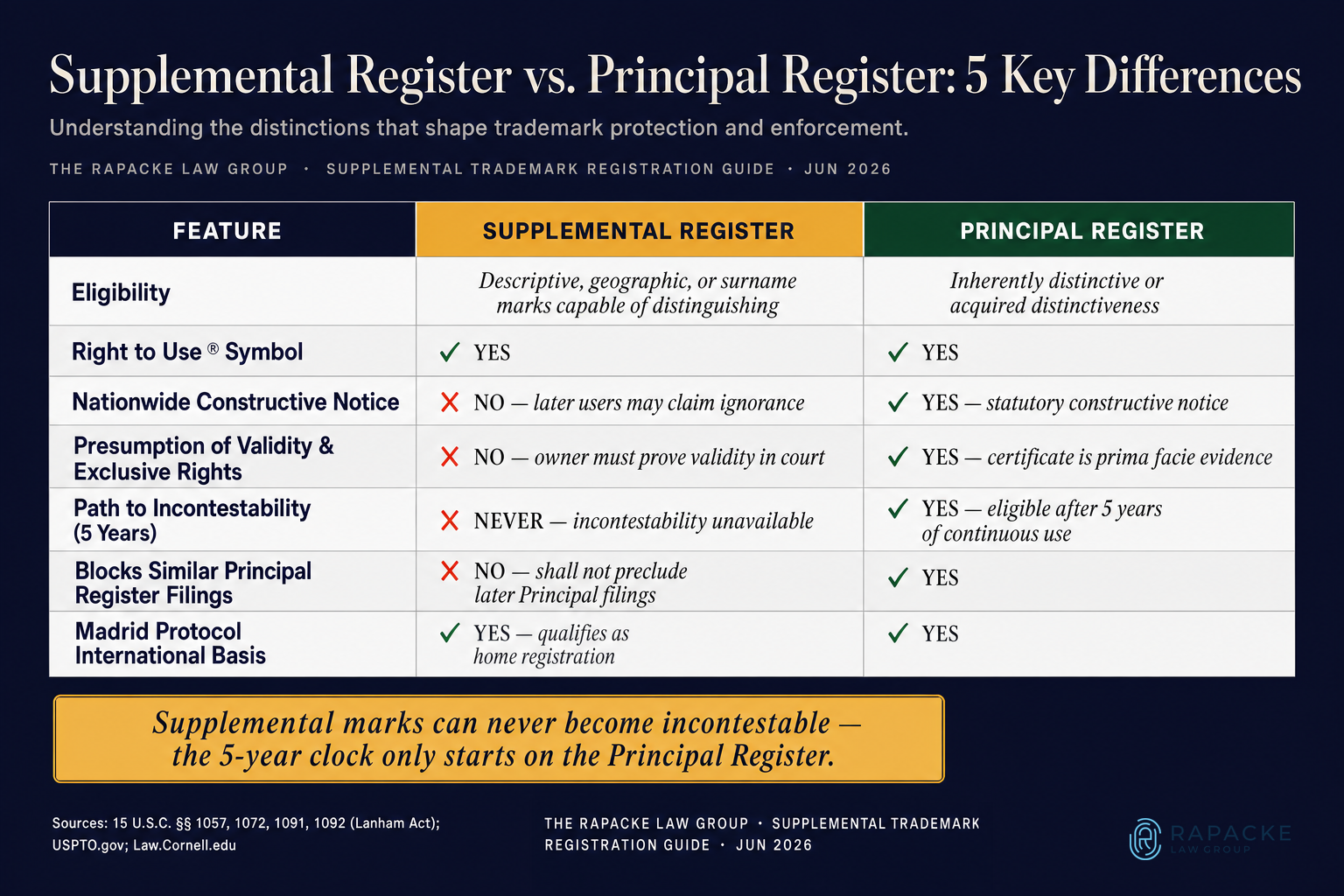 Supplemental Register vs. Principal Register: 5 Key Differences, Source: 15 U.S.C. §§ 1057, 1072, 1091, 1092, 1111 (Lanham Act), USPTO.gov, Law.Cornell.edu
The Legal Foundation Behind the Supplemental Register
The Supplemental Register was established by the Lanham Act in 1946 under 15 U.S.C. § 1091 as a secondary federal trademark register designed to accommodate marks that cannot yet qualify for the Principal Register. The United States Patent and Trademark Office, often called the united states patent office, maintains both registers, and a trademark application filed through the TEAS system can be directed to either one depending on the mark's current level of distinctiveness.
Supplemental registration is a legitimate federal trademark registration pathway under the Trademark Act, but its legal weight differs substantially from Principal Register status. Think of it as a holding position with real but limited benefits, not a consolation prize and not a substitute for full federal protection.
Which Types of Marks Qualify for Supplemental Registration
Under 15 U.S.C. § 1091, marks that are "capable of distinguishing" goods or services but do not yet qualify as inherently distinctive are eligible for the Supplemental Register. This includes marks that are merely descriptive, primarily geographically descriptive, or primarily merely a surname. A SaaS company naming its product "Fast Cloud Storage" would face a descriptiveness refusal because the name directly describes the product's function. See real-world examples of descriptive trademarks that succeeded for a sense of how the distinctiveness spectrum plays out in practice.
Descriptiveness objections are among the most common refusals the United States Patent and Trademark Office issues, and they frequently route applicants toward supplemental rather than principal registration. If your mark describes a feature, function, or geographic origin of your product, it is a candidate for supplemental registration, at least initially.
How the Supplemental Trademark Registration Application Process Works
The trademark application process for supplemental registration trademark filings uses the same TEAS filing system as a principal registration application. A typical trademark application can either file directly for the Supplemental Register or amend after receiving a Principal Register refusal, with no additional filing fee required for the amendment. Understanding how to get a federal trademark from the start helps applicants choose the right path before filing.
As of early 2026, the USPTO reports an average wait time of 4.4 months from filing to first examiner action. Total time to registration runs approximately 9 to 10 months for straightforward applications.
What Protections Supplemental Registration Actually Gives You (And What It Does Not)
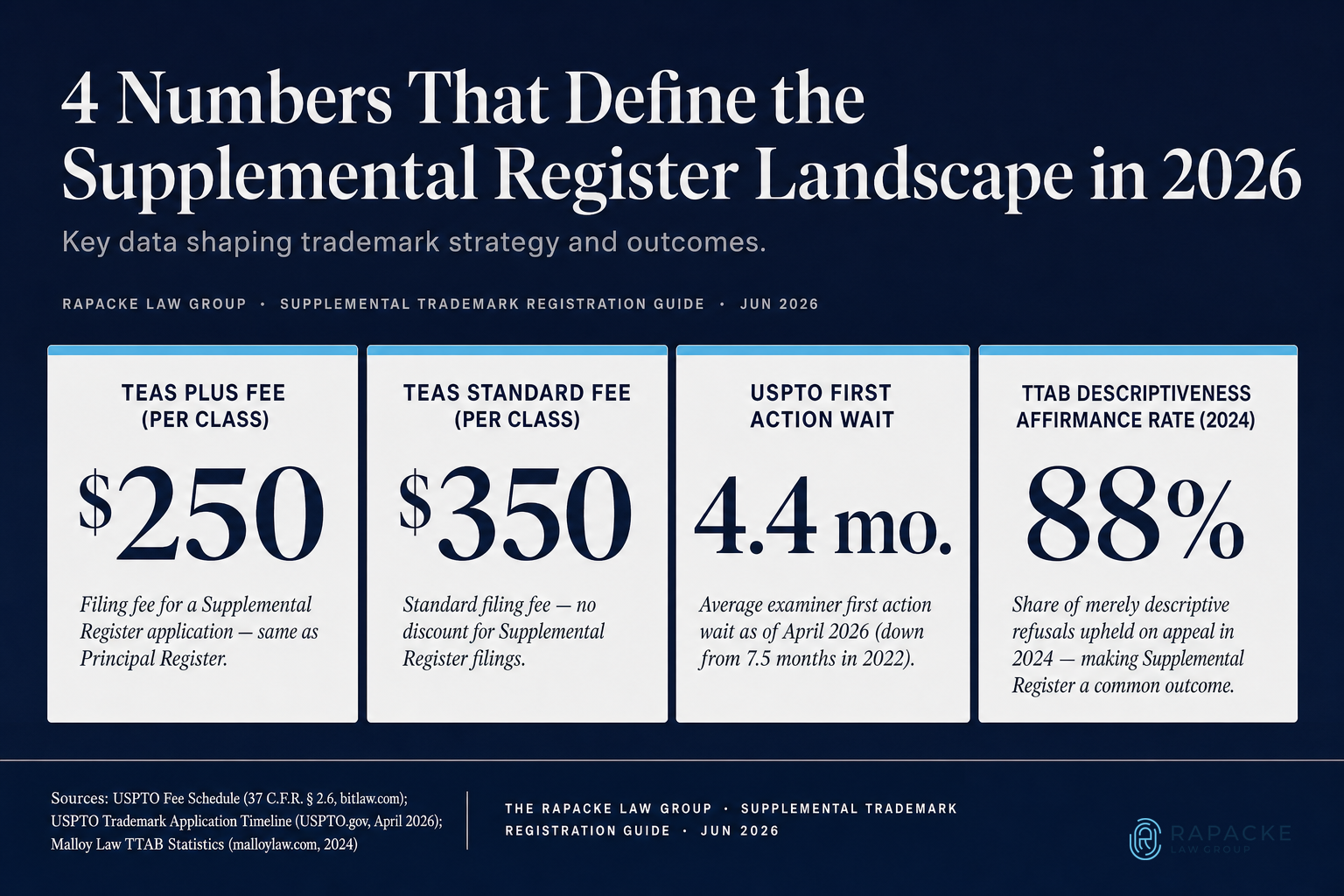 4 Numbers That Define the Supplemental Register Landscape in 2026, Source, USPTO Fee Schedule (37 C.F.R. § 2.6), USPTO Trademark Application Timeline (USPTO.gov, April 2026), TTAB Statistics (2024)
The Real Benefits That Come With Supplemental Registration
Supplemental registration provides four concrete benefits. First, the owner has the right to use the federal ® symbol. Second, the mark appears in the United States Patent and Trademark Office trademark database and shows up in trademark searches conducted by other applicants. Third, the registration can serve as the basis for international trademark filings under the Madrid Protocol, since any USPTO registration meets the home-registration requirement. Fourth, the owner can record the mark with U.S. Customs to block infringing imports.
The Madrid Protocol covers 116 member jurisdictions representing 132 countries, and a supplemental registration trademark qualifies as a valid basis for a Madrid filing under USPTO guidance. For a tech startup prioritizing EU or APAC market entry before achieving Principal Register status, this is a meaningful tactical advantage.
The Protections Supplemental Registration Does Not Provide
The gaps are significant. Under 15 U.S.C. § 1072, constructive nationwide notice of ownership applies only to Principal Register marks, meaning a third party who begins using a confusingly similar mark cannot be presumed to have known about your prior claim. Supplemental Register marks also lack the legal presumption of validity and exclusive rights established under 15 U.S.C. § 1057, cannot achieve incontestable status under Lanham Act Section 15, and do not bar the USPTO from registering a confusingly similar mark on the Principal Register.
If your business model depends on enforcing trademark rights against competitors in federal court, supplemental registration alone is a weak foundation. The burden remains on you to prove acquired distinctiveness every time you litigate.
Trademark Opposition and the Supplemental Register
Supplemental Register marks are published in the Official Gazette for notice purposes, but they are not subject to the standard 30-day opposition window that governs trademark oppositions on Principal Register applications. This reduces procedural friction at filing, but third parties retain the right to petition for cancellation of a Supplemental Register mark at any time under 15 U.S.C. § 1092. Less opposition risk at filing sounds attractive, but the absence of that process also signals weaker legal standing than most founders realize.
How Supplemental Registration Compares to Principal Registration for Your Brand Strategy
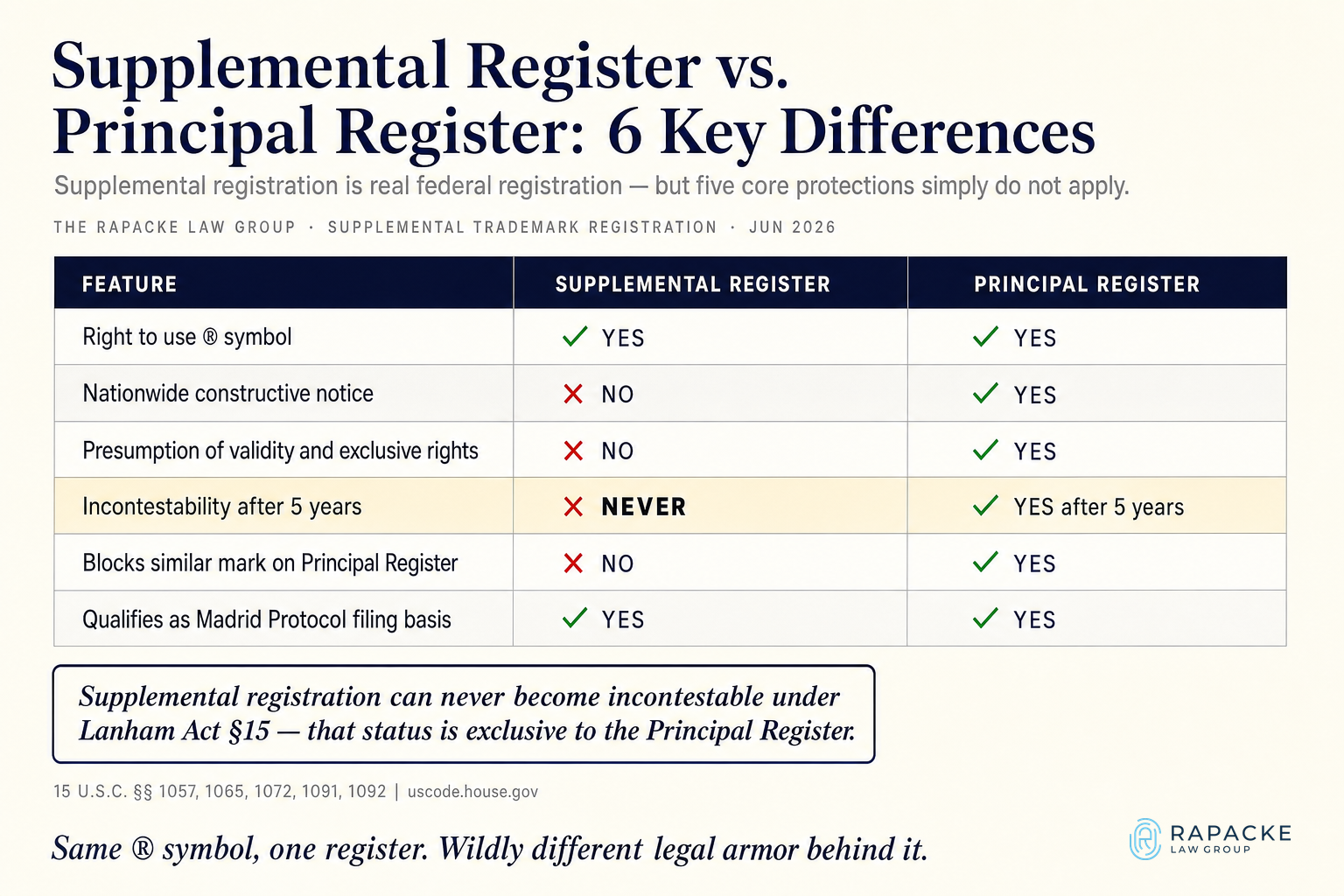 Supplemental Register vs. Principal Register: 6 Key Differences, Source: 15 U.S.C. §§ 1057, 1065, 1072, 1091, 1092, USPTO.gov Madrid Protocol page
What the Principal Register Provides That the Supplemental Register Cannot
A Principal Register trademark provides constructive nationwide notice under 15 U.S.C. § 1072, prima facie evidence of ownership and exclusive rights under 15 U.S.C. § 1057, and the ability to file a Section 15 declaration after five years of continuous use to achieve incontestable status under 15 U.S.C. § 1065. An incontestable mark cannot be challenged on the grounds that it is merely descriptive, which is one of the most common attack vectors in trademark disputes.
For most founders building a long-term brand, the Principal Register is the destination. Supplemental registration is a position on the path, not the finish line.
The Path From Supplemental Registration to the Principal Register
A mark on the Supplemental Register can move to the Principal Register by demonstrating acquired distinctiveness, also called secondary meaning. Under TMEP guidelines implementing Lanham Act Section 2(f), five years of substantially exclusive and continuous use in commerce creates a rebuttable presumption that a mark has become distinctive. The trademark owner must file a new application with evidence of acquired distinctiveness. The existing supplemental registration does not automatically convert.
This pathway makes supplemental trademark registration a deliberate first step in a multi-year brand-building strategy, but only if the trademark owner actively builds the use record needed to prove secondary meaning. Review the full trademark registration timeline to understand how each phase fits together.
When Choosing Supplemental Registration Is the Right Strategic Move
Supplemental registration makes strategic sense in three situations, the mark is descriptive but the business needs to enter international markets quickly via the Madrid Protocol, the founder wants a USPTO record established while building brand recognition, or the mark was refused from the Principal Register and the business needs ongoing U.S. registration status while developing acquired distinctiveness. It is not the right move when the mark could qualify for the Principal Register with a stronger name choice or slight modification.
Common Mistakes Trademark Owners Make With Supplemental Registration
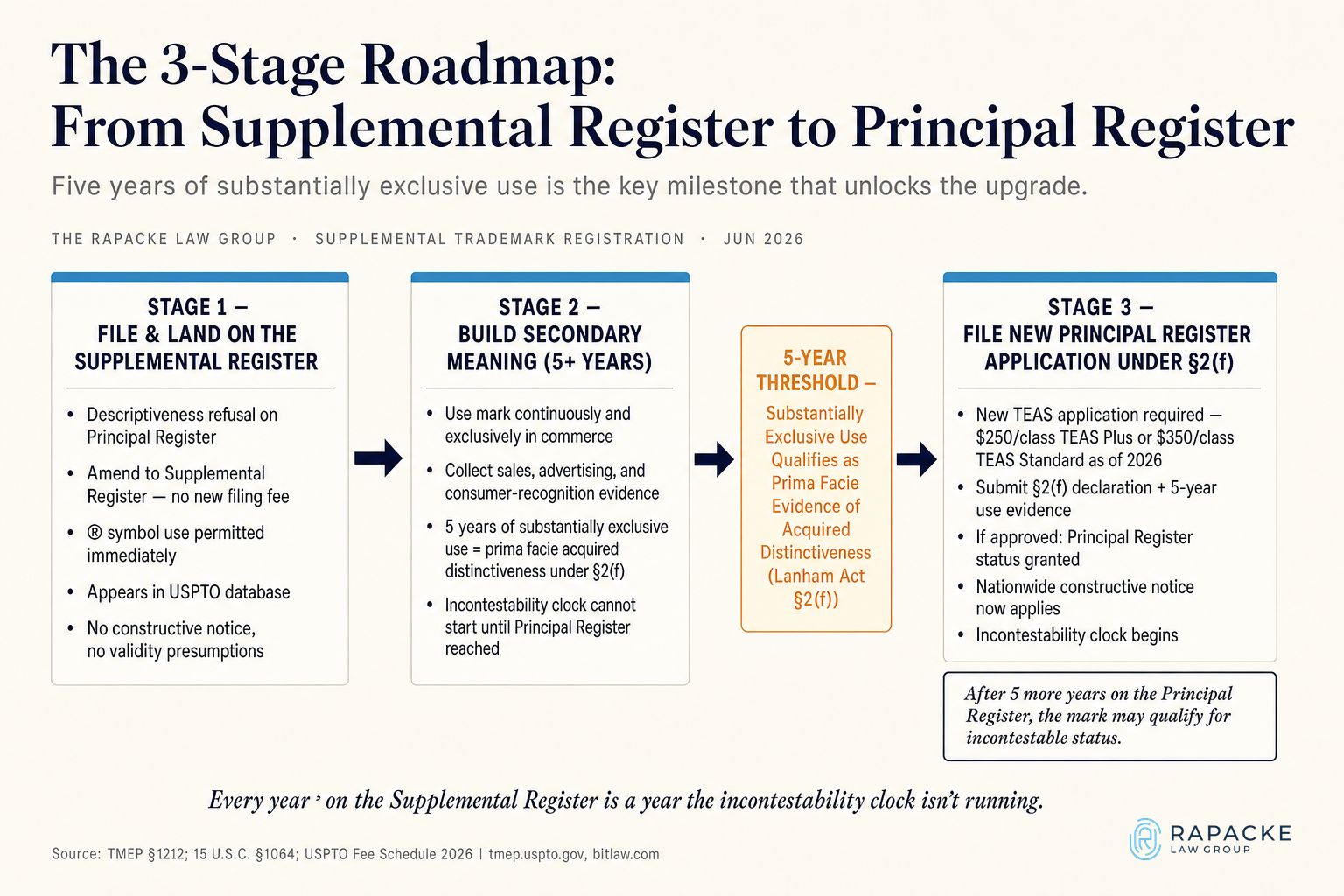 The 3-Stage Roadmap, From Supplemental Register to Principal Register, Source, TMEP §1212, 15 U.S.C. §§ 1064, 1065, USPTO Fee Schedule 2026
Treating Supplemental Registration as Equivalent to Full Federal Protection
Many trademark owners see the ® symbol on their supplemental registration and assume their rights match those of a Principal Register holder. They do not. Without constructive notice, a competitor who starts using a confusingly similar mark after your registration date can argue they had no knowledge of your claim, a problem that a free trademark search by the competitor would not have resolved. The statutory presumptions of validity and exclusive rights under 15 U.S.C. § 1057 do not apply, so you must prove your case from scratch in any enforcement action.
Never build a licensing or enforcement strategy on supplemental registration alone without a clear roadmap to Principal Register status; trademark attorneys can help you map that path.
Failing to File a New Application When the Mark Becomes Eligible
Some trademark owners renew a Supplemental Register mark for years after it has developed sufficient secondary meaning to qualify for the Principal Register. This delays the start of the five-year incontestability clock, which cannot begin until the mark is on the Principal Register. According to USPTO TTAB data, the TTAB upheld approximately 88% of "merely descriptive" refusals on appeal in 2024, underscoring how difficult it is to fight descriptiveness once you are already in the examination process. The upgrade to the Principal Register requires a new trademark application, not an amendment.
If you receive a trademark office action on descriptiveness grounds, set a calendar reminder at the five-year mark and have a trademark attorney evaluate whether your use record now supports a Section 2(f) claim.
Choosing a Descriptive Mark When a Stronger One Was Available
Many founders end up on the Supplemental Register not because of deliberate strategy but because they named their product after what it does. Trademark searching and clearance review before naming a product can prevent years of weaker protection. Ensuring trademark use in commerce is properly documented from day one also strengthens any future acquired distinctiveness claim. Evaluating distinctiveness before a USPTO office action arrives is far less costly than rebuilding a brand or litigating secondary meaning years later.
USPTO Fees, Timelines, and What to Expect During the Supplemental Registration Process
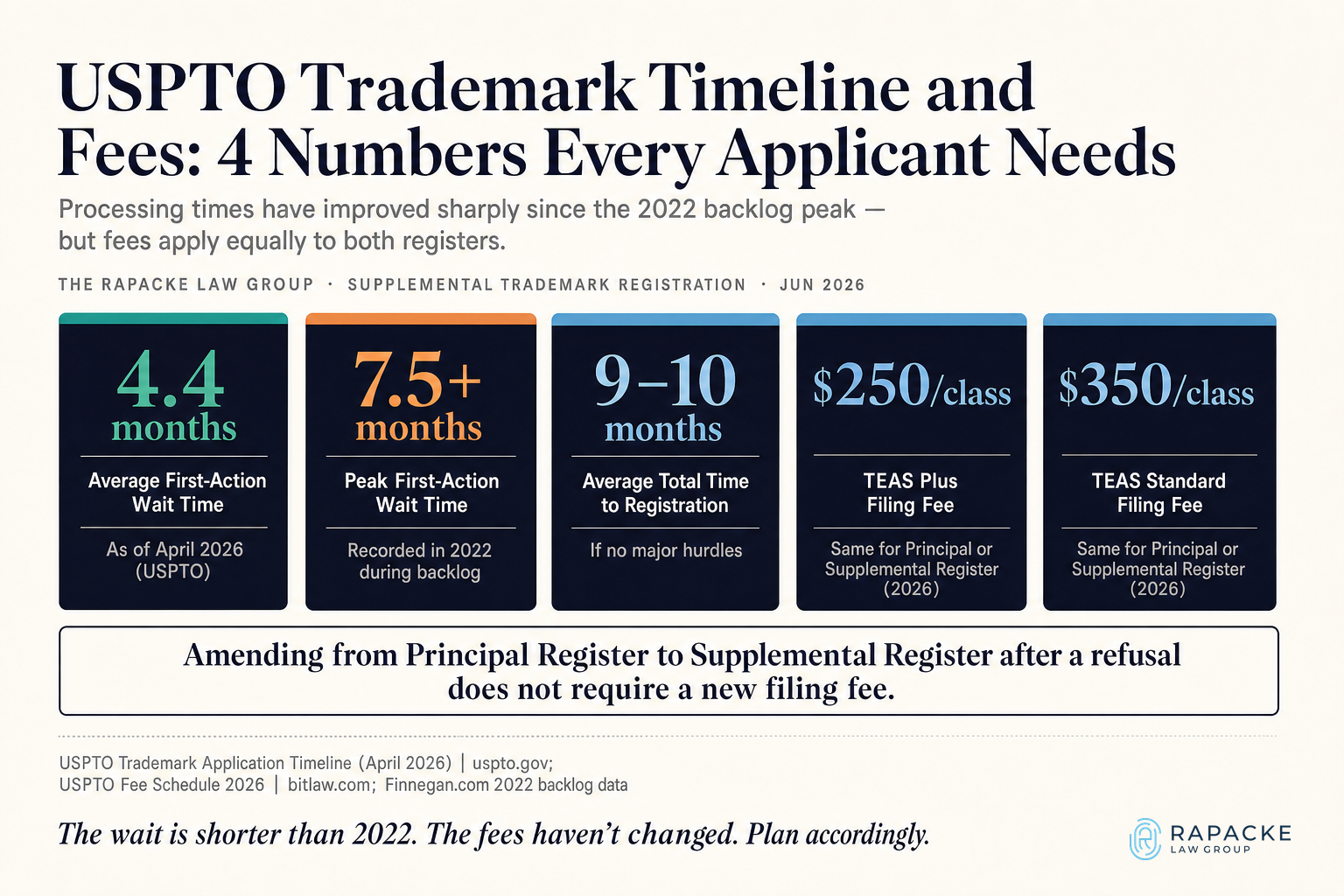 USPTO Trademark Timeline and Fees: 4 Numbers Every Applicant Needs, Source, USPTO Trademark Application Timeline, April 2026, USPTO Fee Schedule 2026 (37 CFR 2.6)
What It Costs to File on the Supplemental Register
Filing fees for a supplemental trademark registration application are identical to any standard federal trademark application. As of 2026, the USPTO fee schedule sets TEAS Plus applications at $250 per class and TEAS Standard applications at $350 per class. There is no reduced fee for targeting the Supplemental Register, and no additional fee is required if you amend from the Principal Register to the Supplemental Register during examination. If you later pursue Principal Register status after building acquired distinctiveness, that requires a new application with new filing fees.
How Long the Process Takes Given Current USPTO Backlogs
As of early 2026, the USPTO trademark application timeline shows a first-action pendency of 4.4 months, a significant improvement from the 7.5-month peak in 2022. Total time to registration for a straightforward Supplemental Register application runs approximately 9 to 10 months. If you need a U.S. registration date to anchor a Madrid Protocol international filing on a specific timeline, file early, as examination timing is not guaranteed regardless of which register you target.
International Trademark Strategy and the Supplemental Register
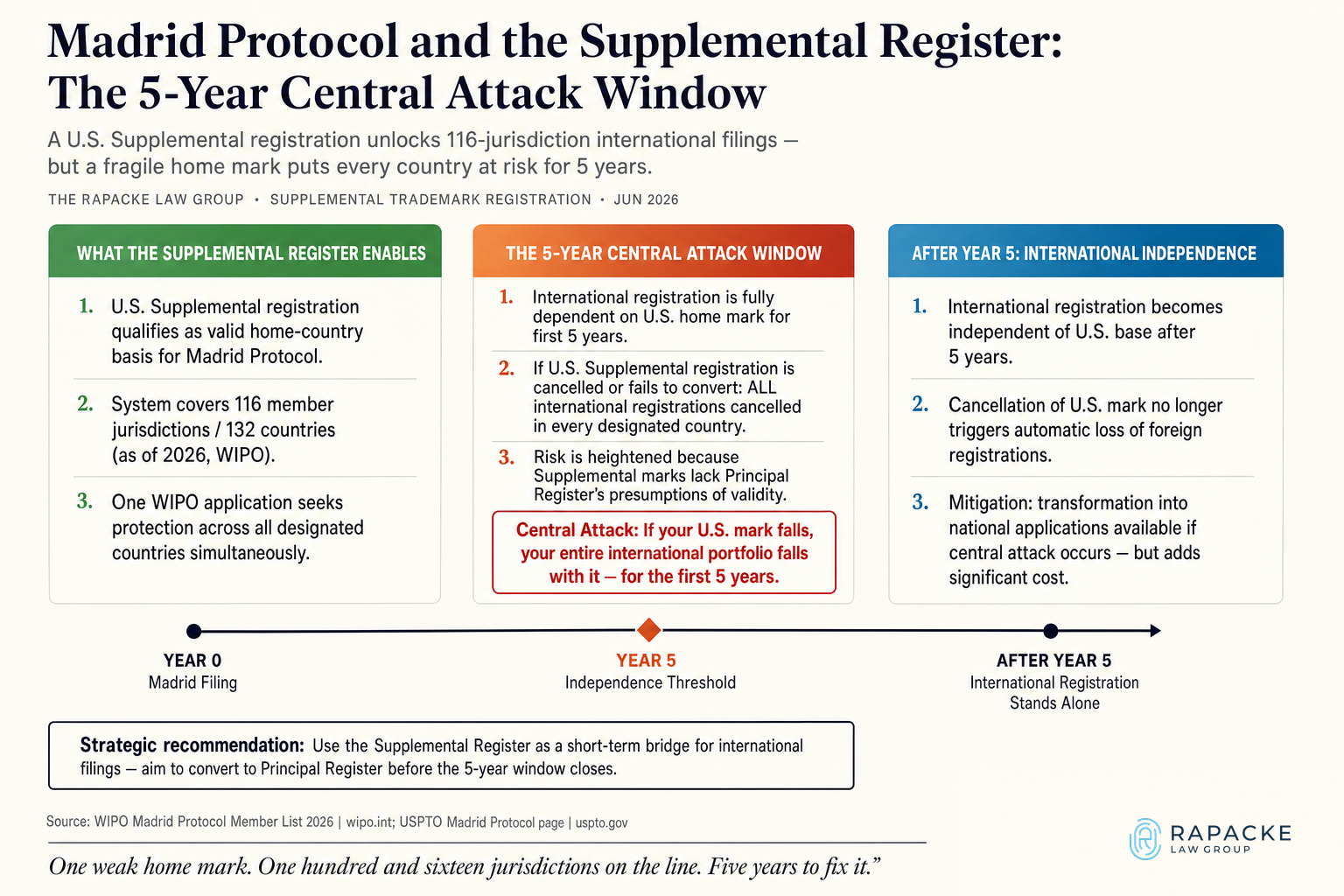 Madrid Protocol and the Supplemental Register, The 5-Year Central Attack Window, Source, WIPO Madrid Protocol Members List, 2026, USPTO Madrid Protocol Page
Using a Supplemental Registration as the Basis for International Filings
Under the Madrid Protocol, a U.S. trademark owner can use a U.S. registration or pending application as the basis for a single international trademark application covering multiple member countries through WIPO, a system that complements international trademark databases maintained by each jurisdiction. A supplemental registration trademark qualifies as a valid home-country registration for this purpose, according to USPTO Madrid Protocol guidance. With 116 member jurisdictions covering 132 countries in the Madrid System, this gives a tech startup meaningful global filing access even before achieving Principal Register status.
For founders with EU or APAC expansion on their roadmap, supplemental registration can accelerate the international IP filing timeline while the U.S. mark builds toward Principal Register eligibility.
Limitations That Affect International Enforcement From a Supplemental Registration
The Madrid System's "central attack" rule, a concept developed through Federal Circuit and TTAB decisions, creates a five-year dependency window. If your U.S. base registration is cancelled or invalidated during the first five years after an international filing, the international registrations built on it can be challenged or cancelled as well. A Supplemental Register mark that fails to demonstrate distinctiveness within that window puts the entire international trademark portfolio at risk.
Build your international trademark strategy on the strongest available U.S. foundation, including a review of any proposed trademark before filing. Use supplemental registration as a tactical bridge only when you have a clear and credible plan to migrate to the Principal Register. Consider whether a TTAB opposition or cancellation proceeding might affect your base registration before committing to an international filing strategy built on a supplemental mark.
Frequently Asked Questions About Supplemental Trademark Registration
What is a supplemental trademark registration?
A supplemental trademark registration is an official registration issued by the United States Patent and Trademark Office placing a mark on the Supplemental Register rather than the Principal Register under 15 U.S.C. § 1091. It is available for marks that are capable of distinguishing goods or services but are not yet inherently distinctive. The owner may use the ® symbol and file international applications under the Madrid Protocol, but the registration does not carry the legal presumptions or enforcement advantages of a Principal Register mark.
What are the requirements for the Supplemental Register?
A mark must be used in commerce and be "capable of distinguishing" the applicant's goods or services to qualify. The mark cannot be generic, but merely descriptive, primarily geographically descriptive, and primarily surname marks typically qualify. The application follows standard trademark office procedures through the TEAS system, and the filing fees are the same as a Principal Register application.
What are the disadvantages of the Supplemental Register?
Supplemental registration does not create constructive notice to the public, does not establish a legal presumption of exclusive rights, cannot achieve incontestable status under Lanham Act Section 15, and is not treated as prima facie evidence of validity in federal trademark infringement litigation. The United States Patent and Trademark Office can also register a confusingly similar mark on the Principal Register without being blocked by a Supplemental Register entry.
Can a supplemental registration become a principal registration?
Yes. After demonstrating acquired distinctiveness, typically through five years of substantially exclusive and continuous use in commerce under Lanham Act Section 2(f), a trademark owner can file a new application for the Principal Register. The supplemental registration does not automatically convert. A new trademark application with supporting evidence is required.
Does supplemental registration allow use of the ® symbol?
Yes. A Supplemental Register mark is an officially registered trademark, and the owner has the right to display the ® symbol. This distinguishes it from a state registration or unregistered common law mark, which may only use ™. However, the ® symbol does not tell the public which register the mark is on, so the legal weight behind it varies significantly.
Your Next Steps to Trademark Registration Success
Supplemental trademark registration can be a legitimate step in your brand's IP strategy, but only when you understand exactly what it does and does not protect. Treating it as equivalent to full federal trademark protection is one of the more costly mistakes a founder can make, creating serious legal issues especially when enforcement, licensing, or investor due diligence turns on the strength of your trademark rights.
The bottom line: a weak supplemental registration leaves your brand exposed to competitors, limits your enforcement options in federal court, and delays the incontestability clock that only starts running on the Principal Register. A strong IP strategy means choosing the right register from the start, or having a documented plan to get there.
Every month spent on the Supplemental Register without a clear upgrade plan is a month your incontestability clock is not running. For brands built on recognition and exclusivity, that gap compounds quickly.
Action items to protect your brand:
- Schedule a Free IP Strategy Call with Andrew Rapacke to evaluate whether your mark qualifies directly for the Principal Register
- Review the SaaS Patent Guide 2.0 if your brand is tied to a software product with broader IP considerations
- Download the AI Patent Mastery resource if your product involves AI-driven features that may need layered IP protection
- Build a use record from day one so the evidence needed for a Section 2(f) acquired distinctiveness claim is already in place when your five-year window opens
Rapacke Law Group handles trademark registration, trademark filing, office action responses, and long-term IP portfolio strategy for tech founders and startups at flat, transparent fees, backed by the RLG Guarantee, get your trademark approved or pay nothing, with a 100% refund if your application is rejected.
To Your Success,
Andrew Rapacke Managing Partner, Registered Patent Attorney Rapacke Law Group