


Key Takeaways
- Copyright protects your logo automatically but only against exact copying. Trademark protection is what stops competitors from trading on your brand recognition.
- Design marks represent 36% of all USPTO trademark applications — file a separate design mark for your logo and a standard character mark for your brand name.
- The U.S. Patent Office filing fee starts at $250 per class (TEAS Plus), but nearly 57% of applications receive an Office Action, making attorney guidance a cost-effective investment.
- Your federal priority date runs from your application filing date, not from registration — file before your logo goes public.
- Federal registration opens the door to international protection through the Madrid Protocol across 130+ countries with a single application.
Design marks made up 36% of all USPTO trademark applications in recent years, yet most business owners still rely on copyright alone to protect their logo. This gap leaves their brand identity legally exposed. Understanding how trademark and logos work together is the foundation of any serious brand protection strategy. Copyright protects the artistic expression in your logo from exact copying.
Trademark protection does something far more powerful: it gives you the exclusive right to use that logo as a source identifier in commerce, letting you stop competitors from using confusingly similar marks even if they drew theirs from scratch.
What a Logo Trademark Actually Does (and Why It's Not the Same as Copyright)
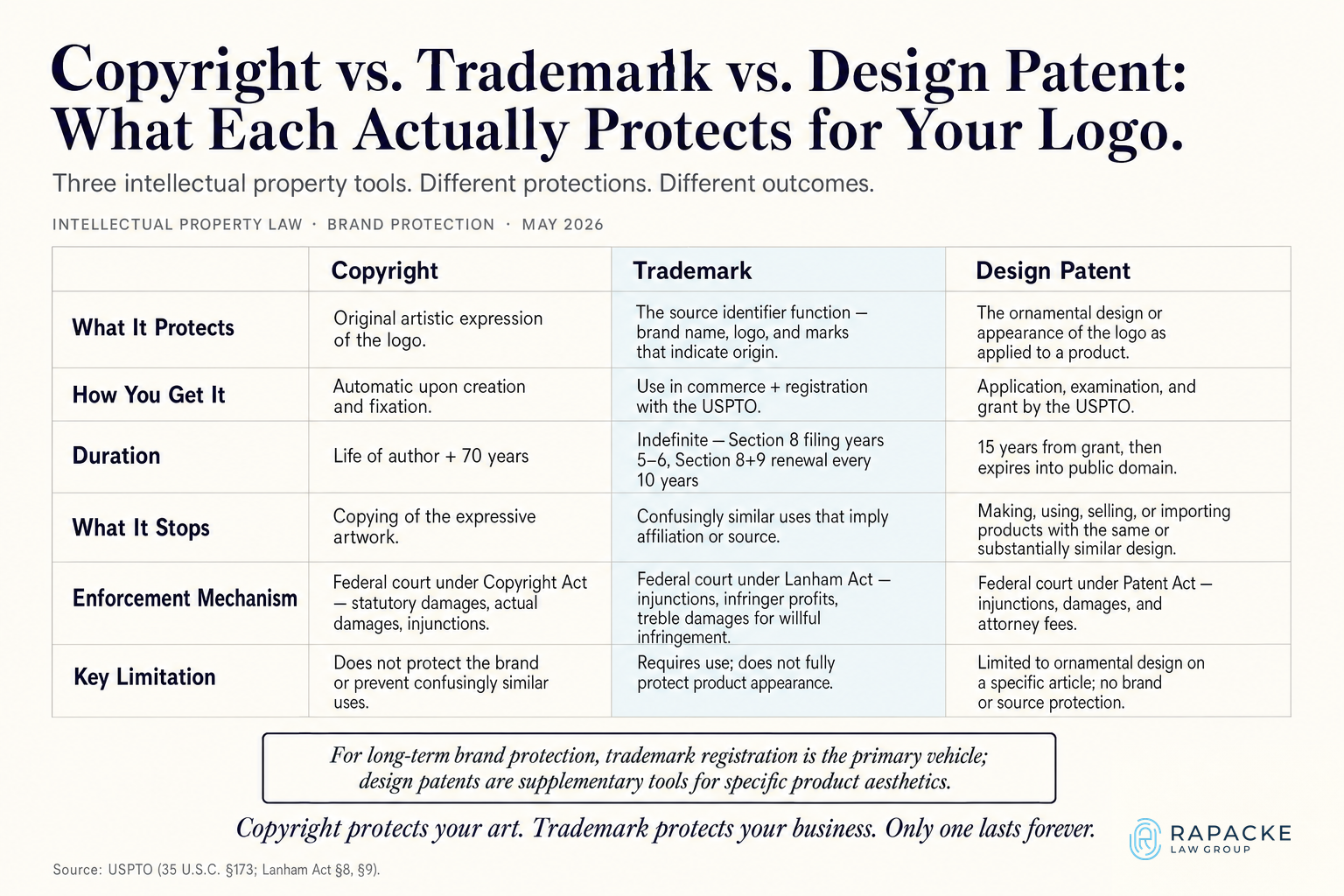
The Legal Distinction Between Logo Ownership and Logo Protection
A logo you design is automatically protected by copyright the moment it's created, but that protection only prevents someone from copying the exact image. Trademark protection operates differently: it grants exclusive rights to use the logo as a brand identifier in commerce. The United States Patent and Trademark Office (the U.S. Patent Office that handles both patents and trademarks) evaluates trademark applications based on united states patent and trademark law, specifically whether the logo identifies your brand's source, not its artistic merit. Grasping trademark basics and understanding how trademark and logos interact at a basic level early can save significant time and money. The USPTO received 945,000+ trademark class filings from U.S. applicants in 2022 alone, according to WIPO data, which illustrates how heavily businesses rely on trademark registration beyond copyright.
If your goal is stopping competitors from trading on your brand recognition, understanding what trademark protection covers is essential, as it goes well beyond logos and names.
What the Registered Trademark Symbol Tells the Market
The registered trademark symbol (®) signals federal registration and carries legal weight the ™ symbol does not. Both registered trademark symbols serve as public notice but have very different legal standing. Under the Lanham Act, monetary damages for trademark infringement are available only when proper ® notice has been given, and using ® on an unregistered mark constitutes a federal violation and can create legal trouble for the trademark owner. Use ™ immediately upon filing to put the market on notice. These trademark symbols serve different legal purposes in the broader relationship between trademark and logos. Switch to ® only after the U.S. Patent Office issues your registration certificate. If you want to understand which symbol you can legally use and when, the distinction matters from day one.
How Trademark Differs from a Design Patent for Logo Protection
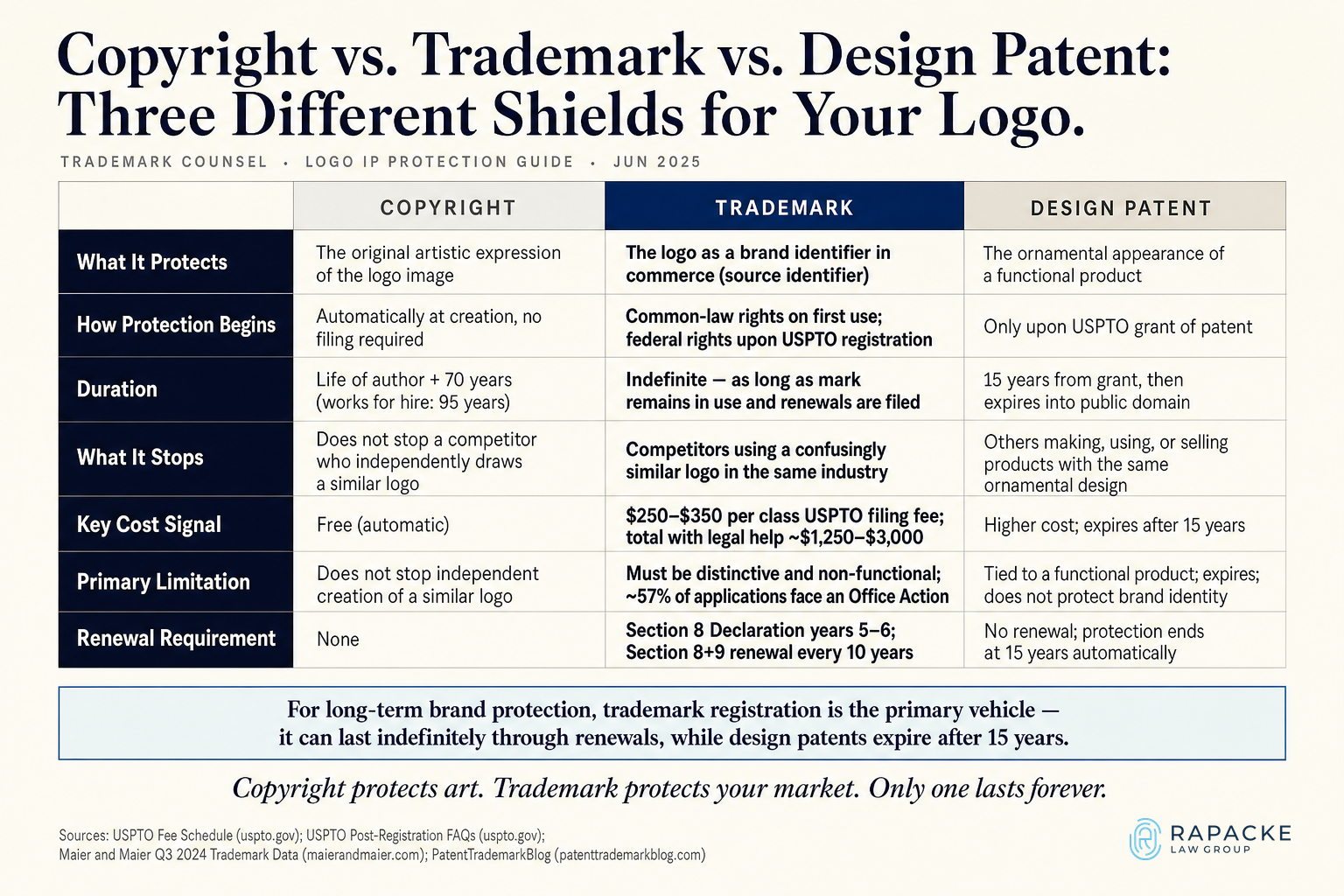
Design patents protect the ornamental appearance of a functional product and last 15 years from grant under 35 U.S.C. §173, after which they expire into the public domain. A federal trademark registration can last indefinitely through renewals as long as the mark remains in use as a protected trademark. For long-term brand protection, trademark registration is the primary vehicle.
Design patents are supplementary tools for specific product aesthetics that can provide additional legal protection, not a substitute for protecting your logo as a brand identifier.
Does Your Logo Qualify for Trademark Protection
The Distinctiveness Spectrum: From Generic to Fanciful
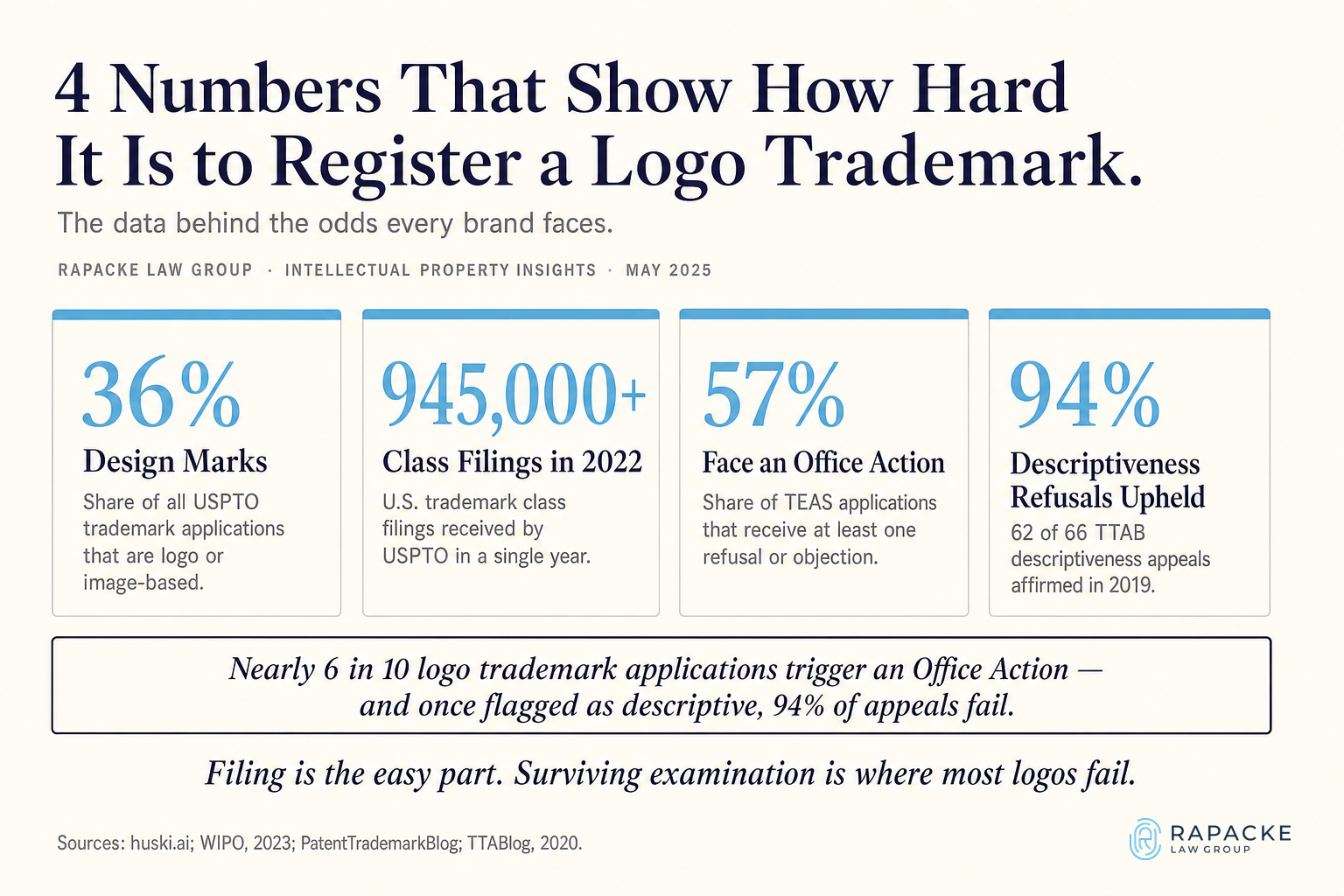
When it comes to trademark and logos, the U.S. Patent Office evaluates marks on a spectrum of distinctiveness. Fanciful marks (invented symbols with no prior meaning) receive the strongest trademark protection. Arbitrary marks apply existing imagery to unrelated goods. Suggestive marks hint at a quality without describing it. Descriptive marks are a weak trademark category that is difficult to register without proof of acquired secondary meaning, and generic marks cannot be registered at all. According to data from The TTABlog, the Trademark Trial and Appeal Board (TTAB) upheld descriptiveness refusals in 62 of 66 cases in 2019, a 94% affirmance rate. Design choices that lean fanciful or arbitrary from the start avoid this obstacle entirely.
Design marks account for 36% of all trademark applications, a figure that underscores how central logo-based marks are to the USPTO's workload. The 945,000+ class filings by U.S. applicants in 2022 frame just how competitive and scrutinized this process is.
Why Purely Functional or Descriptive Elements Cannot Be Trademarked
Any logo element that is functional (meaning its design affects the product's utility or lowers its cost) cannot be registered as a trademark under the standards established in Qualitex Co. v. Jacobson Products Co. and the Inwood Laboratories functionality test. Colors, shapes, and single letters can be registered if they have acquired secondary meaning and serve no functional purpose. Strip functional elements from your trademark application before filing.
Common Logo Mistakes That Trigger USPTO Rejection
Nearly 57% of trademark applications receive an Office Action for issues including likelihood of confusion with existing marks, inadequate specimens, or incorrect identification of goods and services, according to USPTO trademark application data. The U.S. Patent Office's Trademark Center (formerly TESS) allows anyone to search existing registrations before filing, including applicants based in New Jersey and every other state. A comprehensive trademark clearance search before filing is the single most effective way to avoid wasting filing fees on a conflicting application. Before you file, it also pays to understand what trademark protection actually covers so you select the right mark type and classes from the start.
How the Trademark Registration Process Works for Logos
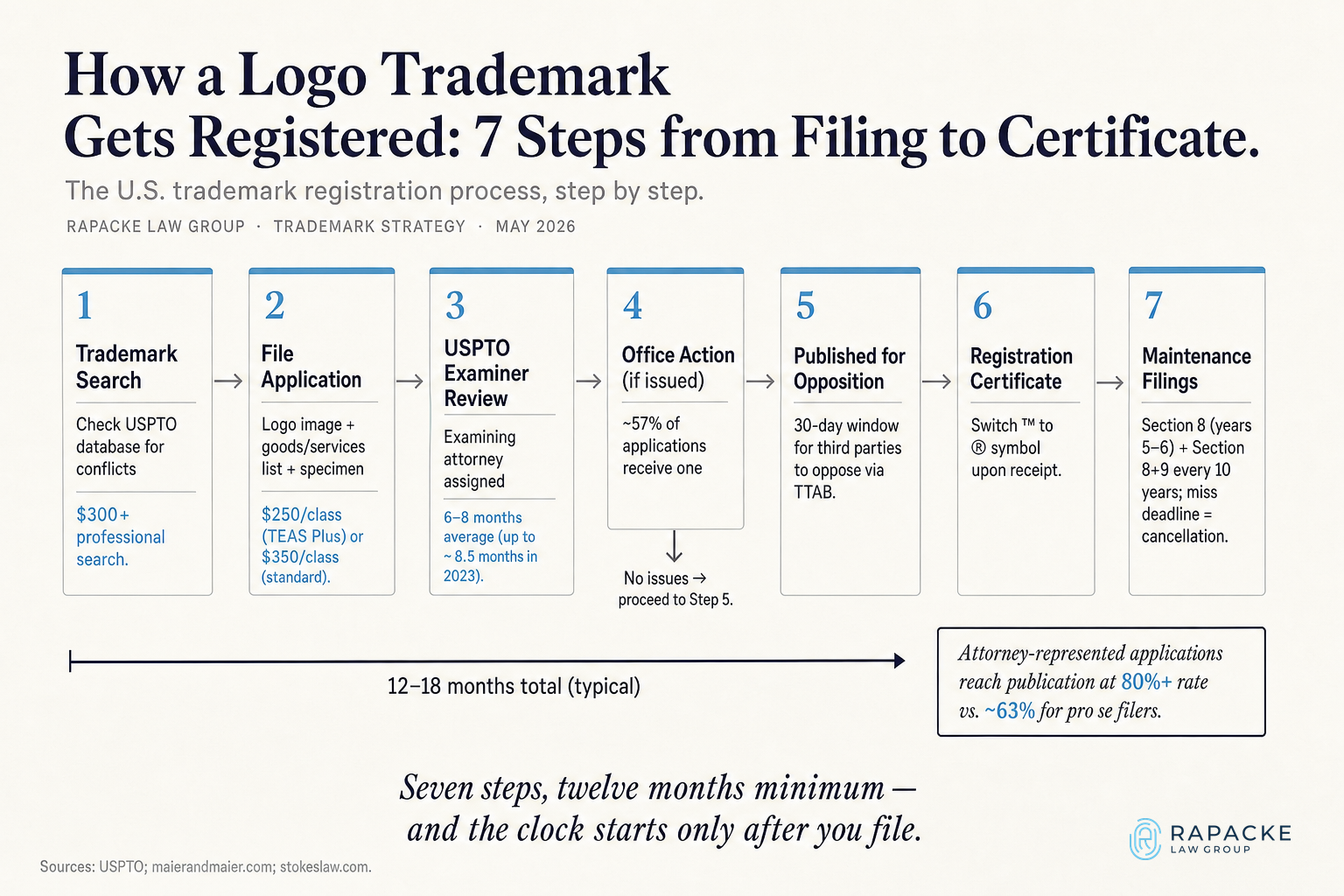
Filing a Logo Trademark Application With the USPTO
Filing correctly for trademark and logos requires selecting a stylized/design mark, uploading a clear JPG of the logo, identifying the correct International Class(es), and paying the filing fee. The current U.S. Patent Office fee is $250 per class for a TEAS Plus application, or $350 per class for a standard application, per the USPTO fee schedule. Filing as an intent-to-use application establishes your federal priority date before your logo launches publicly. That priority date, not the registration date, is what determines who has superior rights.
If you sell on Amazon or operate primarily through e-commerce, trademarking your brand before launch is especially important, since marketplace brand registry protections depend on federal registration. You can also review our step-by-step guide to getting a federal trademark for a detailed walkthrough of each filing stage.
What Happens After You File
A USPTO examining attorney reviews the application approximately 6–8 months after filing. An Office Action is not a denial; most can be overcome with a well-reasoned response. According to USPTO data on attorney representation outcomes, applications handled by counsel reach publication at an 80%+ rate, versus approximately 63% for pro se filers. If approved, the new trademark is published in the Official Gazette for a 30-day opposition window.
Maintaining Your Trademark Registration
Federal registration does not maintain itself. Between years 5 and 6, you must file a Section 8 Declaration of Continued Use. Renewal is required every 10 years through a combined Section 8 and 9 filing, per USPTO post-registration guidance. After 5 years of continuous use, filing a Section 15 Incontestability Declaration significantly limits the grounds on which third parties can challenge your mark. Calendar the Section 8 filing window the day you receive your registration certificate.
What Trademark Protection for a Logo Actually Covers
Geographic Scope: United States vs. International Protection
Federal trademark registration through the U.S. Patent Office provides exclusive rights throughout the United States, through a united states patent and trademark system that grants the legal presumption of ownership and the right to sue in federal court. It does not automatically extend to Canada, the EU, or other countries. The Madrid Protocol, administered by the World Intellectual Property Organization (WIPO), allows a single international application based on your U.S. registration to seek protection in over 130 member countries. If your business sells internationally, filing through the Madrid Protocol before a foreign competitor registers your logo in their market is a practical priority.
The Scope of Your Exclusive Rights
The scope of rights covering trademark and logos is bounded by the International Classes in your registration and the channels of trade where consumer confusion is likely. Courts apply a multi-factor likelihood of confusion test, established by the Ninth Circuit in AMF Inc. v. Sleekcraft Boats — to assess whether two marks are too close. Service marks protect logos used with services rather than physical goods and are registered through the same USPTO process in Classes 35–45. SaaS founders and tech companies whose logo is part of a software program or platform typically file in Class 42 covering software-as-a-service. Common law trademark rights exist in geographic areas of actual use but are difficult to enforce and do not block later federal registrations; a separate trademark registration at the federal level is the only reliable way to secure nationwide rights.
One of the most common misconceptions is that a state trademark registration provides the same protection as a federal registration. It does not. Federal registration is what unlocks nationwide rights, Madrid Protocol access, and federal court remedies.
What Trademark Does Not Protect
Trademark law does not protect ideas, inventions, or creative works — those require patents and copyright respectively. It does not prohibit nominative fair use, where someone references your brand to describe your actual products. Trade dress protection extends trademark-like rights to a product's overall commercial image, but obtaining a trade dress requires proving non-functionality and distinctiveness, which can be a high bar. The Supreme Court addressed trade dresses in Two Pesos, Inc. v. Taco Cabana, recognizing inherently distinctive trade dress as protectable without proof of secondary meaning. Understanding these limits tells you when you also need a copyright registration or a design patent to close gaps in your intellectual property strategy.
What It Costs to Trademark a Logo and How Long It Takes
USPTO Filing Fees and Attorney Costs
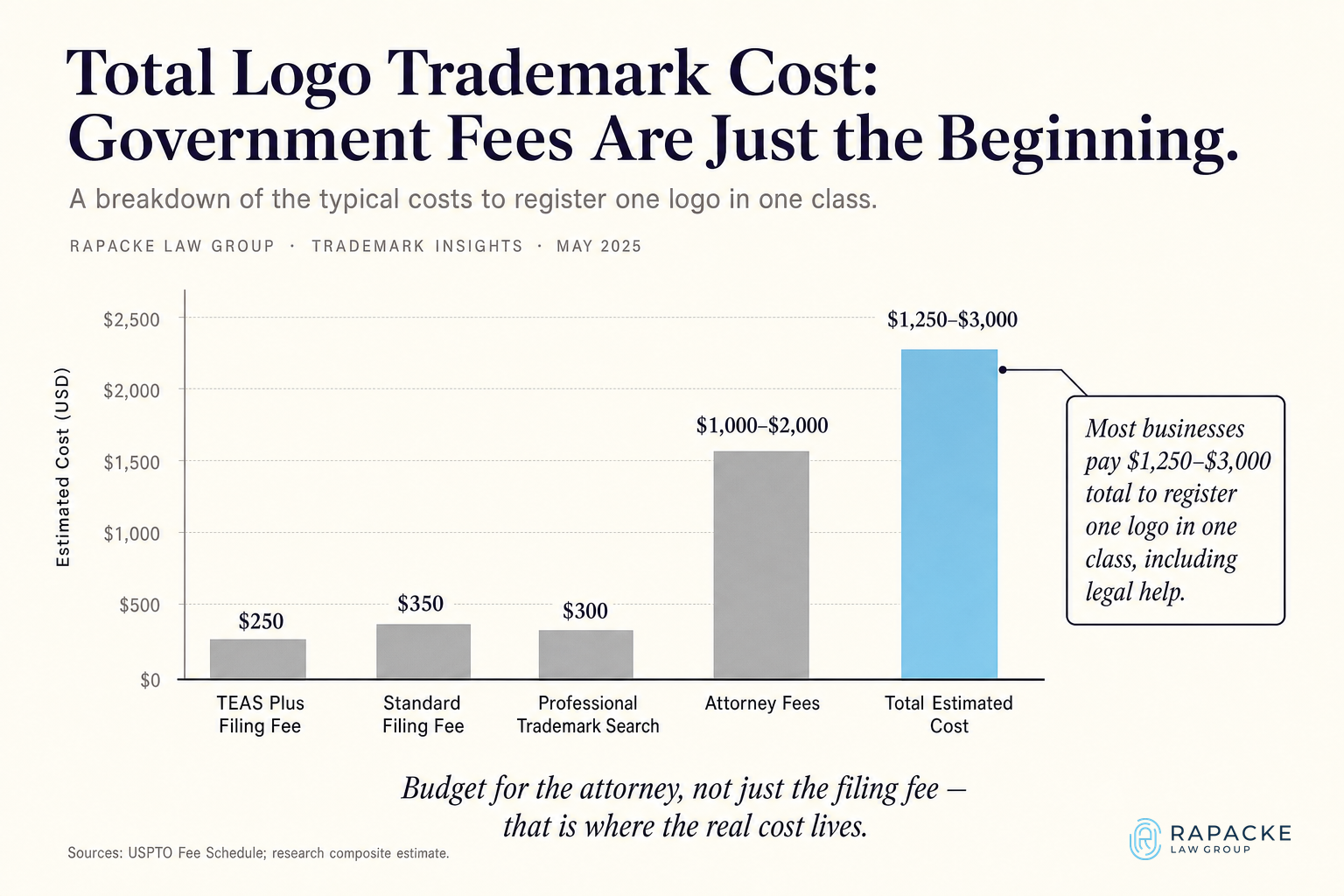
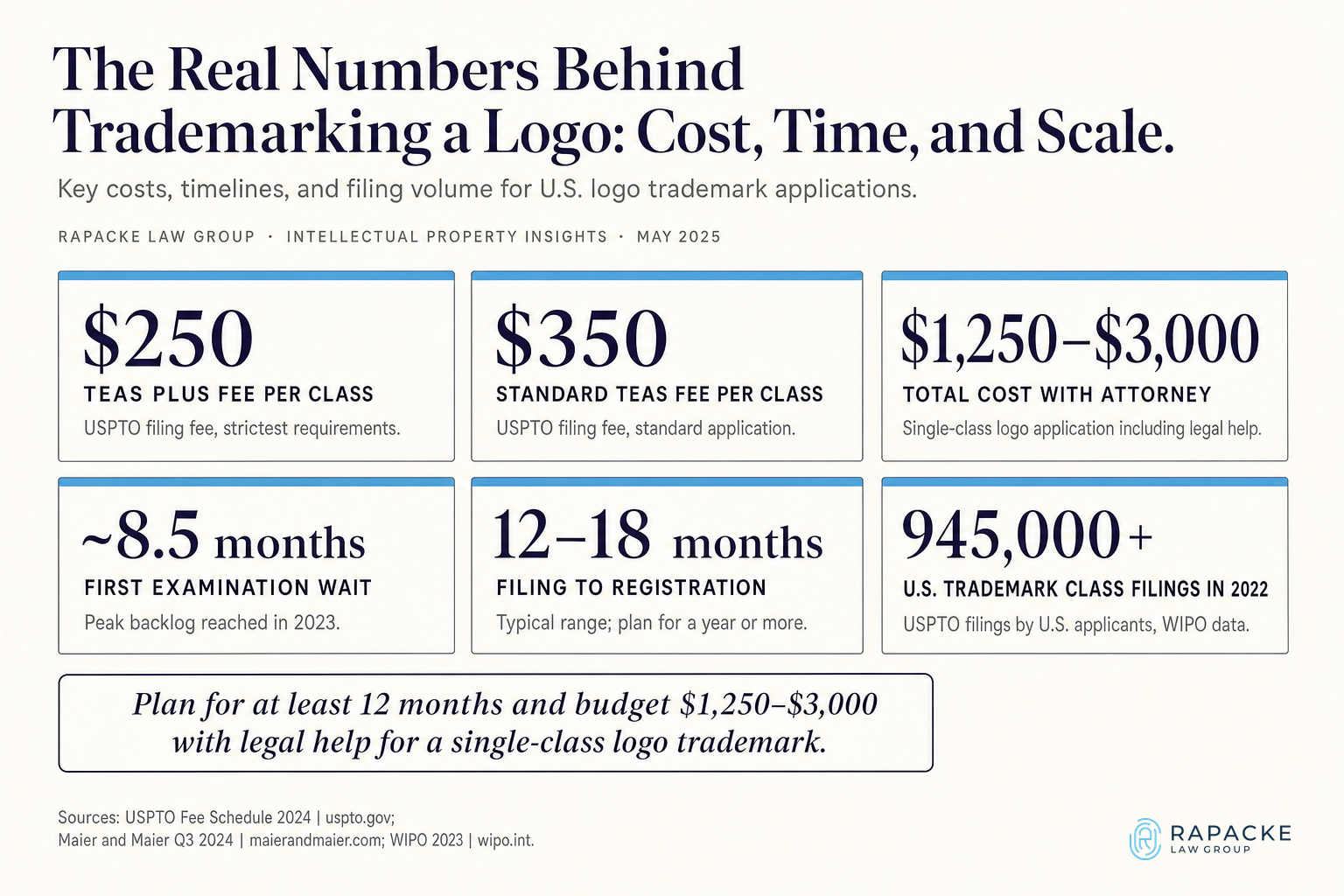
The USPTO TEAS Plus filing fee is $250 per International Class; the standard rate is $350 per class. Most logo trademark applications cover one to three classes, putting government fees at $250–$750. A professional trademark clearance search typically costs $300 or more. Attorney fees (sometimes called legal fees) for a straightforward single-class application range from approximately $1,000 to $2,000, according to industry benchmarks from the AIPLA. Total costs for a single-class registration with professional assistance commonly run $1,250–$3,000 without complications, and more if an Office Action requires a substantive response.
If you are deciding whether to trademark your company name separately from your logo, budget for two applications. A word trademark and a design mark serve different legal functions and neither substitutes for the other; filing separate applications for each ensures complete coverage. Similarly, trademarking a logo involves specific specimen and classification requirements that differ from a standard character mark filing.
How Long the Process Takes
The USPTO currently averages 12–18 months from filing to registration for applications that proceed without Office Actions or oppositions. Applications that receive Office Actions can take 18–24 months. The USPTO trademark dashboard publishes current processing benchmarks by application stage. Plan for at least a year, use ™ during the pendency period, and file as early as possible. Your priority date runs from filing, not registration.
How to Enforce and Defend Your Logo Trademark Rights
Monitoring for Infringement and Cease and Desist Letters
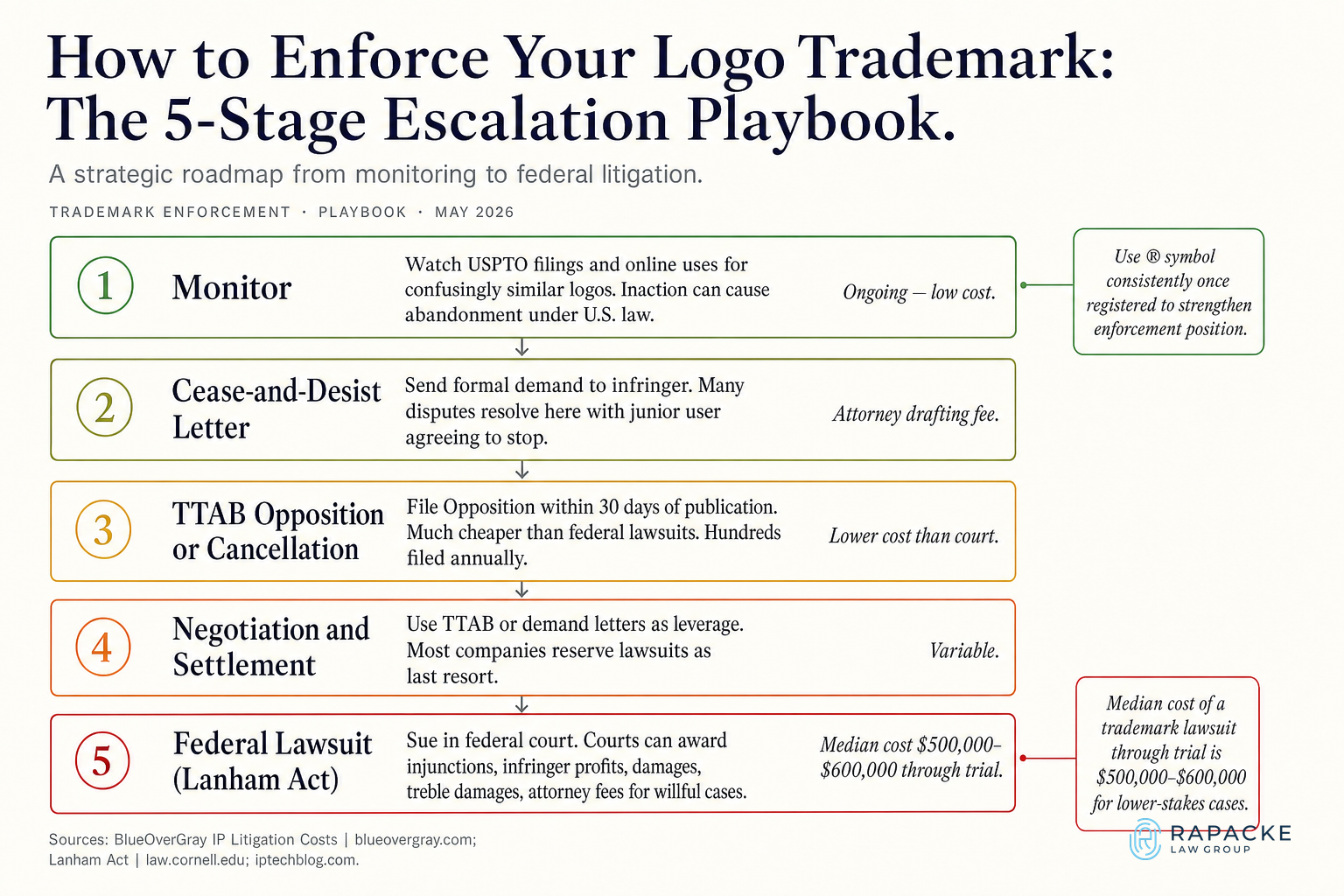
Trademark owners who fail to police their trademark and logos risk a finding of abandonment. Under Lanham Act §45, a mark can lose protection if the owner's inaction causes it to become the generic term for those goods, as happened historically with "aspirin" and "cellophane." Set up monitoring before your registration issues. When infringement is identified, a cease and desist letter is typically the first step toward legal action and resolves many disputes without litigation.
For Amazon sellers, brand protection has an additional layer: the Amazon Brand Registry requires a live federal trademark registration to unlock counterfeit reporting tools and A+ Content. This is one of many reasons why working with an Amazon trademark lawyer before launch can prevent costly enforcement problems later.
Filing an Opposition or Cancellation Through the TTAB
If a competitor files for a confusingly similar mark, protecting your trademark and logos through a TTAB opposition during the 30-day publication window is the appropriate first step. If the registration has already issued, a cancellation proceeding at the TTAB is the appropriate path. TTAB proceedings are significantly less expensive than federal court litigation and are handled entirely within the U.S. Patent Office, acting as the country trademark office for such disputes. A TTAB opposition filed within 30 days of publication is far cheaper than canceling a registration after it issues.
When Trademark Disputes Escalate to Federal Court
Federal trademark registration grants the right to sue in federal court under the Lanham Act, seek injunctive relief or a court order, recover the infringer's profits, and in willful infringement cases, claim attorney's fees under Lanham Act §35. According to the AIPLA Report of the Economic Survey, trademark litigation averages $375,000 or more per side through trial. Most trademark owners find that disputes resolve through coexistence agreements, licensing arrangements, or TTAB proceedings. Use the most cost-effective enforcement tool first and reserve federal litigation for cases where the stakes justify it.
Frequently Asked Questions About Trademark and Logos
Are trademarks and logos the same thing? No. A logo is a visual design element; a trademark is the legal protection applied to it. The relationship between trademark and logos is one of legal status: the logo is the asset, and the trademark is the right that protects it. A logo becomes a trademark when it is used in commerce to identify the source of goods or services and is either registered with the USPTO or protected by common law through actual use. Trademark protection also extends to words, sounds, colors, and product shapes beyond logos.
How do I legally trademark a logo? Start with a comprehensive trademark clearance search through the USPTO's Trademark Center, the primary trademark search system, to confirm no confusingly similar marks exist in your target International Classes. Then submit an application to register your logo as a TEAS Plus application with a clear image of your logo, the correct class identification, a specimen showing the logo in actual commerce, and the $250 per-class filing fee. An experienced intellectual property lawyer or trademark attorney can identify classification issues and respond to Office Actions that would otherwise delay your application.
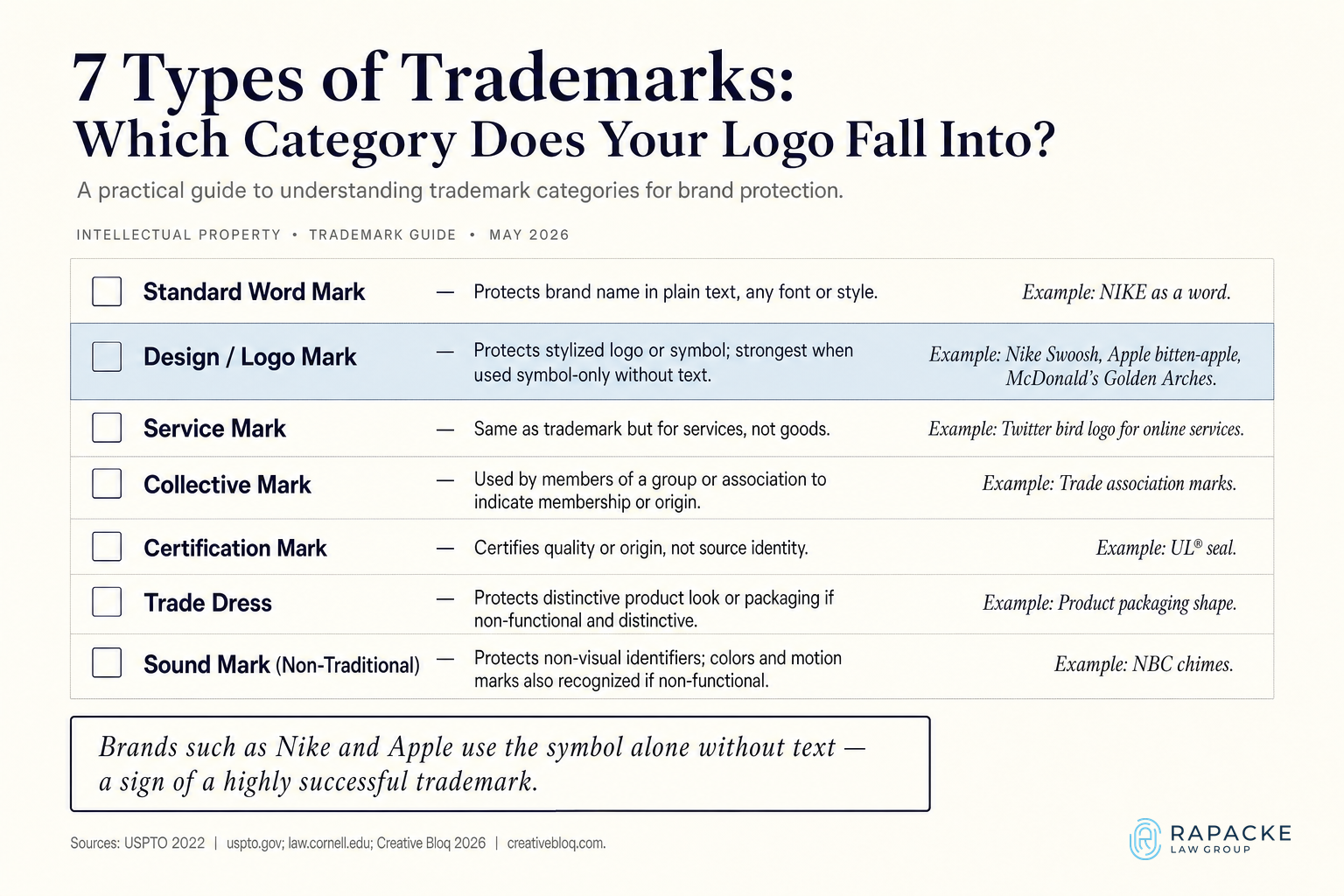
What are the 7 types of trademarks? The USPTO recognizes: (1) standard character marks protecting words in any font, (2) stylized/design marks protecting a specific visual logo, (3) service marks protecting logos used with services, (4) collective marks used by organization members, (5) certification marks certifying origin or quality, (6) trade dress protecting a product's overall commercial image, and (7) sound marks protecting distinctive audio signatures. For most businesses, the relevant categories are design marks for logos and standard character marks for brand names.
What are some examples of famous trademarked logos? These trademark examples, the Coca-Cola script logo (Class 32), the Apple bitten apple (multiple classes), the Starbucks siren (Classes 30 and 43), the Nike swoosh (Class 25), and the McDonald's Golden Arches, are all design marks registered with the U.S. Patent Office that have achieved incontestable status through decades of continuous use and active enforcement.
Can I trademark my own name as part of a logo? Yes, but personal name marks face additional scrutiny. Under Lanham Act §2(e)(4), a mark that is primarily merely a surname or similar name is not registrable without proof of acquired distinctiveness. Including a distinctive design element alongside the name strengthens the application, and helps differentiate the mark from other brands already in the register. Well-known examples include VERA WANG, RALPH LAUREN, FORD, and UK fashion designer Karen Millen.
Do I need a lawyer to trademark a logo? The USPTO permits domestic applicants to file without an attorney, but having a legal team handle the process means attorney-represented applications achieve publication at an 80%+ rate versus approximately 63% for pro se filers. Foreign applicants are required to use a U.S.-licensed attorney. Misclassification, weak specimens, and missed conflicting marks are the most common and most avoidable causes of rejection.
What happens if my trademark application is rejected? A rejection arrives as a USPTO Office Action from an examining attorney. You have 3 months to respond, extendable to 6 months for a fee. This article does not constitute legal advice; consult a licensed attorney for guidance specific to your situation. Responses can include legal arguments, amended descriptions, or additional evidence of distinctiveness. If the examiner maintains the refusal, you can appeal to the TTAB and then to federal court. Most first-Office-Action rejections are resolved through a well-reasoned written response.
Your Next Steps to Logo Trademark Success
Your logo is often the first thing a customer recognizes about your brand. Federal trademark registration through the U.S. Patent Office turns that recognition into an enforceable exclusive right, giving you the sole right to use that logo in commerce as the sole legal trademark owner, one that competitors, copycats, and counterfeiters must respect or face legal consequences. Common law trademark rights protect you only where you actively operate; federal registration protects you everywhere in the United States and opens the door to international intellectual property rights and protection through the Madrid Protocol.
The period between when you start using a logo and when you file a trademark application is the riskiest window for your brand. A competitor who files first can block your registration regardless of who designed the logo.
The bottom line: a logo protected only by copyright is a logo that competitors can legally copy and repurpose as a brand identifier. Federal trademark registration is what converts your visual identity into exclusive, enforceable rights.
Working with a trademark attorney gives you the best chance of a successful registration. Rapacke Law Group guarantees your trademark gets approved or you pay nothing.
Every week you delay filing is a week a competitor could establish an earlier priority date in your class. That gap is difficult and expensive to close after the fact.
Here is what to do next:
- Schedule a Free IP Strategy Call to find out whether your logo qualifies for federal trademark protection and what the registration process looks like for your business
- Run a clearance search through the USPTO Trademark Center before filing anything
- Review the RLG Trademark Registration page: Rapacke Law Group guarantees your trademark gets approved or you pay nothing
- If you operate on Amazon, read why Amazon sellers need trademark protection before launch
- Download the SaaS Legal Forms Checklist if your logo is part of a broader SaaS brand identity
Federal trademark registration is not a legal formality — it is a competitive asset, a key legal designation, and a core part of any sound legal strategy for brand owners. The brands that build lasting market positions protect their visual identity early and enforce it consistently.
To Your Success,
Andrew Rapacke Managing Partner, Registered Patent Attorney Rapacke Law Group