

Key Takeaways
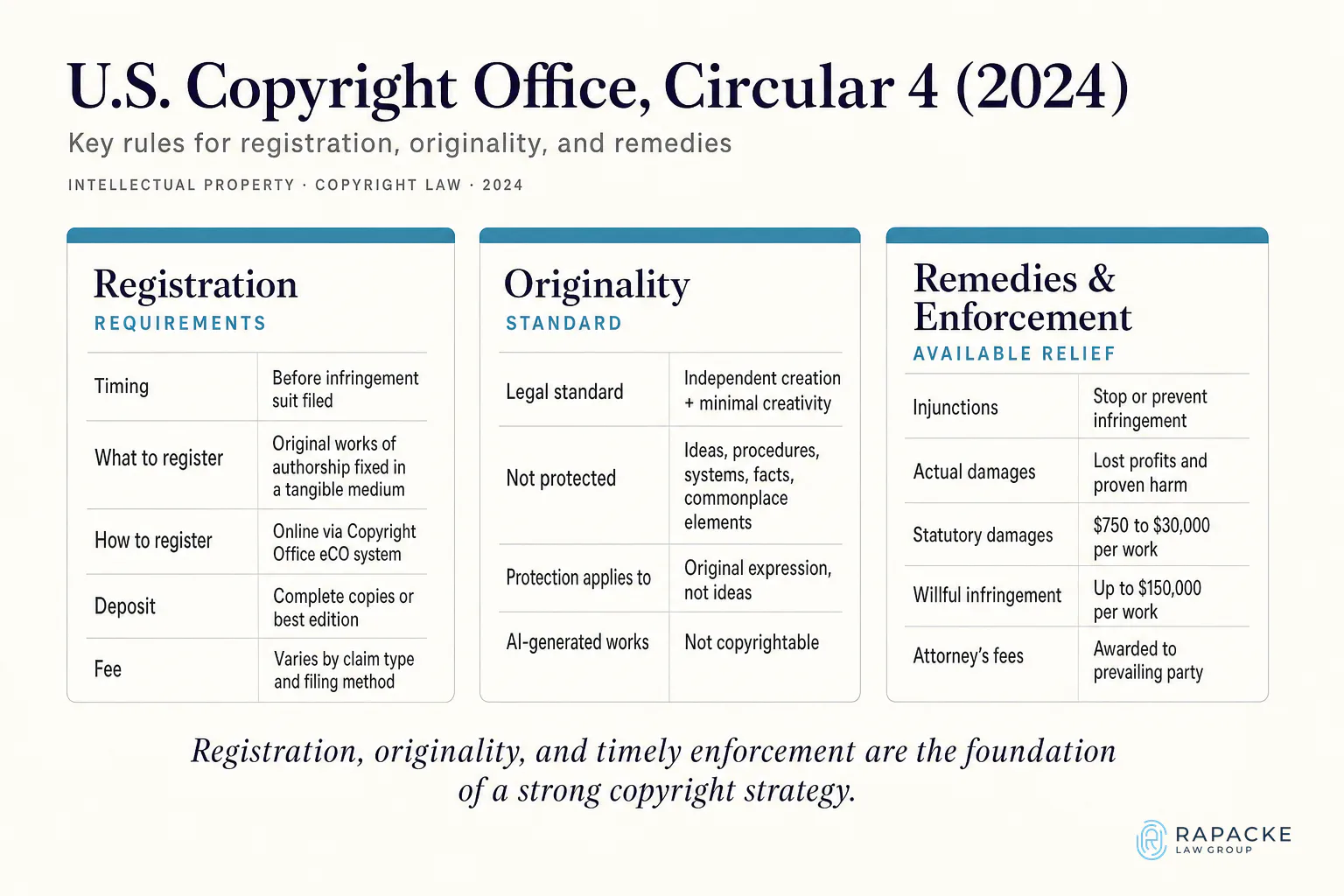
- Copyright exists on fixation in a tangible medium; timely registration preserves statutory damages of $750-$30,000 per work, up to $150,000 for willful and $200 for innocent infringement (17 U.S.C. §504).
- Trademarks protect names, logos, and slogans identifying commercial source; copyright never secures your product name.
- A logo can qualify for both: copyright as artwork, trademark as source identifier. Filing one leaves a gap.
- Register published works before infringement or within three months of publication.
- Clear trademarks before spending on branding. As of August 10, 2026, the USPTO averaged 4.2 months to a first examining action and 9.7 months to registration or abandonment.
*Written by Andrew Rapacke, Managing Partner, Registered Patent Attorney.* Andrew Rapacke is a registered patent attorney and the Managing Partner of The Rapacke Law Group, a full-service intellectual property law firm. He helps individuals and corporations across industries with the protection, prosecution, licensing, and enforcement of their intellectual property, with deep experience in patent, trademark, and copyright matters spanning software, AI and machine learning, blockchain, medical devices, and autonomous vehicle technology. A graduate of the United States Naval Academy, Andrew served as a Naval Engineering Officer before pursuing law and remains active in the startup and inventor communities throughout Florida.
Registering one work with the U.S. Copyright Office costs $45 under the Single Application if you are the sole author and claimant and it was not made for hire, every other basic online claim costs $65, per the Office's Circular 4. A federal trademark application starts at $350 per class under the USPTO fee schedule, before surcharges. Those filings protect different assets, which is how founders end up with a documented codebase and a brand name they cannot legally keep without risking serious legal issues. The copyright or trademark question is one distinction in intellectual property protection matters, are you protecting something you created, or something customers use to recognize who made it?
This article is primarily a practical guide to trademark and patent strategy, with copyright covered as essential supporting context: what each protects, what neither reaches, where they overlap, registration costs and timelines, how to sequence filings to avoid paying later for a gap, and where patents fit.
What Copyright Actually Protects (and What It Does Not)
Copyright protects original creative expression the instant it is fixed in a tangible medium, no filing, no fee, no waiting. This automatic copyright protection is optional to register for the right to exist, but registration is essential to enforce it profitably.
Copyright Covers Expression, Not Ideas
Section 102 of the Copyright Act lists eight categories, including literary works, musical works, pictorial and graphic works, motion pictures, and sound recordings. Software code and computer programs generally fall under literary works. Section 102(b) sets the limit that surprises engineers, copyright never reaches the idea, process, system, or method of operation. The Copyright Office confirms in Circular 61 that copyright covers expressive code, not algorithms, functionality, or system design.
Why Copyright Registration Still Matters
Registration is generally required before you can file an infringement action over a U.S. work, and timely registration preserves statutory damages and stronger legal protection against willful copying. Awards run from $750 to $30,000 per infringed work, rising to $150,000 for willful infringement and dropping to $200 where the infringer proves innocent infringement; these infringement claims are only available to rights holders who registered timely. Attorney's fees are discretionary. Under 17 U.S.C. §412, unpublished works should be registered before infringement begins, published works generally must be registered before infringement or within three months after first publication. That deadline puts copyright registration on the launch checklist, not the cleanup list.
What Copyright Cannot Do for Your Brand
Copyright is the wrong tool for brand identity. Circular 33 states that names, business names, product names, titles, slogans, and domain names generally lack sufficient authorship for copyright law to apply. Distinctive logo artwork may be copyrightable, but copyright does not protect the logo's brand significance. Registering your app's code does not shield the app name, and copyright protection for the code is entirely separate from any rights in the brand.
What a Trademark Actually Protects (and What It Does Not)
A trademark protects words, names, symbols, logos, and slogans that identify a source of goods or services. It blocks confusingly similar branding in your category, not a competitor's similar product.
Trademarks Protect Brand Identity in the Marketplace
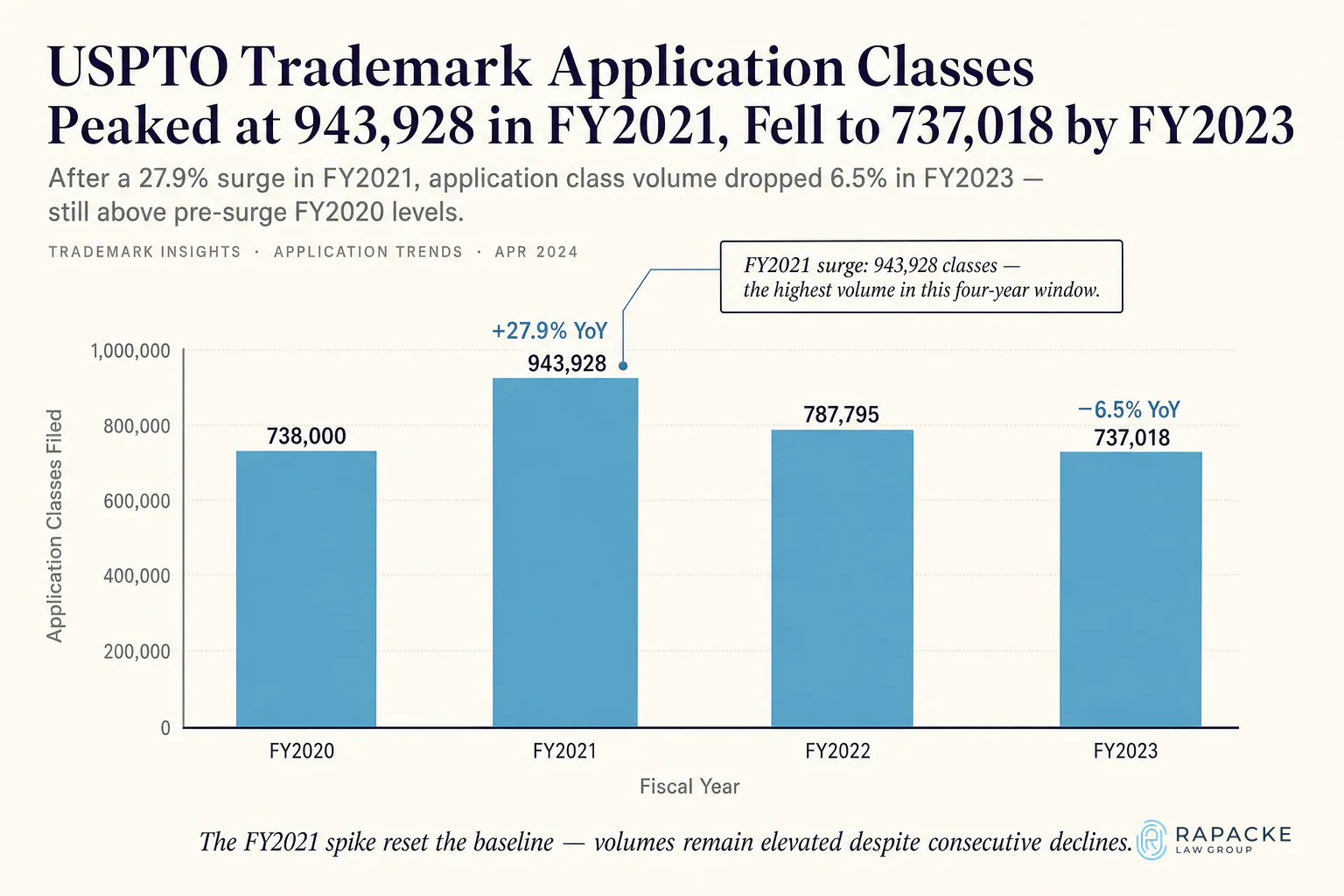
Federal trademark registration with the USPTO creates a nationwide presumption of ownership, public notice, federal court access, and use of ®. The field is crowded, the USPTO Trademark Public Advisory Committee reported 943,928 application classes in FY2021, 787,795 in FY2022, and 737,018 in FY2023, down 6.5% year over year and slightly below the pre-surge FY2020 base of 738,112.
Trademark Rights Depend on Use in Commerce
Rights arise from commercial use, and common-law rights are limited to where you operate. Founders who have not launched can file a bona fide intent-to-use application, but registration issues only after qualifying use. Three consecutive years of nonuse is prima facie evidence of abandonment under 15 U.S.C. §1127, the burden shifts to you, so keep dated proof of use.
What Trademarks Cannot Do
Trademark law addresses consumer confusion about origin, not the creative content inside your product or exclusivity over functional designs and technical methods. If the asset you care about is the invention itself, trademark registration will not reach it.
Copyright or Trademark Side by Side
Copyright protects what you make. Trademark protects how customers find you.
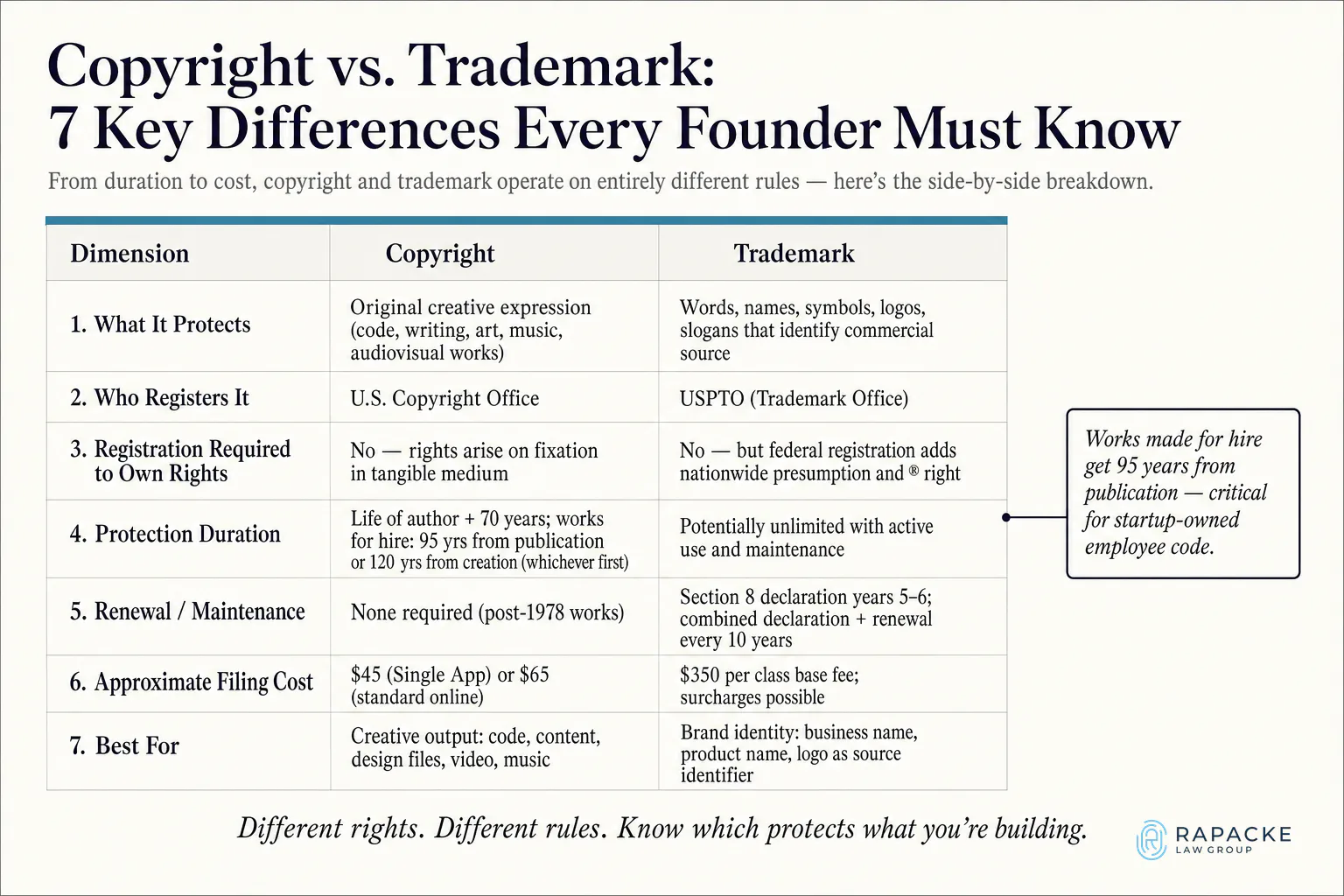
| Factor | Copyright | Trademark |
|---|---|---|
| What it protects | Original expression such as software code, writing, graphics, video, music | Names, logos, slogans, and other source identifiers |
| Governing office | U.S. Copyright Office | United States Patent and Trademark Office |
| Registration required for rights | No, rights attach on fixation | No for common-law rights, yes for nationwide federal rights |
| Duration | Life of the author plus 70 years; 95 years from publication or 120 from creation for works made for hire | 10 years, renewable indefinitely while in use |
| Maintenance | None | Section 8 declaration in years 5 to 6, then combined renewal every 10 years |
| Government filing fee | $45 eligible Single Application, $65 standard online | $350 per class base application, plus possible surcharges |
| Best for | Creative and technical output | Customer-facing brand assets |
Best for Creative Output
Copyright registration is the baseline for original work, marketing copy, documentation, UI graphics, expressive code. Each version with new authorship is a separate work, so one registration does not cover other releases.
Best for Brand Identity
Names, logos, and taglines need federal trademark registration for official trademark registration with the USPTO, ideally before you spend on branding. Maintenance is mandatory, a Section 8 declaration of use in years 5 to 6, then combined Section 8 and 9 renewals every 10 years, $325 per class each, $650 per class combined.
When a Business Needs Both Copyright and Trademark Protection
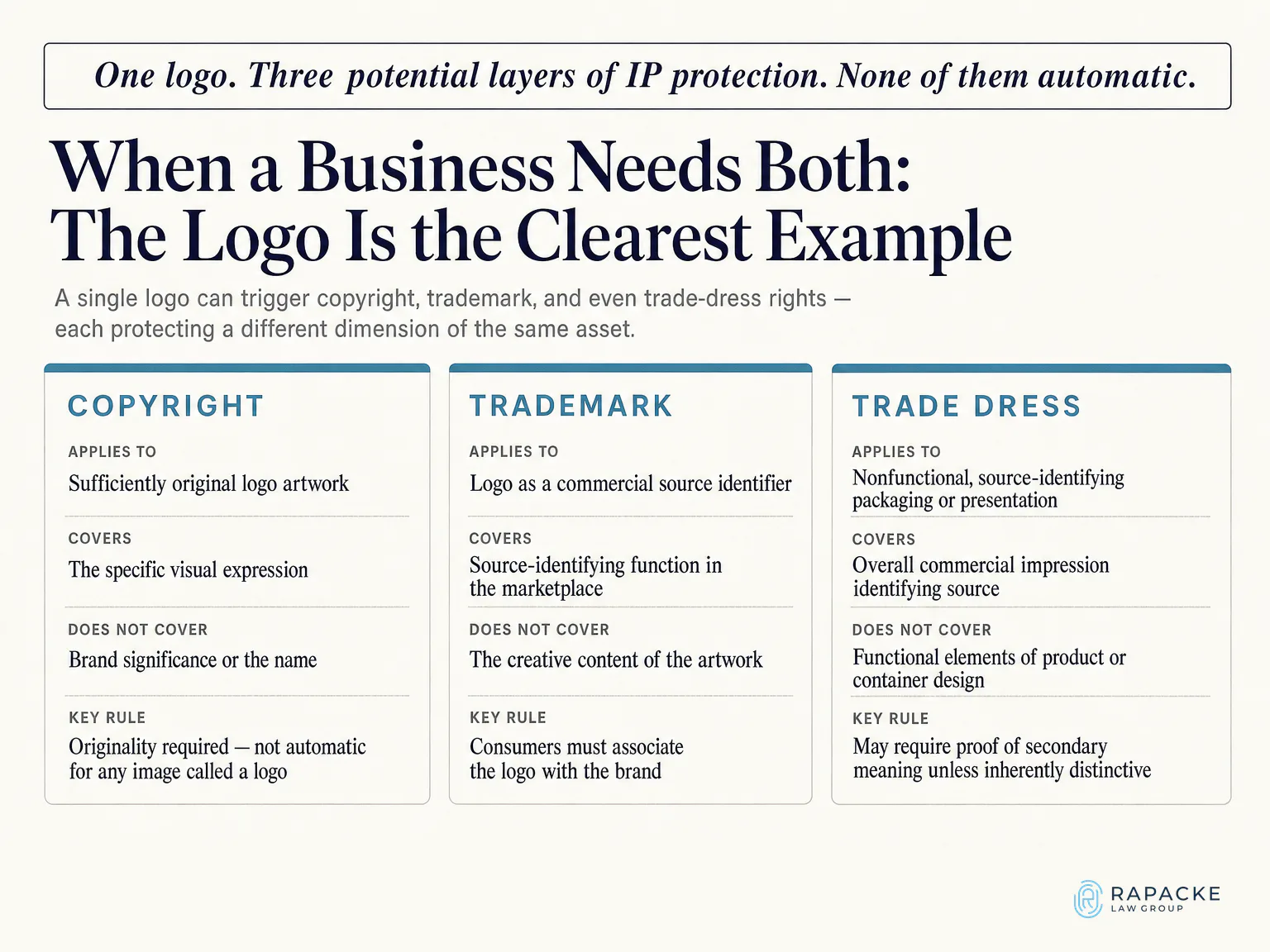
Most businesses with creative assets and a customer-facing brand need both filings. The logo is the clearest example, original artwork can qualify for copyright, while its source-identifying function is what trademark law protects.
The Gap That Leaves Brands Exposed
Register only the artwork and a competitor can adopt a confusingly similar name in your category, potentially triggering intellectual property disputes. Register only the mark and someone can lift your illustration. Neither protection is automatic.
Real-World Scenarios Where Both Apply
A SaaS company needs copyright protection for its codebase and a trademark for its product name, a consumer brand, copyright in packaging graphics and trademark in its name and trade dress, a content creator, copyright in the written work and a trademark on the channel brand.
How They Work Together
Layered intellectual property protection is standard for funded startups because acquirers and investors run IP due diligence. Do an asset audit, list creative works and brand identifiers, then match each to the correct filing.
Where Patents Fit Into This Decision
Patents protect inventions, which neither copyright nor trademark reaches. If your core asset is a novel technical process, patent protection comes first, because public disclosure can compromise it.
Patents Protect Inventions, Not Expression or Brands
Under 35 U.S.C. §101, utility patents cover a new and useful process, machine, manufacture, or composition of matter, subject to novelty and nonobviousness. Design patents cover new, original, ornamental designs. Proprietary algorithms are not automatically patentable under the u.s. patent office guidelines, and trade secrets are sometimes better for nonpublic processes. Our AI Patent Mastery and SaaS Patent Guide 2.0 resources cover drafting software and AI claims to survive examination.
When a Startup Needs All Three
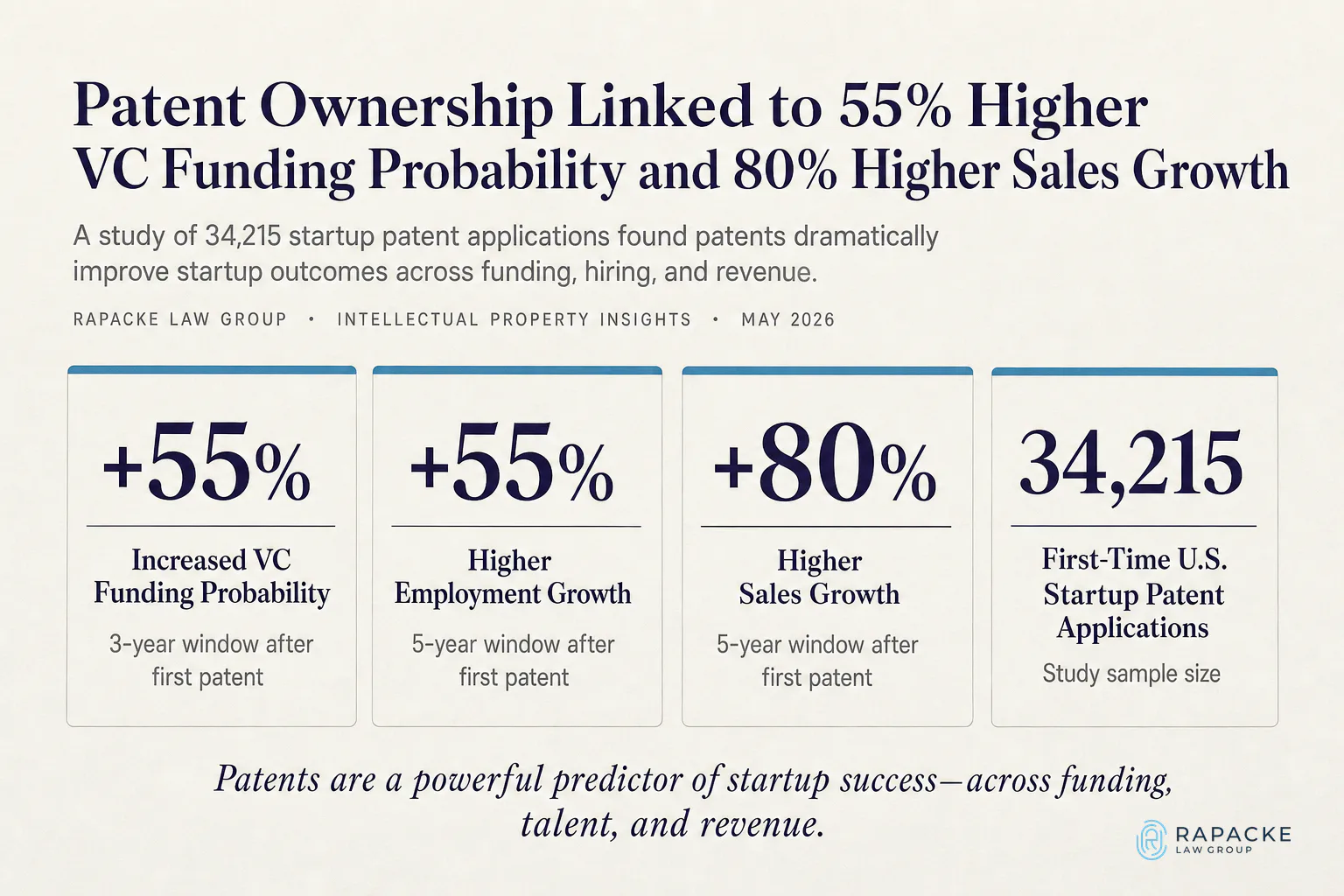
Hardware and software companies with genuinely technical inventions often carry all three forms of intellectual property protection. A study of first-time U.S. startup patent applications in the Journal of Finance, circulated as an NBER working paper, found that winning a first patent more than doubled the likelihood of raising a first or second round of venture capital, with 55% higher employment growth and 80% higher sales growth after five years.
How to Register a Trademark with the USPTO Step by Step
Federal registration runs through five stages. New applications are filed through Trademark Center, which replaced TEAS Plus and TEAS Standard under the 2025 fee rule.
- Clearance search. Search the USPTO trademark search system, then go wider. The federal database misses common-law users, state trademark registration records, and business-name filings. Searching is strongly recommended, not legally mandatory, and a registered trademark provides far greater legal protection than common-law use alone.
- File the application. Choose a standard character or stylized mark, identify the correct international classes, and file at $350 per class. Describing goods or services with free-form text instead of selecting from the USPTO Trademark ID Manual adds $200 per class, and missing required application information, such as applicant name, address, citizenship, a mark description, or a verified statement, adds $100 per class.
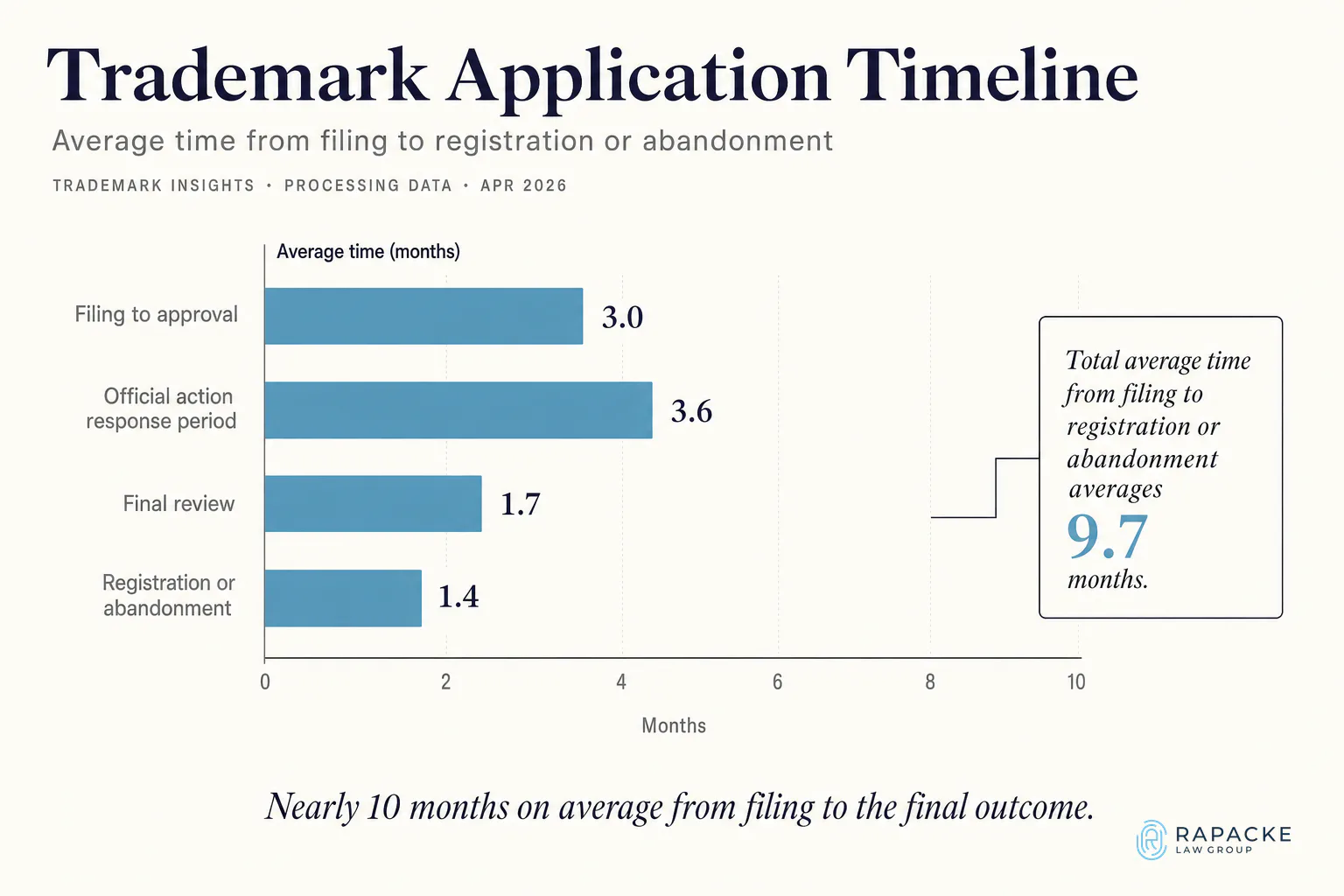
- Examination. A USPTO examining attorney, acting as the trademark office reviewer, reviews for conflicts and legal defects. As of August 10, 2026, the USPTO reported a 4.2-month average to first action against a 5-month target, after roughly 116 days in pre-examination processing.
- Office action response. Miss the response deadline and the application goes abandoned. Descriptiveness refusals may raise supplemental registration as a fallback.
- Publication and registration. Third parties get 30 days from publication to oppose. Intent-to-use applicants then have six months to file a statement of use or an extension.
Average time from filing to registration or abandonment was 9.7 months as of the same August 2026 report. Rapacke Law Group handles trademark filings on a flat-fee basis backed by the RLG Guarantee: get your trademark approved or pay nothing, with a 100% refund if it is rejected.
How to Register with the U.S. Copyright Office
Copyright registration costs $45 for an eligible Single Application, $65 for the standard online application, and $125 for paper filings. Special handling for qualifying urgent matters adds $800 per claim on top of the filing fee.
What the Timeline Actually Looks Like
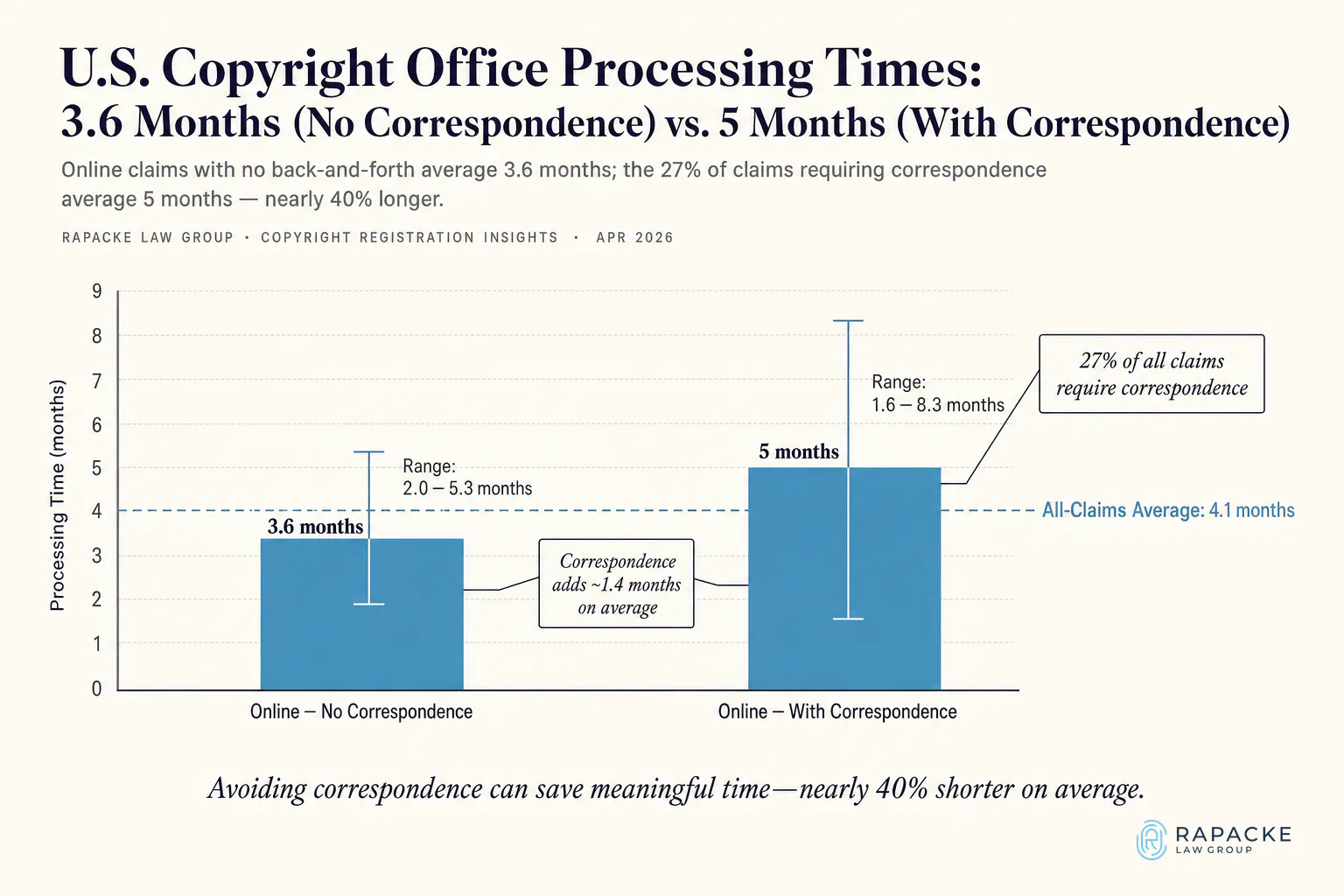
For claims closed between October 2025 and March 2026, the U.S. Copyright Office reported an average of 4.1 months. Online claims with uploaded deposits and no correspondence averaged 3.6 months (2 to 5.3 months), online claims requiring correspondence averaged 5 months. The Office corresponded with applicants in 27% of claims. Your effective registration date is when an acceptable application, fee, and deposit were all received, not the certificate date.
What to Register and in What Order
Prioritize what is most likely to be copied, software code, customer-facing product copy, core marketing assets, and creative content that ships. The group option covers up to 10 qualifying unpublished works under one application, cheaper than filing each separately. Register new high-value output quarterly instead of attempting one mass filing.
The Costs of Getting This Decision Wrong
Costly mistakes come from mismatched filings or lost priority.
Choosing Copyright When You Needed a Trademark
Copyright claims do not address brand confusion. Section 43(a) of the Lanham Act still reaches misleading source designations, and in Two Pesos, Inc. v. Taco Cabana, Inc., 505 U.S. 763 (1992), the Supreme Court held inherently distinctive unregistered trade dress protectable without proof of secondary meaning. Enforcement without registration is narrower, more geographically limited, and evidence-intensive, making trademark infringement claims harder to win.
Delaying and Losing Ground
A federal application can create nationwide constructive priority under 15 U.S.C. §1057(c), but only if the mark registers, earlier users may keep superior intellectual property rights in their territories. Clear your mark and file intent-to-use before launch, register copyrights within three months of publication, and evaluate patents covering new inventions before public disclosure.
Frequently Asked Questions
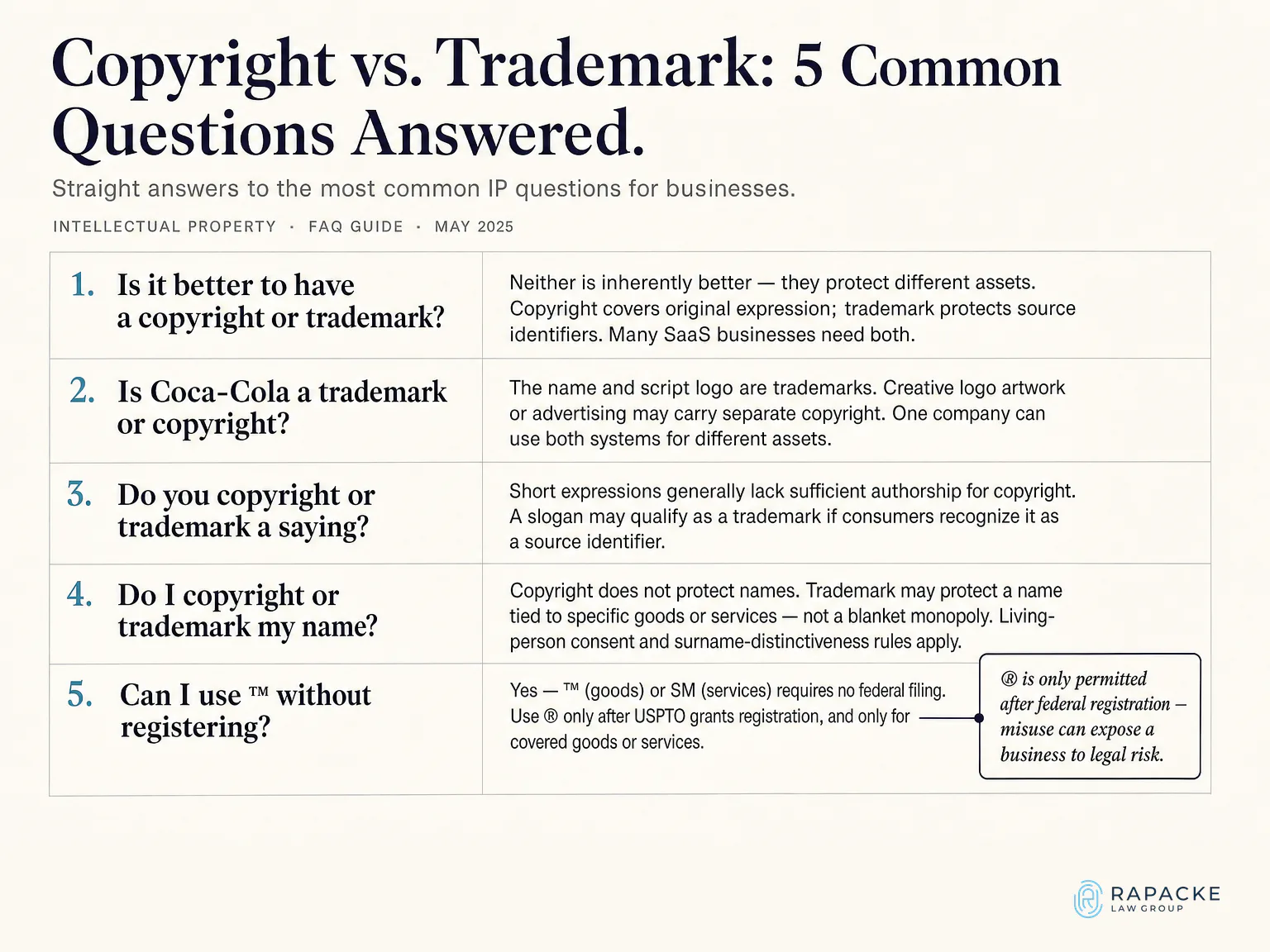
Is it better to have a copyright or trademark?
Neither is better, they protect different assets. Copyright covers original expression, code, writing, graphics, video, trademarks protect names and logos identifying commercial source. Start with whichever is your current exposure.
Is Coca-Cola a trademark or copyright?
The name and script logo are trademarks identifying the producer, the formula is a trade secret. Advertising and creative logo artwork carry separate copyright, layered IP rights.
Do you copyright or trademark a saying?
Usually not copyrightable, Circular 33 explains that short expressions generally lack enough authorship. A phrase can qualify for trademark registration if consumers see it as a source identifier for specific goods or services.
Do I copyright or trademark my name?
Copyright does not protect names, so the answer is trademark when the name identifies the source of goods or services. Rights attach only to the categories you list, and 15 U.S.C. §1052 consent and surname rules may apply.
Can I use the ™ symbol without registering?
Yes. Use the trademark symbols ™ for goods or SM for services without any application, and the copyright symbol likewise for unregistered works. Use the registered trademark symbol ® only after the United States Patent and Trademark Office issues registration.
Your Next Steps to Copyright and Trademark Success
The founder who files the wrong protection first rarely discovers it quietly. It surfaces during a funding round or a demand letter, requiring legal action from someone who filed the name you have marketed for years. Copyright and trademark are not competing options, sequencing depends on which asset carries the most risk.
The bottom line: A weak copyright or trademark strategy produces unregistered brand assets and copyrights registered too late for statutory damages. A strong one gives you a clearance record, a federal registration, and registrations dated before anyone had reason to copy.
Every month you delay, another applicant may file a confusingly similar mark, and every published work left unregistered past the three-month window loses statutory remedies, showing up later as rebrands and enforcement you cannot afford.
- Schedule a Free IP Strategy Call to map which filings your assets require, in what order
- Run clearance on your name and logo before your next branding invoice
- Register your highest-exposure creative works this quarter
- Calendar your Section 8 and Section 9 deadlines the day your mark registers
Our trademark work is flat-fee and backed by the RLG Guarantee: get your trademark approved or pay nothing, with a 100% refund if it is rejected.
To Your Success,
Andrew Rapacke Managing Partner, Registered Patent Attorney
Andrew Rapacke Managing Partner, Registered Patent Attorney Rapacke Law Group