


Key Takeaways
- The 20-year utility patent term runs from the earliest non-provisional filing date, not grant, so examination consumes term.
- Design patents run 15 years from grant (filed on or after May 13, 2015) or 14 years (filed earlier).
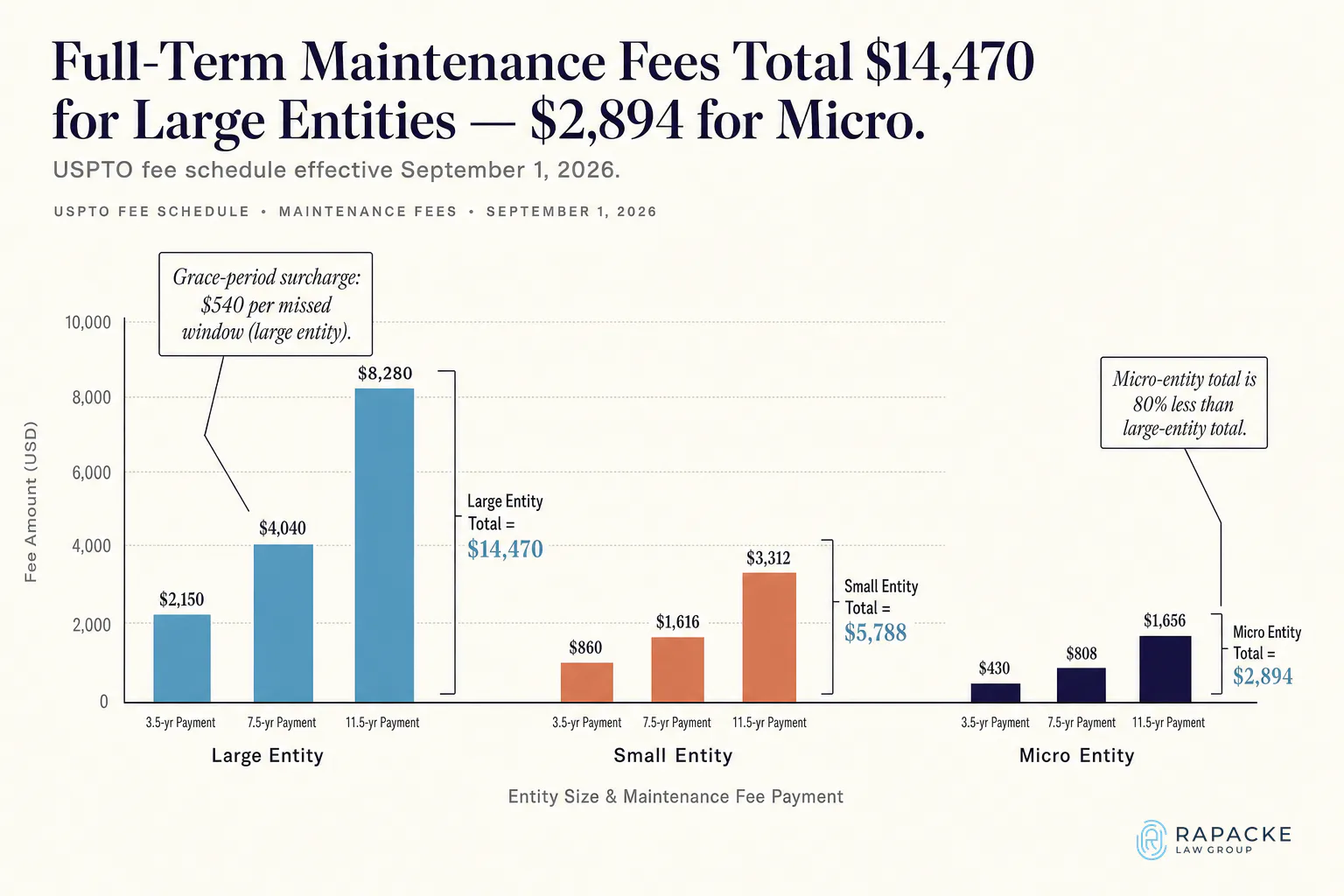
- Missing any one maintenance fee window expires a patent early; full-term fees total $14,470 (large entities), $2,894 (micro).
- Patent term adjustment (USPTO delay) and extension (regulatory review) are the main routes past 20 years for patents filed on or after June 8, 1995; both have strict deadlines.
- Review your portfolio two to three years before patent expiration, while continuation options and licensing leverage remain.
*Written by Andrew Rapacke, Managing Partner, Registered Patent Attorney.* Andrew Rapacke is a registered patent attorney and the Managing Partner of The Rapacke Law Group, a full-service intellectual property law firm. He helps individuals and corporations across industries with the protection, prosecution, licensing, and enforcement of their intellectual property, with deep experience in patent, trademark, and copyright matters spanning software, AI and machine learning, blockchain, medical devices, and autonomous vehicle technology. A graduate of the United States Naval Academy, Andrew served as a Naval Engineering Officer before pursuing law and remains active in the startup and inventor communities throughout Florida.
By Andrew Rapacke, Managing Partner and Registered Patent Attorney, Rapacke Law Group
Utility patents require maintenance fees at 3.5, 7.5, and 11.5 years after grant, under 37 C.F.R. § 1.362, if the window and six-month grace period close unpaid, the patent expires on the grant anniversary in year four, eight, or twelve. Patent expiration ends your right to exclude competitors, rarely on the date founders assume.
It covers utility and design patent terms, what adds or subtracts time, and how to calculate yours.
What Patent Expiration Actually Means for Your Rights
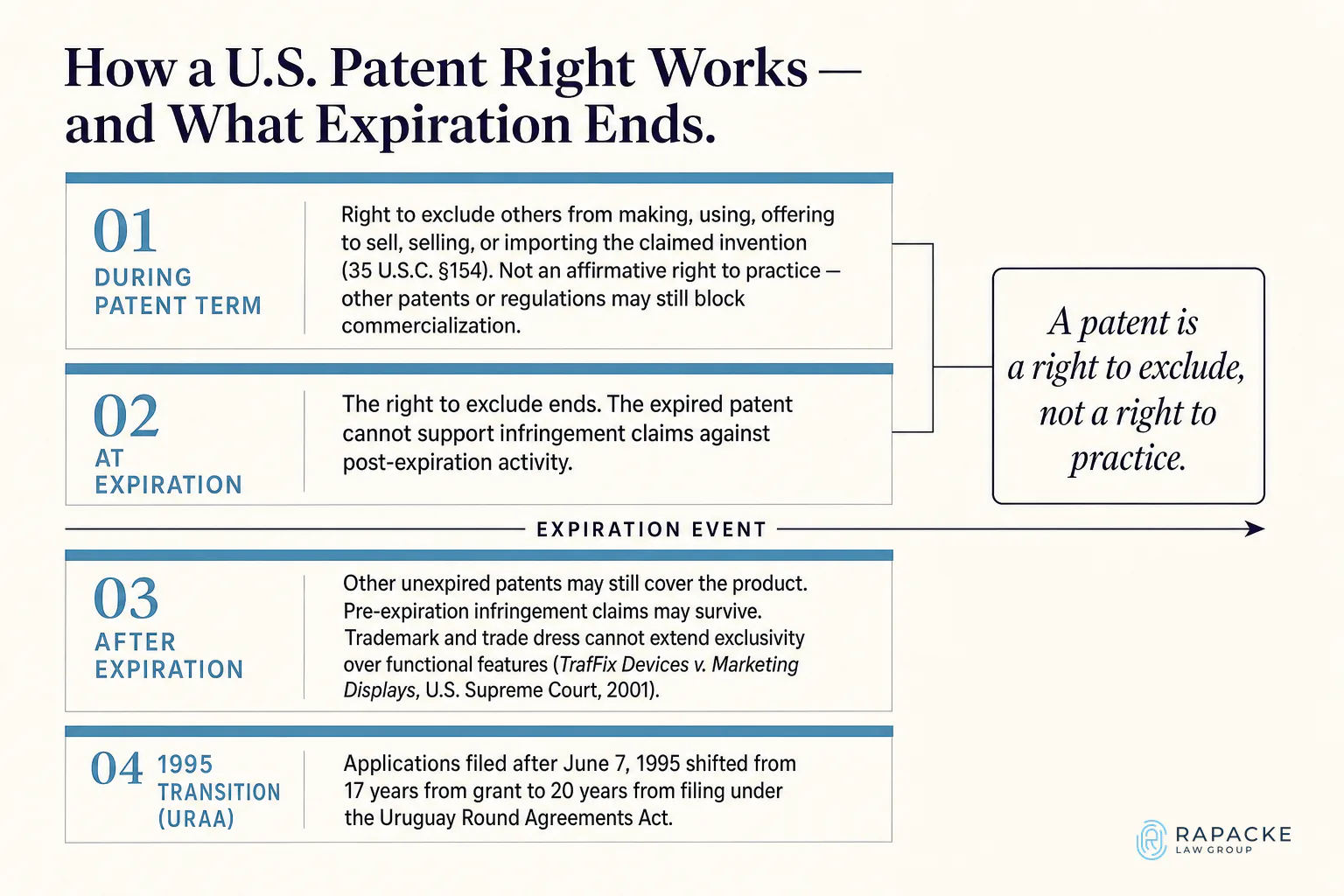
Patent expiration is the date your patent stops supporting infringement claims against new activity. From then on, competitors can make, use, sell, or import what the expired claims covered.
The Definition in Plain Business Terms
Under 35 U.S.C. § 154, a patent grants only the right to exclude others, USPTO guidance stresses it does not grant the right to make, use, or sell the patented invention. You lose that exclusion right going forward, though pre-expiration infringement claims survive subject to the applicable limitations period. The rights of a patent are only half the picture.
Why Patents Are Designed to Expire
The system is a time-limited bargain, disclosure in exchange for a defined exclusivity period, which is how patents act as an incentive to invest in R&D. New patents must clear prior art before the patent office grants exclusive rights. The Uruguay Round Agreements Act moved applications filed on or after June 8, 1995 to 20 years from filing, pre-URAA law ran 17 years from grant, and patents in force on June 8, 1995 or issued from applications filed before that date get the greater of 20 years from filing or 17 years from grant, why older family members follow different math. The Uruguay Round Agreements Act also shifted the earliest effective filing date to the center of term calculations. Timing the clock early captures the full benefits of patent protection.
How Expiration Differs from Lapse or Invalidity
Expiration is the natural end of the statutory patent term. Lapse happens when maintenance fees go unpaid through the grace period. Invalidity is separate, a court or the Patent Trial and Appeal Board can hold claims invalid or unenforceable long before their scheduled expiration date. Each ending carries different licensing and enforcement consequences.
How Long Each Type of Patent Lasts
Utility patents last 20 years from the earliest effective non-provisional filing date. Design patents last 15 years from grant (14 years if filed before May 13, 2015).
Utility Patents and the 20-Year Standard
The clock for a U.S. utility patent starts at the term-determining filing date, per MPEP § 2701, the earliest application in the benefit chain specifically referenced under 35 U.S.C. §§ 120, 121, 365(c), or 386(c), including a PCT international application entered into the U.S. national stage, whose term runs from the international filing date. Examination eats into it, USPTO data shows first action pendency averaged about 19.9 months in FY2024 and traditional total pendency reached 26.3 months in FY2025, rising toward 29.3 months in FY2026, leaving post-grant life well under 20 years absent patent term adjustments. File software patents before launch.
Design Patents and the 15-Year Rule
U.S. design patents run their terms from grant, so examination doesn't consume them, MPEP § 1505 makes the application filing date control which rule applies. Faster examination gives rights sooner, not longer.
Provisionals and PCT Filings
Provisionals don't start the clock, § 119 priority is excluded from the term calculation, so you get 12 extra months, a provisional patent extension strategy adds limited runway. Filing a non-provisional application triggers the 20-year clock, and PCT national-phase entries run from the international filing date.
| Patent type | Term length | Clock starts | Maintenance fees |
|---|---|---|---|
| Utility | 20 years | Earliest effective non-provisional filing date | Yes, at 3.5, 7.5, 11.5 years |
| Design (filed on or after 5/13/2015) | 15 years | Grant date | No |
| Design (filed before 5/13/2015) | 14 years | Grant date | No |
Why Your Patent Term Is Not Always Exactly 20 Years
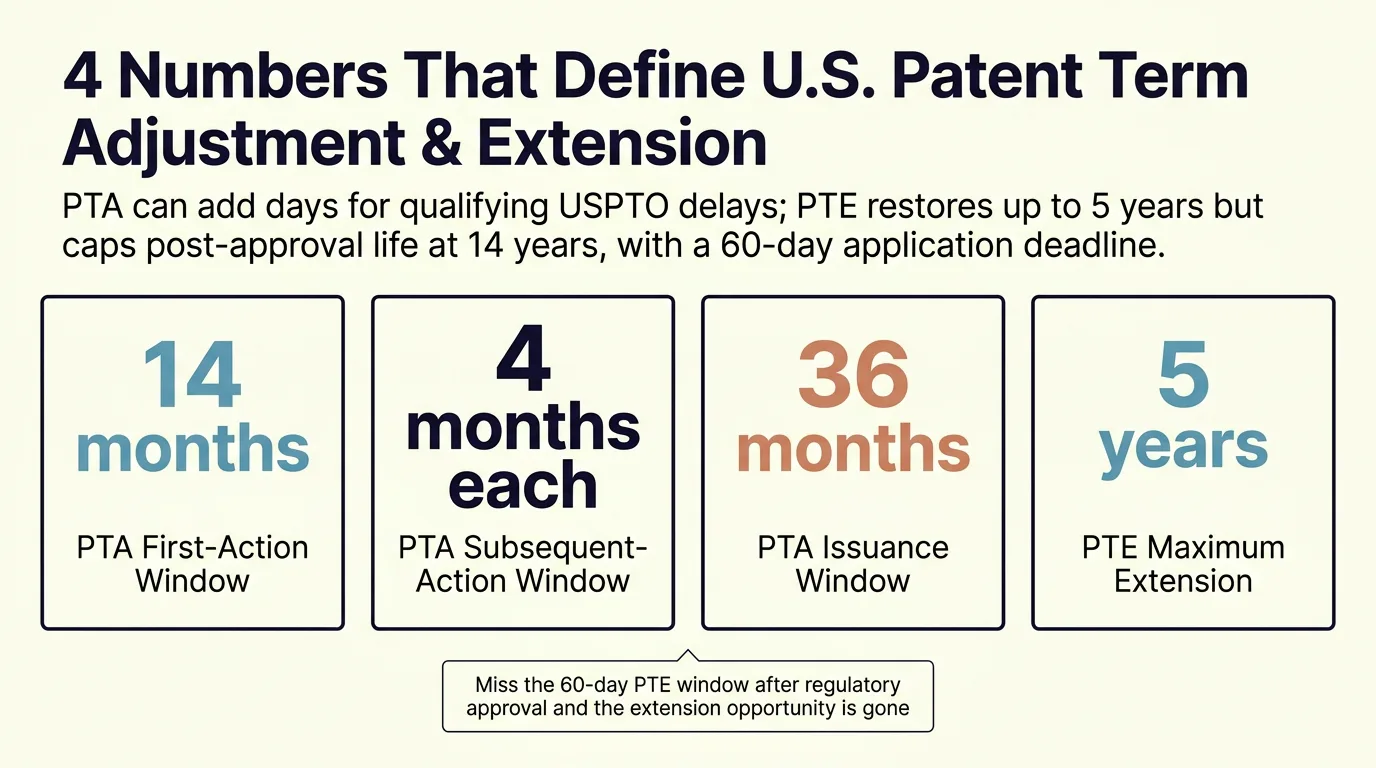
Two mechanisms move expiration dates, patent term adjustment adds days for USPTO delay, and patent term extension restores time lost to federal regulatory review. A terminal disclaimer can shorten a term.
Patent Term Adjustment Adds Time Back
Patent term adjustment follows a 14-4-4-4-36 framework under 35 U.S.C. § 154(b), first action within 14 months, replies within 4 months each, issuance within 36 months. Patent term adjustments are calculated per application and appear on the patent's face page. The first deadline is missed most. USPTO dashboard data shows only 22 percent of patent applications received a first action within 14 months in FY2025, while 97 percent of amendment responses and 99 percent of PTAB-related actions met their four-month windows. Awarded days appear on the issued patent's face, challenge a miscalculation within two months of grant, extendable by five months under MPEP § 2734.
Patent Term Extension for Regulatory Delays
Patent term extensions cover products held in premarket regulatory review, drugs, medical devices, food additives, veterinary products, through the FDA or USDA. Under 35 U.S.C. § 156, extension is capped at 5 years, and remaining term generally cannot exceed 14 years from approval. Only one patent per approved product qualifies, and the restored term covers only the approved product and its approved uses, not every claimed embodiment. Patent holders must apply within 60 days of the first qualifying approval. The patent application or product dossier must be submitted within 60 days of the first qualifying approval.
Obviousness-Type Double Patenting Can Shorten Your Term
Obviousness type double patenting is a doctrine that blocks stacking exclusivity on obvious variations of an earlier claim. The fix is often a terminal disclaimer tying the later patent's expiration to the earlier one. In Acadia Pharmaceuticals v. Aurobindo Pharma, applying Allergan USA v. MSN Laboratories, 111 F.4th 1358, the Federal Circuit confirmed a first-filed, first-issued, later-expiring claim cannot be invalidated by a later-filed, later-issued, earlier-expiring claim from the same priority family. Divisional applications may also qualify for the § 121 safe harbor.
How Maintenance Fees Determine Whether Your Patent Survives
Utility patents die from unpaid patent maintenance fees more often than from anything dramatic. Payments are due at 3 to 3.5 years, 7 to 7.5 years, and 11 to 11.5 years after issuance, with a six-month surcharge grace period after each.
The Three Deadlines and What They Cost
Under the USPTO fee schedule effective September 1, 2026, large entity fees are $2,150, $4,040, and $8,280, $14,470 total before late surcharges. Small entities pay $5,788, micro entities $2,894. Grace period surcharges run $540, $216, and $108 by entity size. Design patents require no maintenance fees.
What Happens When a Patent Expires for Nonpayment
If the grace period closes unpaid, 37 C.F.R. § 1.362(g) expires the patent at the end of that period, not retroactively at the original due date. Patent owners can petition to accept delayed payment when the delay was unintentional, fees are $2,260, $904, or $452 within one year, and $3,000, $1,200, or $600 beyond. Accepted payment treats the patent as never expired, but statutory intervening rights can protect a competitor's investment made during the gap, a key limit on whether you can re-patent an expired patent.
Tracking Deadlines Across a Portfolio
Use Patent Center for file history and the USPTO patent office Maintenance Fees Storefront for payment windows, amounts due, and payment history. Past a handful of U.S. patents, the United States patent and trademark office records are best managed through professional docketing, which is cheaper than one lapse. Rapacke Law Group handles portfolio docketing on fixed fees backed by The RLG Guarantee, so you know the cost before committing. Vet software carefully before trusting a deadline to it, as you would AI agents used by corporate IP teams.
How to Calculate Your Patent Expiration Date
The USPTO does not determine patent expiration dates, its calculator is educational only. See our guide on when a patent expires.
The Formula for Utility Patents
Start with the term-determining filing date, the earliest effective filing date for the non-provisional filing under §§ 120, 121, 365(c), or 386(c), then add 20 years plus any patent term adjustment and extension. Then apply any terminal disclaimer, capping the date at the earlier patent's expiration. Confirm maintenance fees are paid.
The Formula for Design Patents
Take the grant date of the original patent. Add 15 years if filed on or after May 13, 2015, otherwise 14. No maintenance fees apply, the date holds unless a terminal disclaimer applies.
Complications That Change the Answer
Continuations and divisional applications inherit the parent's term-determining date, so a patent granted in 2024 can expire in 2029. Foreign priority under § 119 and provisional filings are excluded. RCEs, appeals, and applicant delay reduce patent term adjustment. Patents in force on June 8, 1995 or issued from applications filed before that date get the greater of 20 years from filing or 17 years from grant. Complex families require attorney verification and legal advice before relying on any calculated date.
What Happens to Your Invention After Patent Expiration
The claimed subject matter of an expired patent is no longer enforceable under that patent. Anyone can practice it, which is how generic drug makers enter markets.
The Limits of Public Domain Entry
Expiration of one patent does not clear the field. Obviousness type double patenting restrictions aside, another patent in the same family, or a competitor's, may still cover the product or process. Freedom to operate remains a separate analysis, so clearance review still matters.
How the Patent Owner Is Affected
The former patent holder keeps no right to exclude under that patent. Trademarks, undisclosed know-how, and data can still carry weight, but there is a hard limit. In TrafFix Devices v. Marketing Displays, the Supreme Court held that an expired utility patent is strong evidence the disclosed features are functional and therefore ineligible for trade dress protection.
Strategic Options Before Expiration
Audit continuation options while a related application is pending, since a continuation requires a pending application as a family member. License while the term holds commercial value. Protect undisclosed elements, training data, deployment processes, algorithms outside the specification, as trade secrets. These moves maximize the lifespan of patent rights, especially where the most valuable AI patents are filed.
Frequently Asked Questions
Do all patents expire after 20 years?
No. Utility patents generally end 20 years from the term-determining filing date, but patent term adjustment, patent term extension, terminal disclaimers, and unpaid maintenance fees all change the real date. Design patents run 15 years from grant for applications filed on or after May 13, 2015, or 14 years for earlier applications.
Can a U.S. patent be renewed after 20 years?
Generally no. Maintenance fees keep a patent alive inside its existing term, they do not renew it. For patents filed on or after June 8, 1995, the extra statutory time comes from patent term adjustment for qualifying USPTO delay and patent term extension for regulatory review under 35 U.S.C. § 156.
What patents are expiring in 2026?
No official list exists. Patents with a 2006 term-determining filing date generally reach nominal patent expiry in 2026, though earlier filings can expire in 2026 after picking up patent term adjustment days, and later ones sooner under a terminal disclaimer. Check the face page and confirm maintenance fee status.
How much is a 20-year patent?
Maintenance fees alone total $14,470 (large entity), $5,788 (small entity), and $2,894 (micro entity) under the current fee schedule. Filing, search, examination, and issue fees add several thousand more per tier, before attorney fees.
What is the earliest effective filing date and why does it matter?
It is the earliest application in the benefit chain specifically referenced under §§ 120, 121, 365(c), or 386(c), including a PCT international application, whose term runs from the international filing date, and it starts the 20-year clock. This is the earliest effective filing date. A provisional application or foreign priority claim under § 119 does not count.
Your Next Steps to Patent Expiration Success
An unplanned patent expiration hands years of engineering work to whoever moves fastest. Confirm the real expiration date from the term-determining filing date, adjustment days, and any terminal disclaimer, calendar all three maintenance fee windows the week the patent issues, and schedule an IP strategy review two to three years out. Competitors read expiration dates too.
Here is where to start:
- Schedule a Free IP Strategy Call to review your portfolio's expiration timeline while you still have leverage.
- Pull each face page and patent number to verify adjustment days and disclaimers, then confirm maintenance fee status and set reminders at 3, 7, and 11 years from issue.
- Read the AI Patent Mastery guide or the SaaS Patent Guide 2.0 if your next filing covers software or machine learning.
The bottom line: the weak approach is ignoring expiration dates until a patent lapses, handing years of engineering work to competitors. The strong approach is proactively reviewing your portfolio early to retain licensing leverage, continuation options, and competitive advantage. We work on fixed fees, and The RLG Guarantee backs it, on patentability searches, you get a 100 percent refund if the search shows your invention is not novel.
To Your Success, Andrew Rapacke Managing Partner, Registered Patent Attorney
Andrew Rapacke Managing Partner, Registered Patent Attorney Rapacke Law Group