
Key Takeaways
- A concept isn't patentable; the technical process solving a technical problem may be, subject to eligibility, prior art, obviousness, and disclosure.
- Software eligibility runs through Alice/Mayo: USPTO Step 1, Step 2A Prong One, Prong Two, and Step 2B.
- Utility patents last 20 years from the earliest U.S. non-provisional filing date; design patents 15 years from grant, ornamental only.
- Provisional applications cost $325, $130, or $65 in USPTO fees by entity size, securing priority only for what they describe.
- Copyright protects code, not functionality; trade secrets suit server-side methods.
Written by Andrew Rapacke, Managing Partner, Registered Patent Attorney. Andrew Rapacke is a registered patent attorney and the Managing Partner of The Rapacke Law Group, a full-service intellectual property law firm. He helps individuals and corporations across industries with the protection, prosecution, licensing, and enforcement of their intellectual property, with deep experience in patent, trademark, and copyright matters spanning software, AI and machine learning, blockchain, medical devices, and autonomous vehicle technology. A graduate of the United States Naval Academy, Andrew served as a Naval Engineering Officer before pursuing law and remains active in the startup and inventor communities throughout Florida.
This article is general information only and does not constitute legal advice. Reading it does not create an attorney-client relationship. Patent eligibility depends on the specific facts of each invention.
No, you cannot patent a bare idea. Patents protect inventions, the specific method, process, or system that produces a result. So the useful answer to "can you patent an idea for an app" is that your technical implementation may be patentable if it clears subject matter eligibility under 35 U.S.C. §101, is novel, is non-obvious, and is described in enough detail to support real claims. Below, what the United States Patent and Trademark Office (USPTO) examines, what makes app functionality eligible, whether a utility or design patent fits, and how early filing affects your priority date.
Why You Cannot Patent a Bare App Idea but Often Can Patent What the App Does
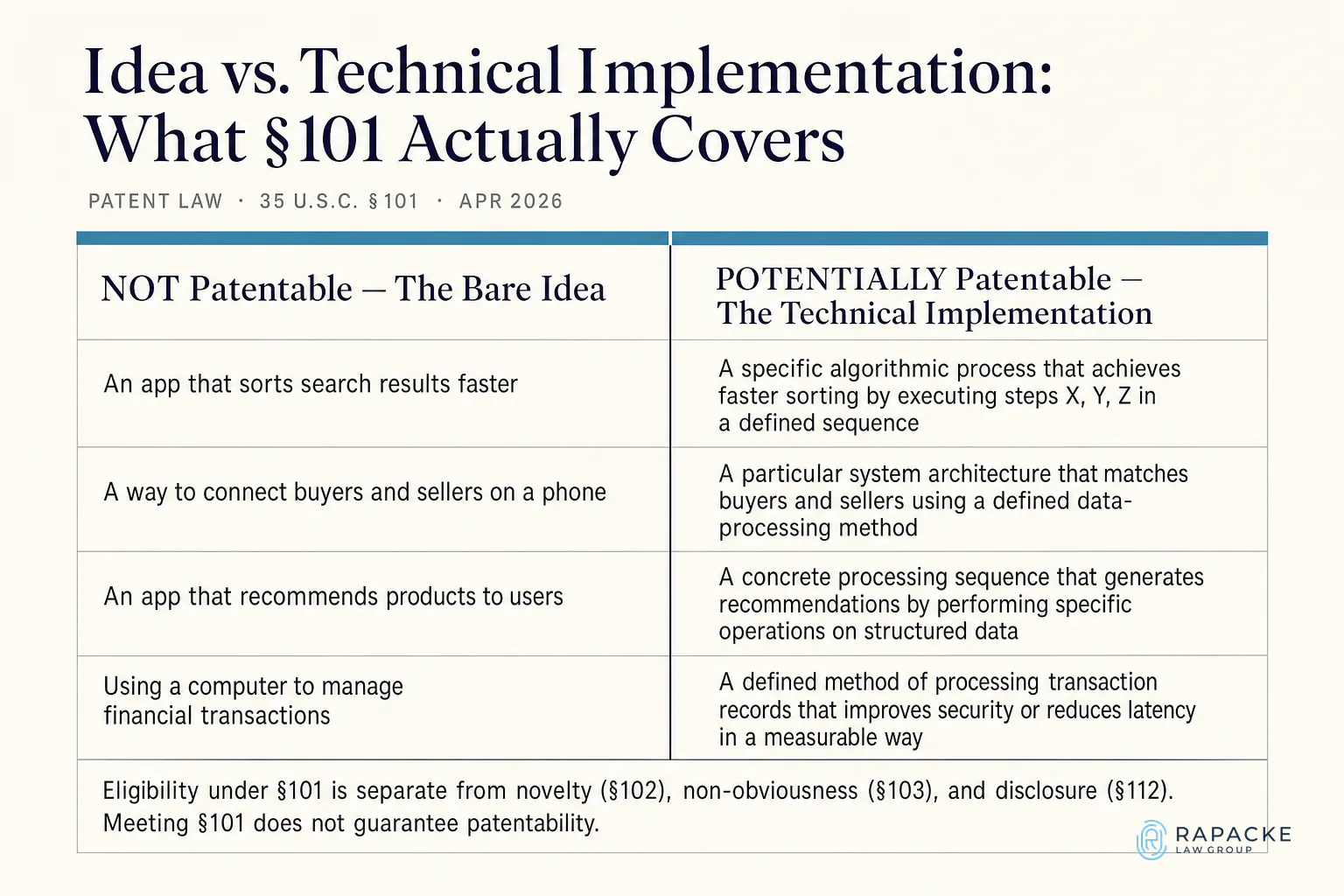
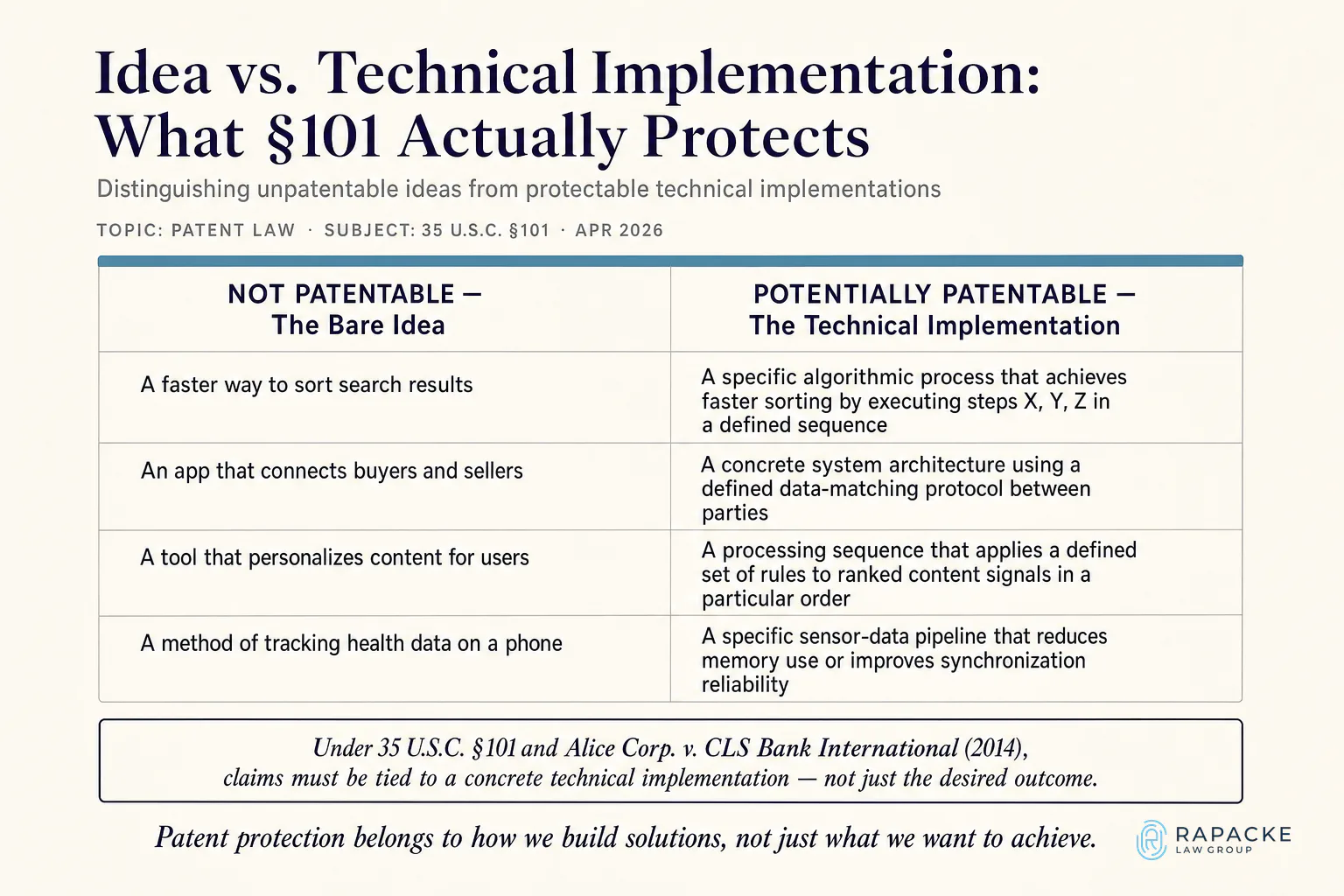
Patent law protects claimed inventions, not concepts. Under 35 U.S.C. §101, patents cover a process, machine, manufacture, or composition of matter. "An app that matches users faster" is a goal, a defined sequence of processing steps producing that result through a specific technical mechanism is claimable. See also: mobile apps are patentable.
What 35 U.S.C. §101 Actually Says About Software
Section 101 is the threshold gate for patentable subject matter before novelty (§102), non-obviousness (§103), and disclosure (§112). Software is not categorically excluded. Ask whether your app's functionality is a concrete technical process, not a desired outcome, our software patents checklist covers common disclosure gaps.
Why an Abstract Idea Alone Fails the Patent Office's Test
Courts exclude abstract ideas, laws of nature, and natural phenomena, Alice Corp. v. CLS Bank International, 573 U.S. 208 (2014), governs software. Per USPTO MPEP §2106, reciting a generic computer, smartphone, or conventional network does not rescue an abstract process. "Abstract" is a legal term of art.
How the Alice/Mayo Framework Determines Whether Your App's Functionality Is Eligible
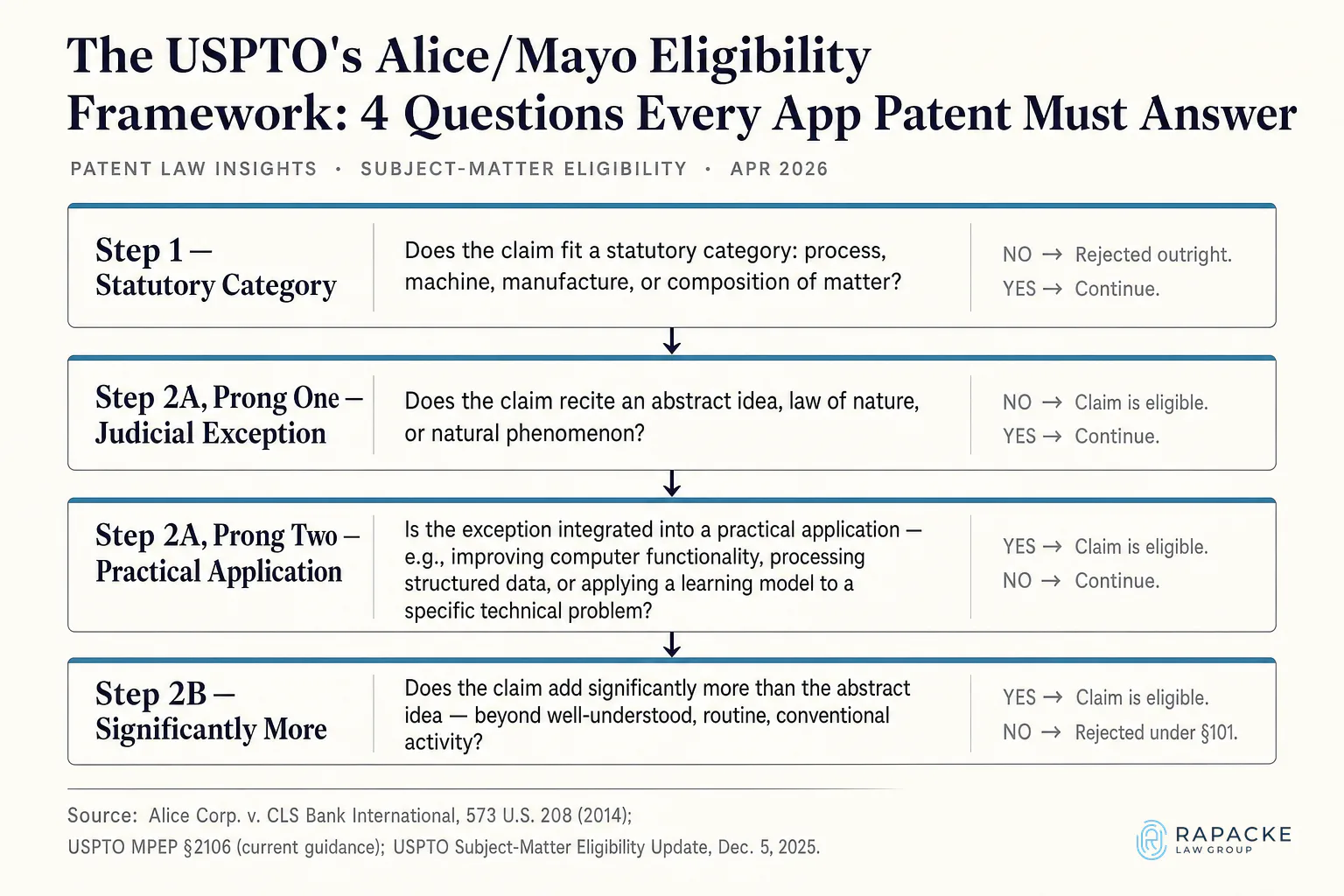
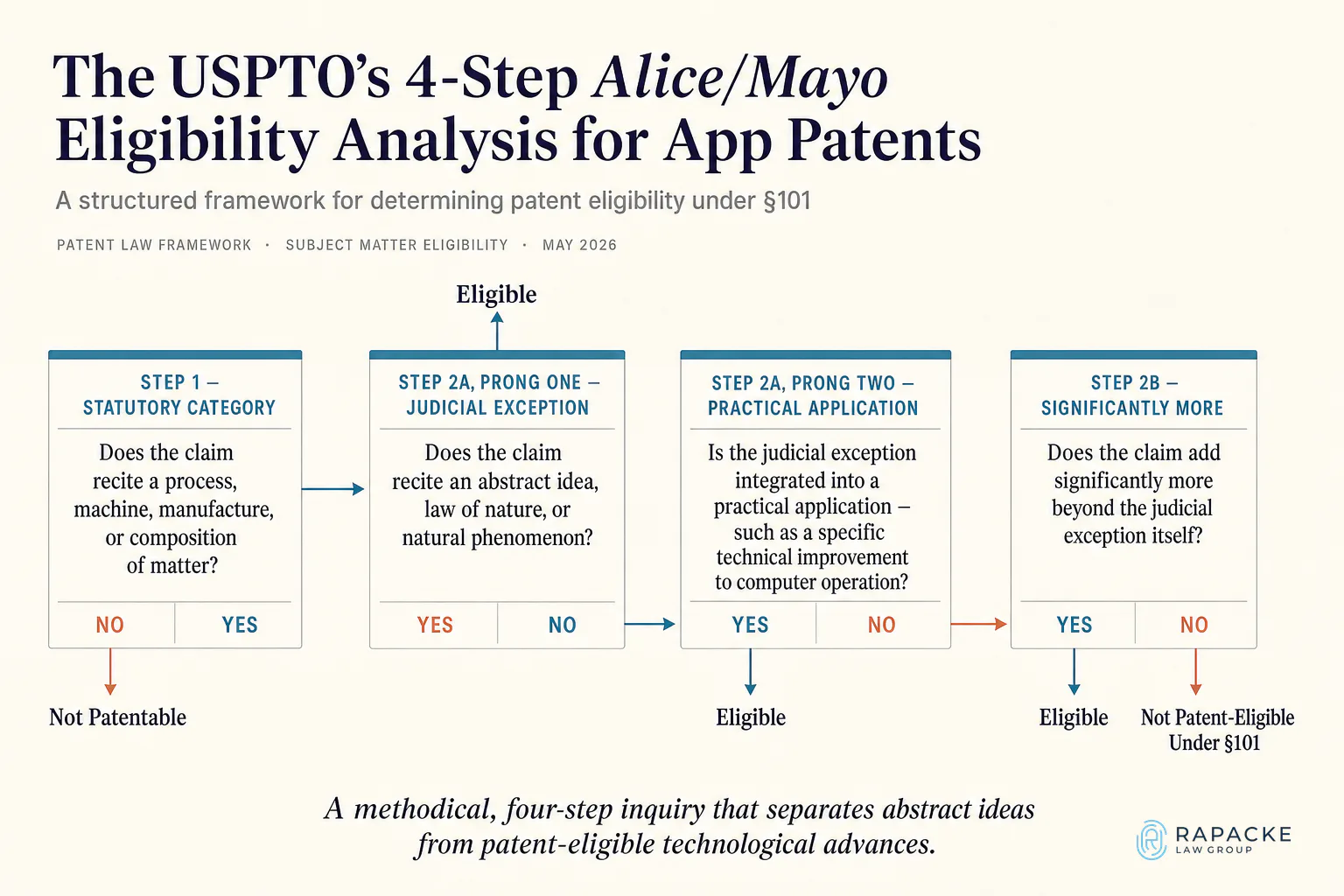
The USPTO runs a four-question analysis, Step 1, statutory category, Step 2A Prong One, does the claim recite a judicial exception such as an abstract idea, Prong Two, is that exception integrated into a practical application, Step 2B, does the claim add significantly more?
What "Significantly More" Means for App Patent Claims
The strongest route through Prong Two is a specific technological improvement the specification explains and the claims capture, cutting latency, reducing database calls, lowering memory use, or measurably hardening security. A strong patent examiner response will show how each claim limitation contributes to that improvement. Known business activity performed on a phone does not qualify. After a §101 rejection, the USPTO's best practices for Rule 132 Subject Matter Eligibility Declarations allow objective evidence of that improvement, software patent examples show how allowed claims are worded.
How the USPTO Has Applied Alice to Software Since 2014
In McRO, Inc. v. Bandai Namco Games America, the Federal Circuit treated the software claims as eligible subject matter because they recited particular rules for automated lip synchronization rather than the desired result. A December 5, 2025 update to subject matter eligibility guidance, based on the precedential Ex Parte Desjardins, directs examiners to weigh improvements in computer functionality, structured data processing, data structures, and learning models. The Desjardins memorandum treats an improved machine learning training technique as non-abstract, relevant to AI features, covered in Are Machine Learning Algorithms Patentable? Claim scope and specification detail can be decisive, but drafting cannot make an abstract concept patentable.
Utility Patents vs Design Patents for Apps and Which One You Need
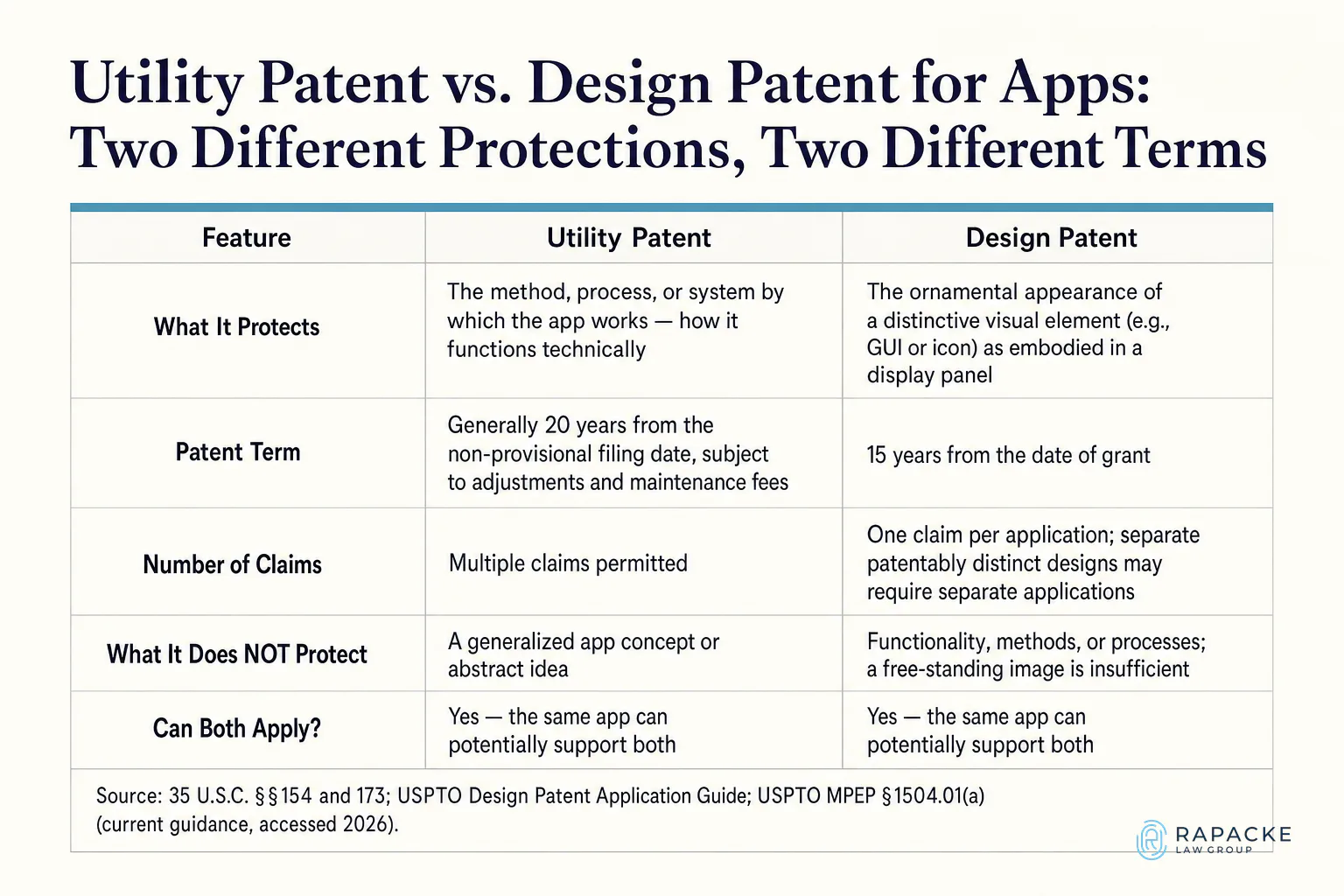
Utility patents cover how an app works, design patents cover ornamental appearance. A utility patent runs 20 years from the U.S. non-provisional filing date under 35 U.S.C. §154, measured from the earliest referenced non-provisional application, a design patent lasts 15 years from grant under §173.
When a Utility Patent Is the Right Choice for App Functionality
A utility patent protects the functional invention of a computer program or mobile application, how your system processes, routes, or synchronizes data, and requires claims, a specification, and typically drawings. See our guide on how to patent software.
When a Design Patent Protects a Distinctive App Interface
A design patent covers a GUI or icon claimed as an ornamental design for an article of manufacture under 35 U.S.C. §171. Once a granted patent issues, the design patent number appears on the product or its packaging. The USPTO's supplemental guidance for computer-generated interfaces and icons, published March 13, 2026, treats an icon "for a computer, computer display, or computer system" as eligible when the title and claim properly identify an article of manufacture, and removes the older requirement that the drawing depict that article in solid or broken lines. Each design patent application has one claim, distinct designs need separate filings.
Why Filing a Provisional Patent Application Early Protects Your Priority Date
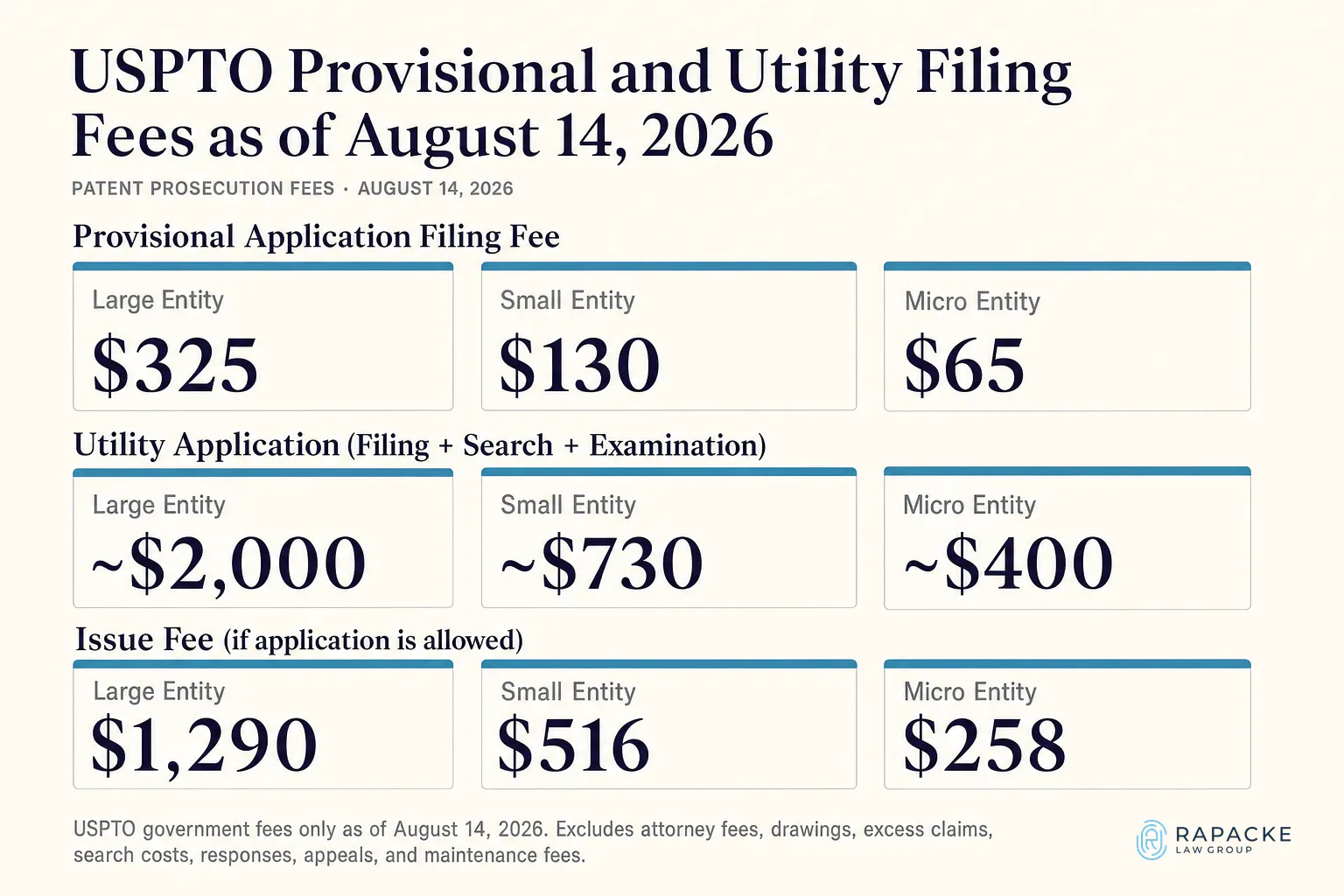
A provisional patent application establishes an earlier effective filing date and is never examined, so it never becomes a patent on its own. It stays pending 12 months, during which a corresponding non-provisional must be filed to preserve the benefit. USPTO provisional filing fees under the August 14, 2026 fee schedule are $325 for large entities, $130 for small entities, and $65 for micro entities, excluding drafting, drawings, searches, and attorney services. One structural point founders miss, filing a separate non-provisional patent application that claims benefit, rather than converting under 37 C.F.R. §1.53(c)(3), can push the 20-year term endpoint out by up to twelve months, because a converted application takes its term from the original provisional filing date. See Should You Patent Your SaaS MVP?
What the One-Year Grace Period Means and What Can Trigger It
Under 35 U.S.C. §102(b)(1), an inventor-originated public disclosure made one year or less before filing generally is not prior art against that inventor in the United States. A founder who demos publicly has twelve months to file a provisional and preserve U.S. rights, while patent offices in absolute-novelty countries may already be closed. Nonconfidential launches, publications, sales activity, or presentations may trigger §102 consequences. If you are patenting software or any other mobile application feature, identify the earliest date your app was publicly described and exactly what was disclosed.
How a Provisional Buys Time Without Locking In Final Claims
Formal claims are not required, but the §112(a) written description and any drawings needed to understand the invention still are. Thin filings also weaken the technical contribution of the disclosure. Later claims receive the provisional's date only for subject matter the provisional actually supports, thin filings that skip technical implementation are the most common reason founders discover their priority date does not cover what they built. Under MPEP §211 and 37 C.F.R. §1.78(b), benefit can sometimes be restored for a non-provisional filed within fourteen months if the delay was unintentional and a grantable petition is filed. Treat that as a narrow safety net, not a plan.
What Alternatives Protect App Concepts That Are Not Yet Patentable
Patents are not the only option, software patents examples that show what qualifies show where your features fit.
| Protection | What it covers | Key limit |
|---|---|---|
| Patent | Functional method, process, system | Requires eligibility, novelty, non-obviousness, disclosure |
| Copyright | Original source code as expression | Not functionality or program logic |
| Trade secret | Confidential algorithms and methods | Lost via independent development or reverse engineering |
When Trade Secret Protection Makes More Sense Than a Patent
Copyright attaches automatically to original fixed code (U.S. Copyright Office), protecting expression rather than functionality; register within three months of publication to preserve statutory damages and attorney's fees (Circular 1). Trade secrets last while information stays secret and is guarded by access controls and confidentiality agreements. The USPTO Trade Secret IP Toolkit notes independent development and reverse engineering are proper acquisition, so secrecy suits server-side methods.
How to Find Out Whether Your App's Functionality Is Actually Patentable
Document the technical problem, how your technical solution improves on existing technology, the processing sequence, why conventional techniques fail, and the measurable effect, such as lower latency. That record feeds the USPTO's December 2025 technological-improvement analysis.
Document the Technical Problem and Solution Before Anything Else
Founders describe apps by user experience, patent law needs the layer beneath. Write a one-page technical description of your core process and how it delivers patent protection before meeting counsel.
What a Prior Art Search Reveals Before You File
A scoped search shows whether your method already appears in issued patents and published applications, but guarantees nothing, Section 102 prior art also covers printed publications, public use, and on-sale activity. Start with our trademark and patent office search tools walkthrough.
Frequently Asked Questions: Can You Patent an Idea for an App
How much does it cost to patent an app idea?
As of August 14, 2026, USPTO provisional filing fees are $325, $130, or $65 (large, small, micro entities). Standard electronic utility filing, search, and examination fees total roughly $2,000, $800, and $400. These figures do not include legal fees for drafting and prosecution.
How much is an app idea worth?
There is no standard price. WIPO recognizes income, market, and cost approaches, but valuation requires an identifiable, transferable asset with measurable economic benefits, which an unbuilt concept rarely is.
Can I sell my idea for an app?
Yes, if a buyer agrees. Under 35 U.S.C. §261, U.S. patents and applications transfer by written assignment, specify whether source code, designs, know-how, or trademarks also transfer.
What ideas cannot be patented?
Bare ideas, abstract ideas, laws of nature, and natural phenomena. Apps also fail when not novel, obvious, or not enabling, see whether you can patent a hot, new mobile app.
Do I need a working prototype to file a patent application?
No. §112(a) requires enablement and written description, not a shipped product, a wireframe or feature list alone omits the technical implementation.
How long does the patent application process take for an app?
The patent application process timing varies by technology center, patent examiner, amendments, and appeals. The USPTO pendency dashboard publishes current figures.
Can someone else patent my app idea if I had it first but did not file?
Priority favors the first inventor to file, subject to prior art and derivation rules under 35 U.S.C. §§102 and 135.
Your Next Steps to App Patent Success
A bare app idea is not patentable, the technical method behind a well-developed app may be. Which one you have depends on your system, the prior art, and what you have already disclosed publicly.
The bottom line: weak applications describe what the app does for users and lean on generic hardware, the profile examiners reject under Step 2A Prong Two. Strong ones claim the technical problem, the processing sequence solving it, and the measurable improvement.
Timing is what founders lose, a demo day, press mention, or open beta starts the one-year U.S. clock and kills most foreign rights the same day. Investors ask what is filed, not what is planned.
- Schedule a Free IP Strategy Call for an honest read on whether your functionality is worth filing on.
- Write a one-page technical description of your core process and its measurable improvement.
- Order a patent search, then file a provisional before your next public demo.
- Work through the SaaS Patent Guide 2.0 and, if AI is central, AI Patent Mastery.
My team evaluates §101 eligibility, runs patent search and prior art searches, and drafts claims, on flat fees quoted upfront. The RLG Guarantee: if the USPTO denies your provisional patent application, you receive a full refund. If you need patent information about next steps in the patent application process after an initial filing, we guide you through each stage. If a patentability search finds your invention is not novel, you receive a 100% refund. No attorney can promise patentability; we say early if filing is wrong.
To Your Success,
Andrew Rapacke
Managing Partner, Registered Patent Attorney
LinkedIn | X: @rapackelaw | Instagram: @rapackelaw
Attorney Advertisement. Prior results do not guarantee a similar outcome. This article is general information only and does not create an attorney-client relationship.
Andrew Rapacke
Managing Partner, Registered Patent Attorney
Rapacke Law Group