

Key Takeaways
- The US uses first-inventor-to-file: the earliest effective filing date wins, so file before disclosing.
- Software isn't automatically abstract; the USPTO treats claims improving computer functionality, like *Enfish*'s self-referential database, as eligible.
- Baseline USPTO fees (provisional, nonprovisional, issue) run roughly $723 micro, $1,446 small, or $3,615 large entity; check the live schedule, as fees change.
- Copyright attaches automatically but won't stop a competitor writing different code for the same function.
- A thin provisional can forfeit your priority date, as in *New Railhead Manufacturing v. Vermeer*.
*Written by Andrew Rapacke, Managing Partner, Registered Patent Attorney.* Andrew Rapacke is a registered patent attorney and the Managing Partner of The Rapacke Law Group, a full-service intellectual property law firm. He helps individuals and corporations across industries with the protection, prosecution, licensing, and enforcement of their intellectual property, with deep experience in patent, trademark, and copyright matters spanning software, AI and machine learning, blockchain, medical devices, and autonomous vehicle technology. A graduate of the United States Naval Academy, Andrew served as a Naval Engineering Officer before pursuing law and remains active in the startup and inventor communities throughout Florida.
By Andrew Rapacke, Managing Partner and Registered Patent Attorney
A SaaS founder ships a novel scheduling engine after months of software development, waits six months, then learns a competitor filed on the same architecture in month two. Under the Leahy-Smith America Invents Act, whose first-inventor-to-file provisions took effect March 16, 2013 according to the USPTO, the earlier effective filing date generally controls. The patent system is built around priority, not conception. A computer software patent is a race, not a reward for thinking of it first. This guide covers patentable subject matter after Alice, including how to get a patent in software for implemented inventions, the filing sequence in the order you will experience it, current government fees, and the errors that get software patents rejected.
Not All Software Qualifies and Here Is What the Law Actually Requires
Software qualifies for a computer software patent when the claims recite a specific technical improvement, not an abstract result on a generic computer. That standard comes from the U.S. Supreme Court's decision in Alice Corp. v. CLS Bank International (2014): step one asks whether the claim is directed to an abstract idea, and step two asks whether it recites significantly more. Our software patents checklist tests that threshold.
The Abstract Idea Problem and Why Eligibility Rejections Still Sting
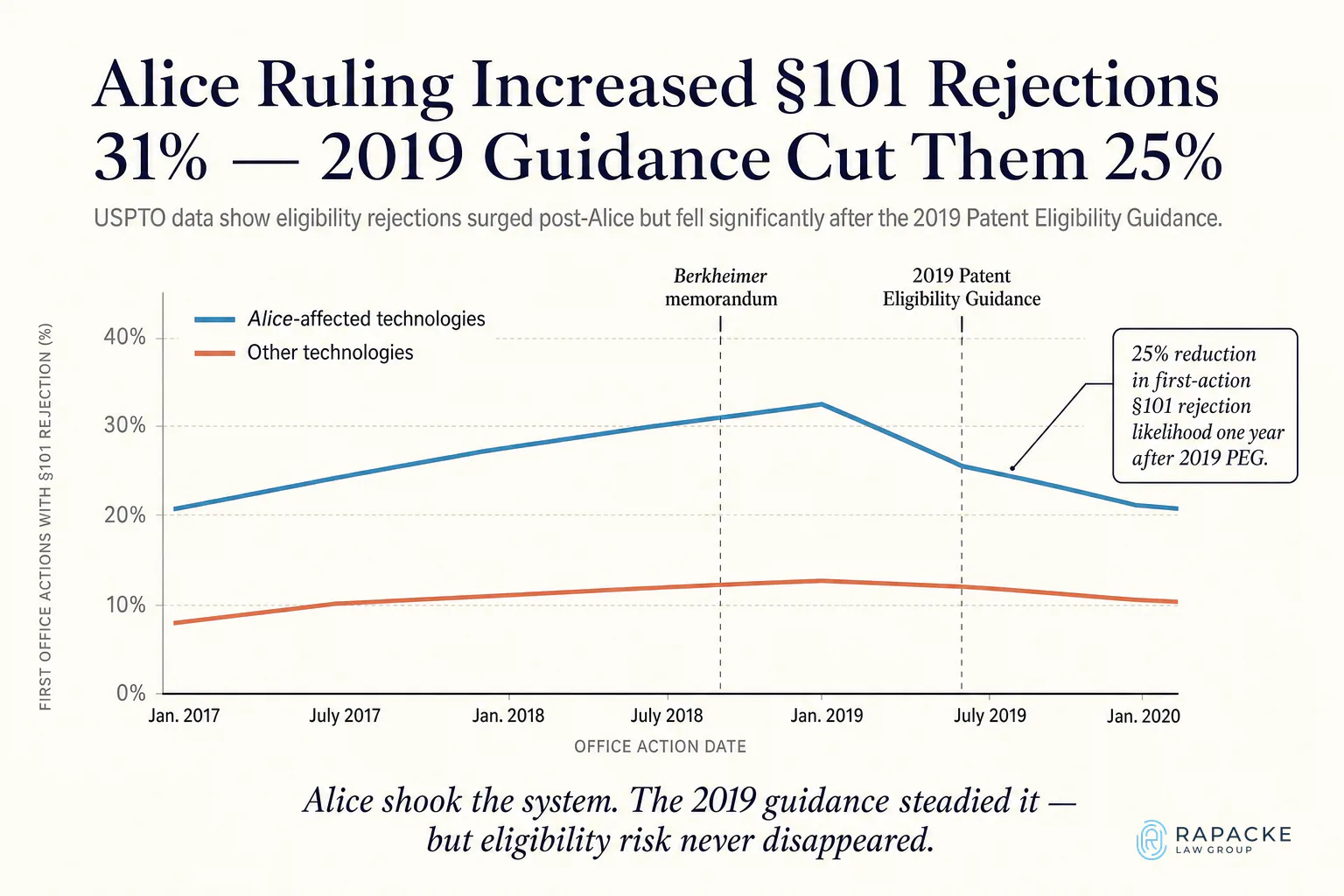
U.S. law bars patents on abstract concepts and abstract ideas alone, the USPTO lists mathematical concepts, certain methods of organizing human activity, and mental processes. Agency economists found Alice raised first-office-action Section 101 rejections 31% in affected technologies and examination uncertainty 26%, after the 2019 Revised Patent Subject Matter Eligibility Guidance, which clarified patentable subject matter for computer-implemented inventions, rejections fell 25% and uncertainty 44%.
What "Significantly More" Means in Practice
Winning claims recite a practical application or documented improvement to computer technology that solves a technical problem, judged as a whole under USPTO eligibility guidance. In Enfish, U.S. Patent Nos. 6,151,604 and 6,163,775 claimed a self-referential table yielding faster searches and smaller memory needs, the Federal Circuit refused to treat all computer improvements as abstract after the U.S. Supreme Court's Alice ruling, and McRO and DDR Holdings followed. Frame claims around what changes inside the machine and demonstrate an inventive step beyond the prior art, see identifying patentable features.
The Copyright Versus Patent Line Every Developer Should Know
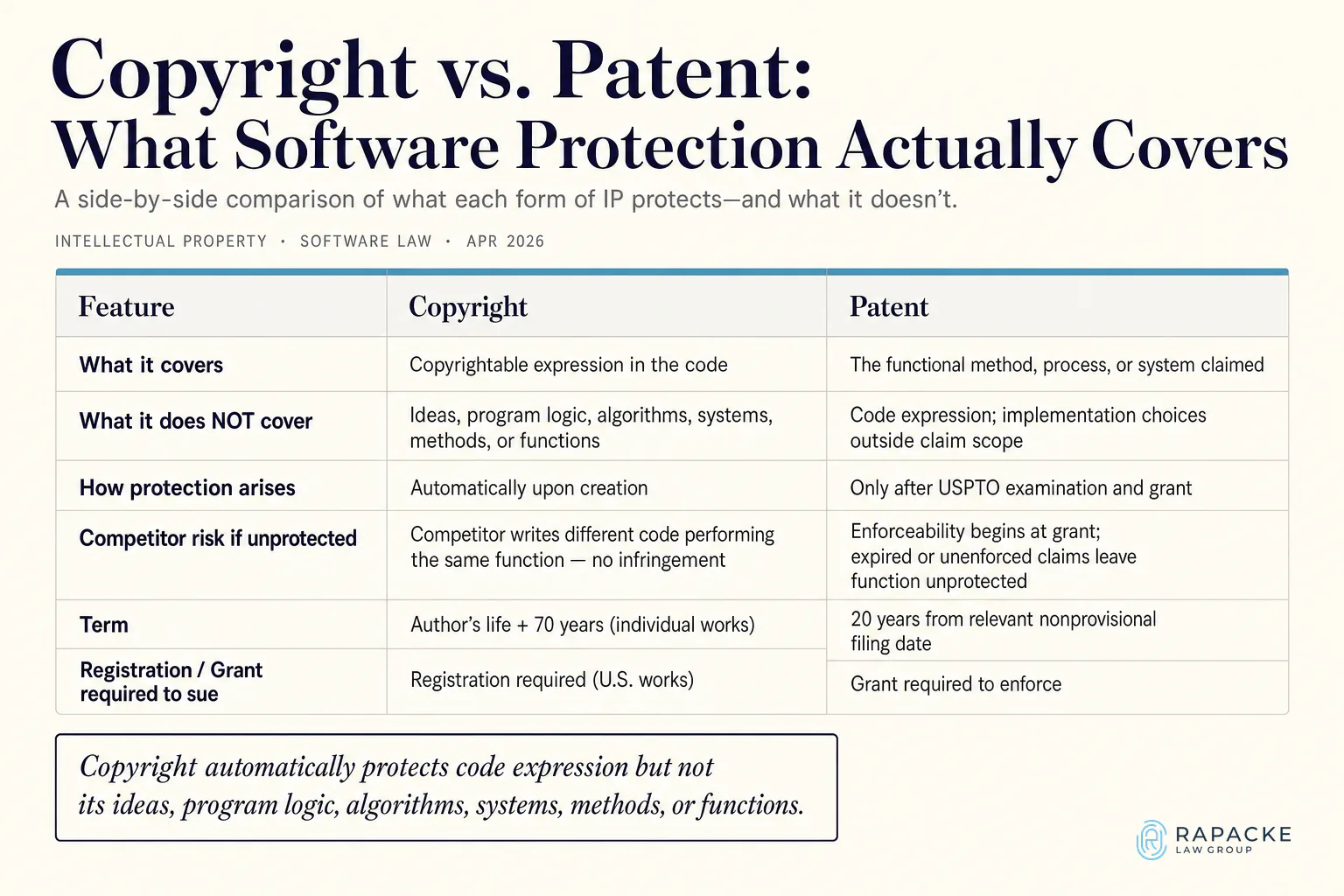
Copyright attaches automatically to your code, but the U.S. Copyright Office states it does not cover the ideas, program logic, algorithms, systems, methods, or concepts inside a computer program. Under copyright law, that protection is limited to the expressive elements of the code itself. Circular 61 covers code as a literary work and extends copyright protection to that expression, not the processes it implements, so a competitor writing different code for the same unpatented method may not infringe. Without patent protection for a computer program, competitors can freely replicate the underlying method. See software patent versus copyright.
How to Patent Computer Software Without Getting Rejected
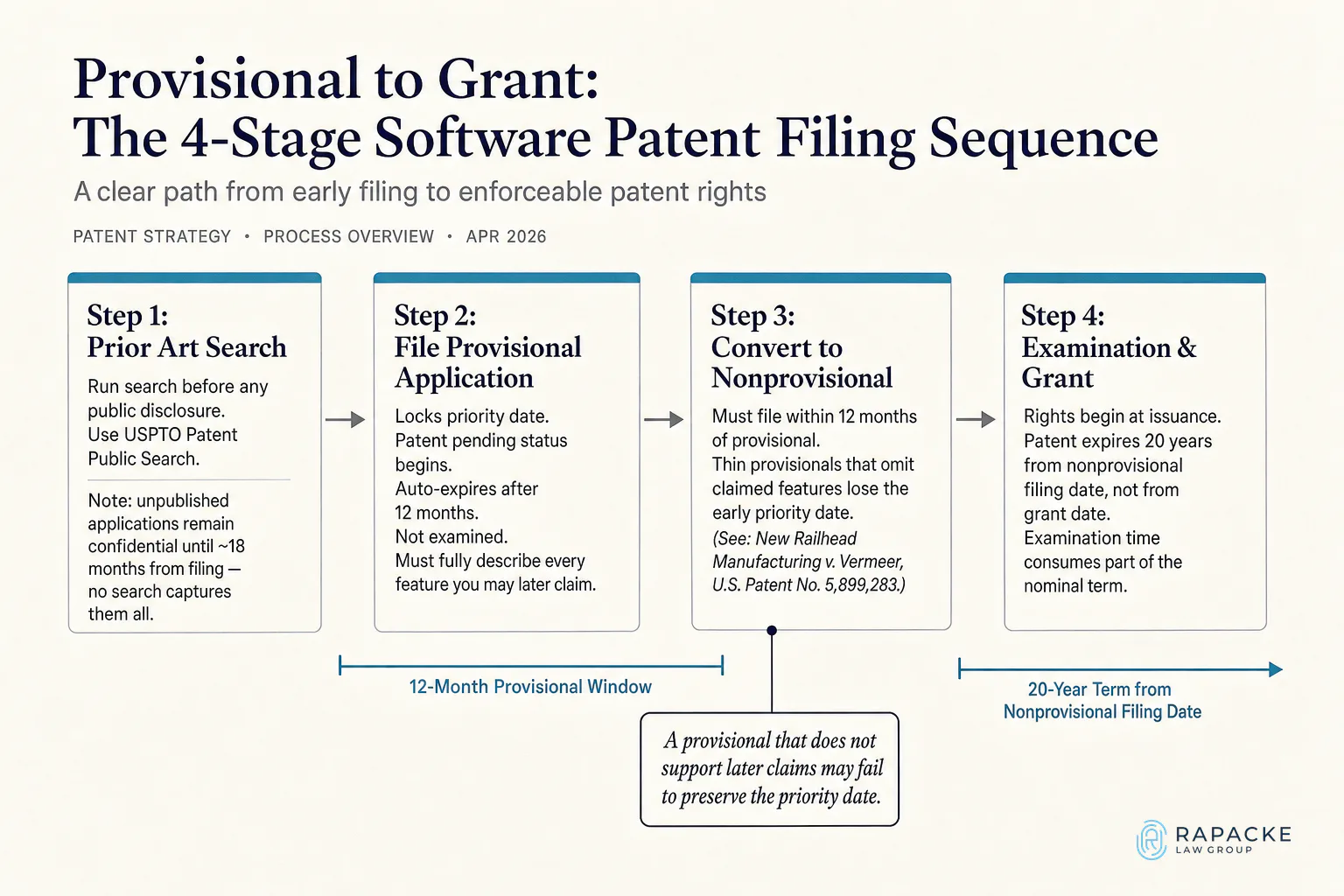
To patent computer software, including computer programs and related inventions, search prior art, file a provisional, then convert to a nonprovisional with carefully drafted claims within 12 months. Our step-by-step guide to patenting software covers each stage.
Step 1, Run a Prior Art Search Before Anyone Outside Sees the Invention
Start with USPTO Patent Public Search and Google Patents, which together index millions of issued patents and published patent applications covering computer programs and related inventions. Pending applications stay confidential until publication roughly 18 months after the earliest claimed filing date, so no search catches every competing filing. Search before showing investors or launching.
Step 2, File a Provisional Patent Application to Lock Your Date
A provisional secures a priority date for 12 months and costs $70 (micro entity), $140 (small), or $280 (large) under the USPTO fee schedule, with no search or examination fee. Formal claims are not required, but the disclosure must enable everything you later claim, architectures, workflows, data structures, alternatives, technical effects, and functional aspects of each embodiment. On timing, see when software should be patented. We file provisionals flat-fee under the RLG Guarantee, a full refund if the USPTO denies the application.
Step 3, Convert to a Nonprovisional Within 12 Months
A provisional is never examined and is abandoned at 12 months, so file the nonprovisional inside that window to claim the benefit, per MPEP 211. It carries the formal claims, detailed description, drawings, and abstract, and claim drafting decides whether your protection is broad enough to matter. USPTO patents dashboard data shows first office action and total pendency both exceed a year, see options for expediting software patent examination if timing is critical.
What a Software Patent Actually Covers and What It Does Not
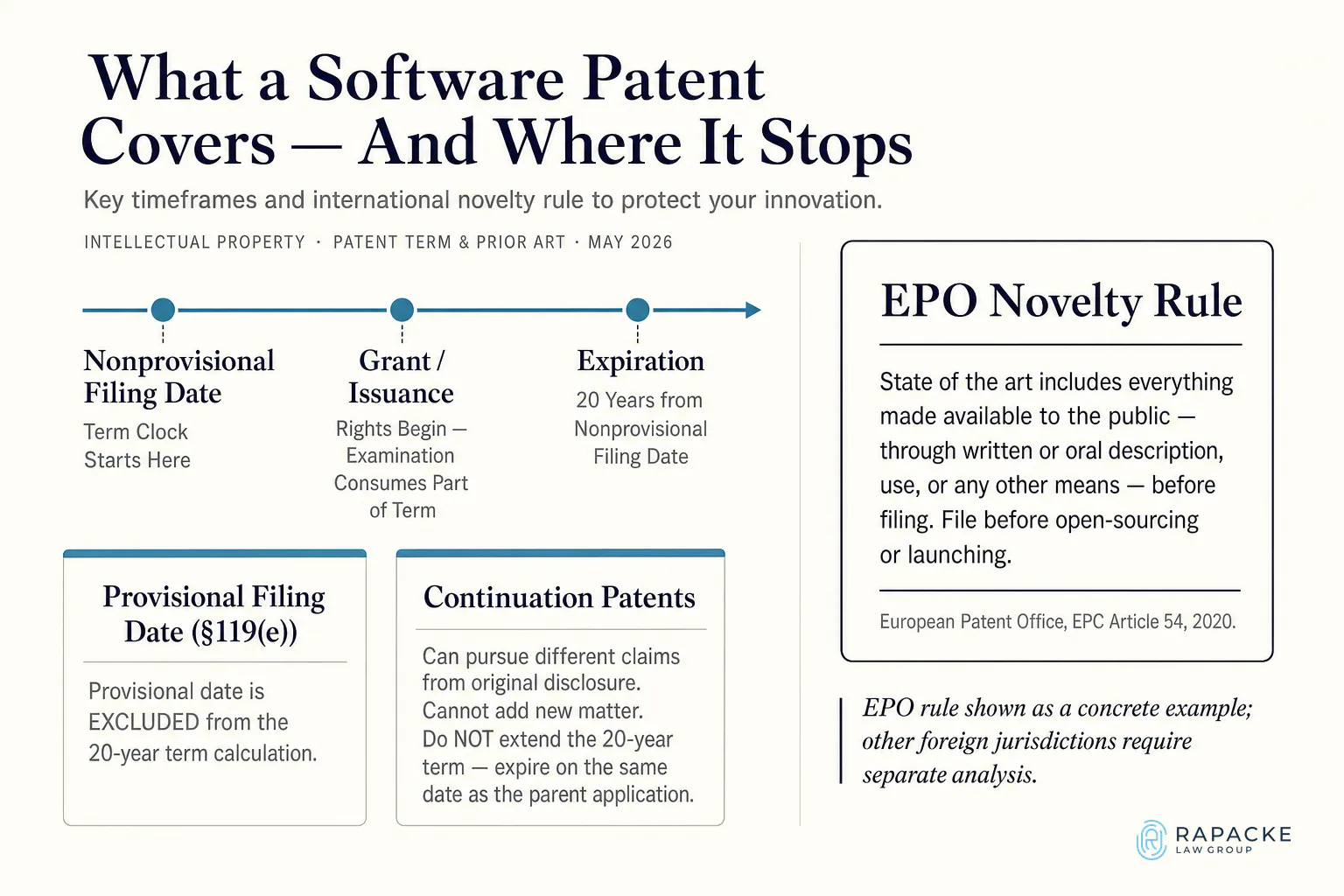
A computer software patent covers only what the issued claims recite, providing patent protection that is fully enforceable from the grant date, with limited provisional rights to a reasonable royalty available from publication under 35 U.S.C. 154(d), and expiring 20 years from the relevant nonprovisional filing date. It does not cover your source code, that is copyright protection, and it does not cover ideas you never described in the application. See our data-driven look at whether software patents are enforceable.
System Claims Versus Method Claims
Software applications commonly pursue method claims covering process steps, system claims covering a computer system configured to execute them, and sometimes computer-readable-medium claims covering computer programs. The right mix depends on who would infringe and how. Watch fee thresholds, the USPTO charges extra above three independent claims or 20 total claims.
What Open Source Software and Public Disclosure Do to Your Rights
Publishing as open source software, shipping a public release, or presenting at a conference before filing can eliminate rights. Under Article 54 EPC, the European state of the art includes everything made available to the public before filing, and the EPC provides no general inventor grace period, only narrow six-month exceptions under Article 55 for disclosures stemming from evident abuse or from officially recognized international exhibitions. Patent protection in Europe therefore depends entirely on filing before any public disclosure. U.S. law provides a limited one-year grace period for certain inventor-originated disclosures under 35 U.S.C. 102, but intervening filings and independent prior art can still block you. Treat any nonconfidential sharing or proposed sale as requiring patent review first.
Term Length and What That Window Means Strategically
Because examination consumes part of the nominal term, ask whether the feature still matters commercially when the patent issues. Continuations also let you pursue patent protection on related inventions that were disclosed but not yet claimed. Continuations preserve the ability to pursue additional claims supported by your original disclosure for related inventions, but cannot add new matter (per MPEP § 201.07) and do not extend the 20-year term (per 35 U.S.C. § 154; MPEP § 2701).
The Real Cost of a Software Patent and Whether the ROI Makes Sense
Government fees are modest, professional drafting is where the money goes. One provisional plus baseline nonprovisional filing, search, and examination fees plus the issue fee total roughly $723 for a micro entity, $1,446 for a small entity, and $3,615 for a large entity, excluding excess claim, prosecution, and maintenance fees.
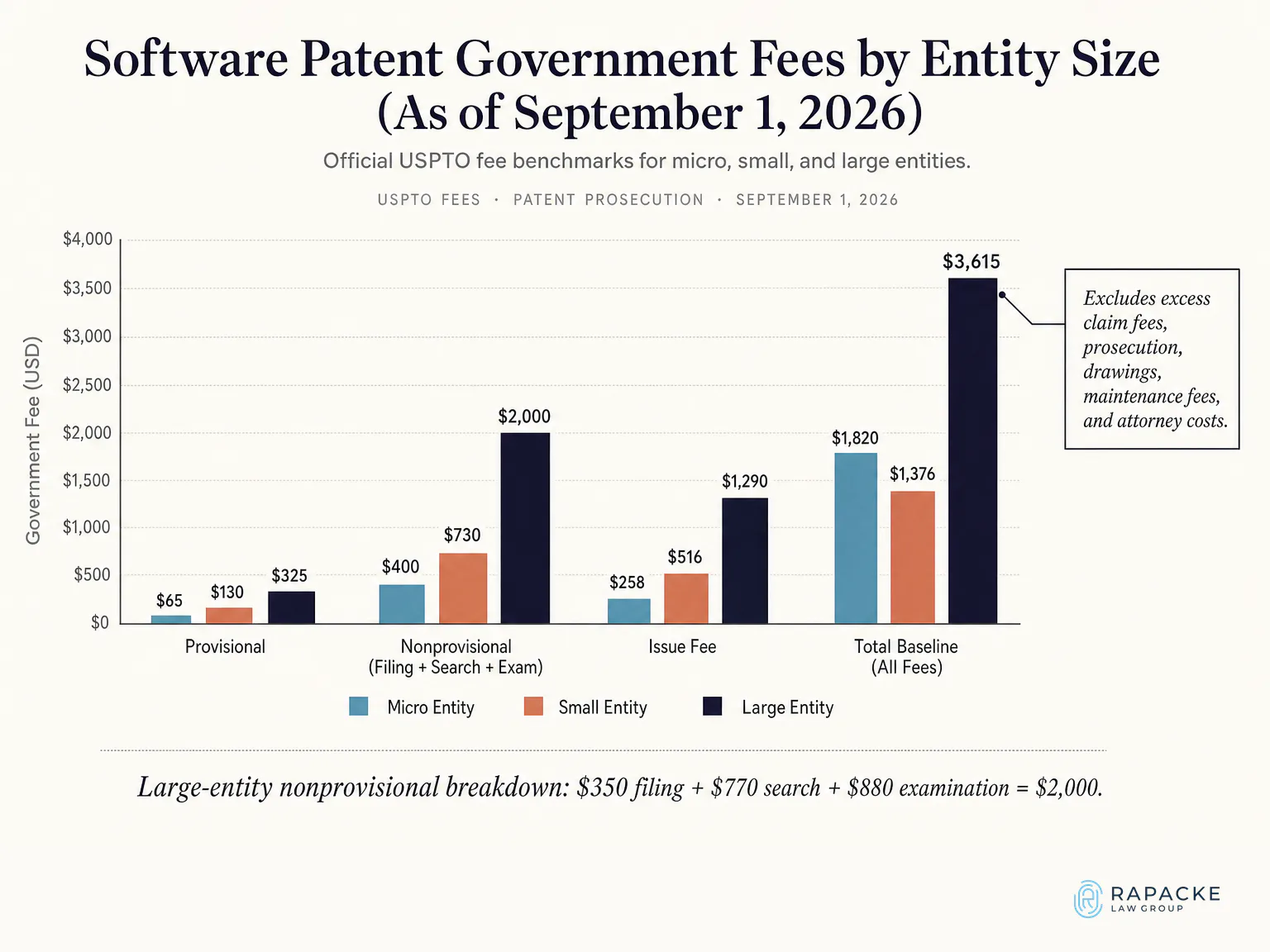
| Fee | Micro | Small | Large |
|---|---|---|---|
| Provisional filing | $70 | $140 | $280 |
| Nonprovisional filing, search, exam | $400 | $800 | $2,000 |
| Utility issue fee | $258 | $516 | $1,290 |
Totals sum the separate filing, search, examination, and issue fees on the USPTO fee schedule, which the office adjusts regularly. Confirm live numbers before you budget.
Two avoidable surcharges sit outside that table, filing an original nonprovisional utility application on paper rather than through Patent Center adds $400 ($200 for small and micro entities), and submitting the specification, claims, or abstract in a non-DOCX format adds $430 ($172 small, $86 micro). Establish entity status early, since most patent fees drop 60% for small entities and 80% for micro entities.
Attorney fees vary widely with technical complexity. AIPLA's 2025 Report of the Economic Survey is the standard industry reference, though its detailed tables are not public. We quote software patent applications as a flat fee up front, so founders can budget the work instead of watching an hourly meter. Provisional applications are filed under the RLG Guarantee: if the USPTO denies the provisional, you receive a full refund.
When Investors Want to See an Application on File
Venture technical diligence examines ownership, assignments, freedom to operate, and whether the core differentiator has patent protection. A filed application establishing patent eligibility, even before grant, gives you something concrete to point to. Our SaaS Patent Guide 2.0 maps that sequence to a fundraising timeline. Filing before the pitch is easier than explaining why you have not.
Five Mistakes That Get Software Patents Rejected or Invalidated
The USPTO's December 5, 2025 eligibility guidance stresses evaluating the claimed invention as a whole against the specification's technological improvements.
1. Claiming the Result Instead of the Technical Mechanism
"Optimizing user experience" is a business outcome. In the precedential Ex Parte Desjardins decision, artificial intelligence and machine learning claims survived because the specification explained how the model itself operated differently. AI filings: AI Patent Mastery.
2. Filing a Thin Provisional
In New Railhead Manufacturing v. Vermeer, the provisional never described the drill bit as angled with respect to the sonde housing, a limitation later claimed in U.S. Patent No. 5,899,283, so the Federal Circuit denied that patent the benefit of the provisional filing date.
3. Waiting Too Long After Disclosure
Demos, pitch decks, and press coverage start the clock, and Europe has no general grace period.
4. Drafting Claims Too Narrowly
Over-narrow claims invite design-arounds, claim the broadest defensible scope your disclosure supports, including patentable subject matter in related inventions covered by your specification.
5. Never Papering Inventorship and Assignments
Contractor code without an assignment clouds ownership and can undermine patent protection for related invention work. Fix it before diligence does.
Frequently Asked Questions About Computer Software Patents
Can computer software be patented?
Yes. The USPTO says software is not automatically abstract, citing Enfish's improved database structure and McRO's rule-based animation. Software inventions that improve computer functionality can qualify as patentable subject matter. Claim a specific technical improvement, not a generic-computer business result. See can you patent code.
How much does it cost to get a software patent?
Government fees total about $723 micro, $1,446 small, or $3,615 large entity for a provisional, nonprovisional, and issuance. Attorney fees are separate and usually larger.
Is it worth patenting software?
Yes, when the feature is a durable technical differentiator a competitor could reproduce. Patent protection rewards software developers who move quickly and claim the specific technical mechanism. Full enforceable rights begin at issuance, though limited provisional rights can attach at publication under 35 U.S.C. 154(d), and the term expires 20 years from the nonprovisional filing date. U.S. patent law makes this the primary form of legal protection for a patentable invention in software.
Can you give me an example of a software patent?
Enfish. U.S. Patent Nos. 6,151,604 and 6,163,775 claimed a self-referential database structure with gains in search speed, memory use, and flexibility, demonstrating computer functionality improvements that the U.S. Supreme Court's Alice framework did not bar. Note that eligibility and validity over prior art are separate questions, and some Enfish claims were later held obvious over the prior art. More software patent examples.
Do I need a patent attorney to file?
You may file pro se, but the USPTO's utility patent guide calls applications complex legal documents best prepared by someone trained to prepare them.
Your Next Steps to Computer Software Patent Success
U.S. patent law rewards the earlier effective filing date, so every week without a provisional on file erodes your advantage. A patentable invention in software loses its window when a competitor files first. A weak software patent claims a result and gets rejected under Section 101. A strong one describes the technical mechanism inside the machine.
Your Next Steps to Computer Software Patent Success:
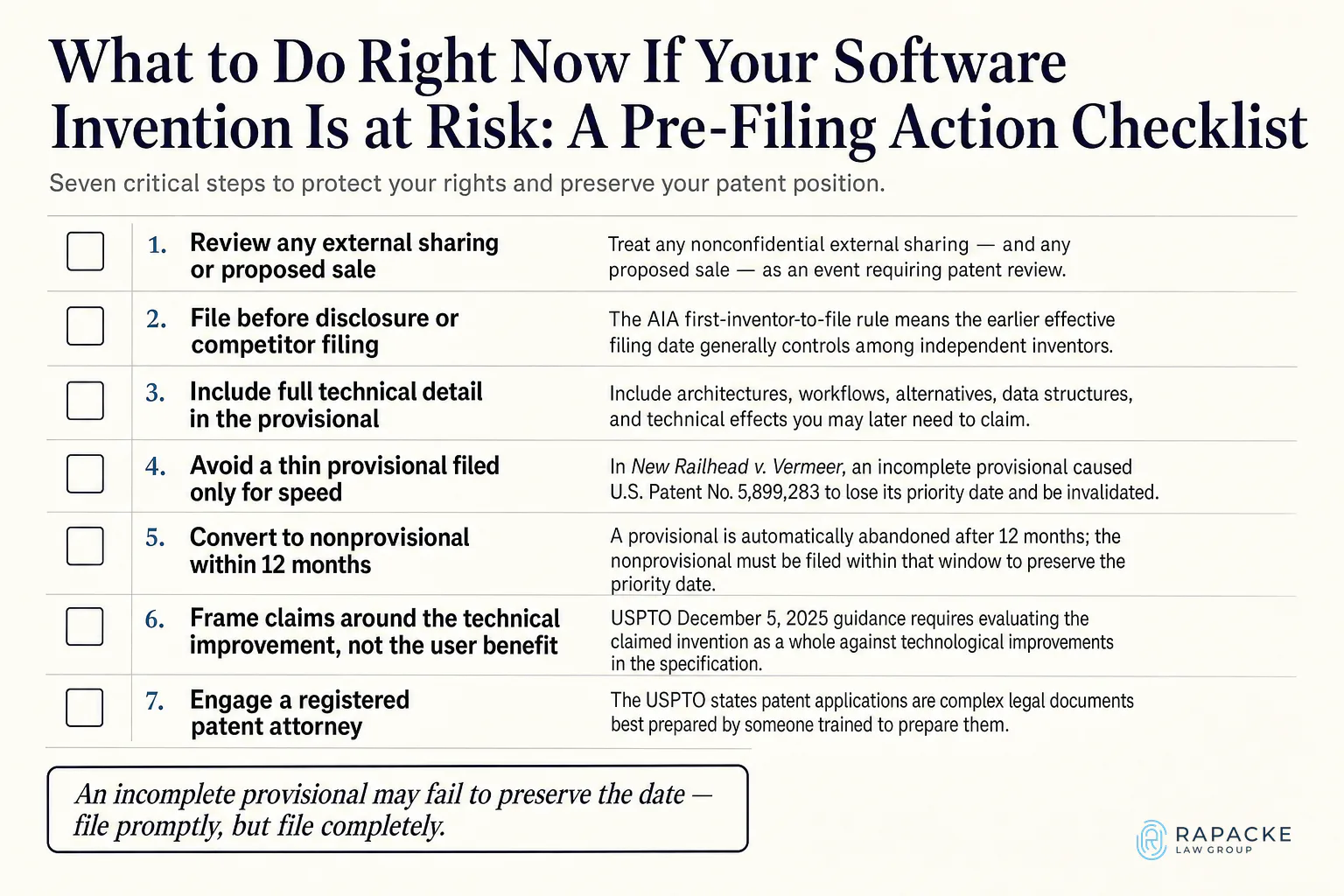
Securing a computer software patent requires moving quickly, drafting claims around the technical mechanism, and building a disclosure that survives both Section 101 eligibility review and prior art challenges. Patent attorneys experienced in patentable subject matter analysis are best positioned to draft those claims. The steps below reflect the sequence that gives founders the strongest position.
The bottom line: a weak patent claims a business result and gets rejected or designed around; a strong patent describes the inventive concept, i.e., exactly what changes inside the machine and why that change is an improvement.
Every day without a filed provisional is a day a competitor can establish an earlier effective filing date. Under the first-inventor-to-file system, that date controls, and no amount of documentation of prior conception recovers it.
- Schedule a Free IP Strategy Call to confirm eligibility and filing sequence.
- Run a prior art search before your next public release.
- Document the technical improvement while engineering is fresh.
- File the provisional first, then refine claims.
I price this work as a flat fee, so cost is known before drafting.
To Your Success, Andrew Rapacke, Managing Partner, Registered Patent Attorney
Andrew Rapacke Managing Partner, Registered Patent Attorney Rapacke Law Group