


Key Takeaways
- Docket the Notice of Allowance the day it issues. The six-month clock runs from that date, not from your filing or launch date.
- File an extension before every cutoff if any listed item is not yet live. Five extensions max out at 36 months.
- For SaaS, a genuine sign-in or service page showing the mark beats a logo file, mockup, or "coming soon" page.
- Delete or divide out goods and services you do not yet offer before you sign the verification.
- Confirm which entity owns an intent-to-use application before any restructure, because an early assignment can void the filing.
Written by Andrew Rapacke, Managing Partner, Registered Patent Attorney. Andrew Rapacke is a registered patent attorney and the Managing Partner of The Rapacke Law Group, a full-service intellectual property law firm. He helps individuals and corporations across industries with the protection, prosecution, licensing, and enforcement of their intellectual property, with deep experience in patent, trademark, and copyright matters spanning software, AI and machine learning, blockchain, medical devices, and autonomous vehicle technology. A graduate of the United States Naval Academy, Andrew served as a Naval Engineering Officer before pursuing law and remains active in the startup and inventor communities throughout Florida.
A SaaS founder receives a Notice of Allowance in March, spends the spring closing a seed round, and realizes in October that the six-month statement of use trademark deadline has passed. The United States Patent and Trademark Office (USPTO), which many founders still call the United States Patent Office or the old united states patent office, then abandons the pending application under 15 U.S.C. §1051(d). The brand loses its path to registration just as the marketing budget scales, and the trademark office will not simply overlook the lapse, since the trademark office enforces these deadlines strictly.
Think of an intent application like a reservation at a busy restaurant: it holds your table, but it expires unless you show up with proof of use, and the same holds for all intent applications.
This guide covers the deadline, specimen, and goods-list errors that cause application dismissal and abandonment. It also explains how to pick the right use filing and how weak filings surface in due diligence, and where a trademark attorney adds value. For a tech startup, the brand filing sits beside your software and AI patent strategy, so aligning its timing with patent filings and funding readiness protects both your technology and your valuation. Government fees are covered in our guide to new USPTO fee changes. This article is general information, not legal advice.
What Is a Statement of Use for Trademark Applications and When Is It Due?
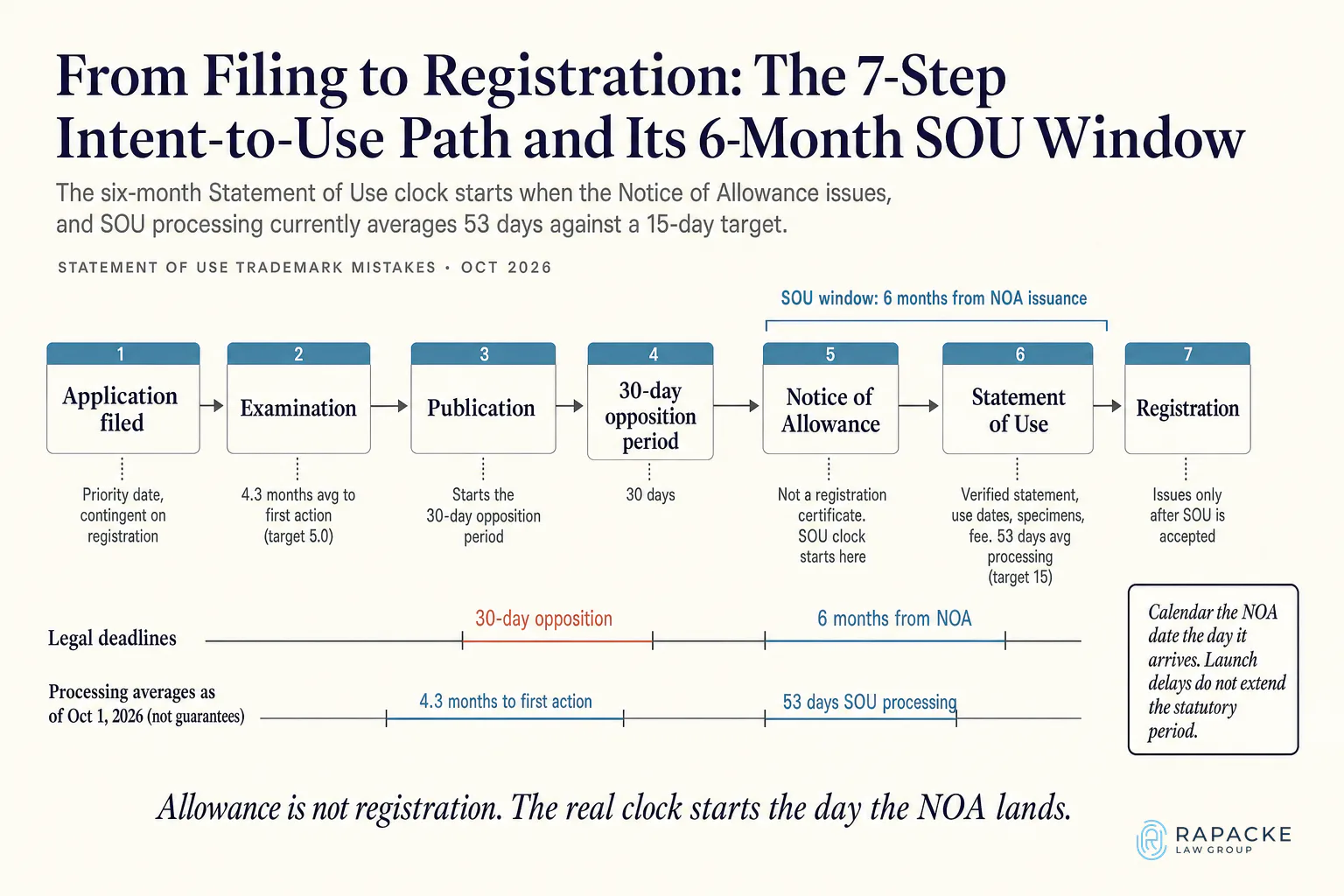
A Statement of Use, the key trademark statement for an intent-to-use mark in any us trademark filing, proves the mark is in genuine commercial use. It is due six months after the Notice of Allowance unless extended.
What the filing actually proves to the USPTO
An intent-to-use application (often shortened to ITU) earns constructive-use priority, meaning your filing date counts as your first-use date nationwide, under 15 U.S.C. §1057(c) only upon registration. Per 37 C.F.R. §2.88 and TMEP 1109.06 (the USPTO's Trademark Manual of Examining Procedure, or TMEP), it needs use dates, a specimen per class, goods in use, the fee, and verification. 15 U.S.C. §1127 requires bona fide use in commerce, not token sales.
Where it fits in the trademark registration process
In the trademark application process, the Notice of Allowance follows publication in the trademark official gazette and the end of the opposition period, which initially lasts 30 days but may be extended. See how to get a federal trademark. USPTO data from October 1, 2026 shows 4.3 months to first action and 53 days to process a Statement of Use. Trademark Center, reflecting broader technology changes at the agency, became the only place to file new trademark applications on January 18, 2025, when the TEAS (the Trademark Electronic Application System, formally the trademark electronic application system) initial application forms were retired, other TEAS forms moved to Trademark Center in stages (USPTO system-status notice, Trademark Center release notes).
Which Statement of Use Trademark Deadlines Do Founders Miss Most Often?
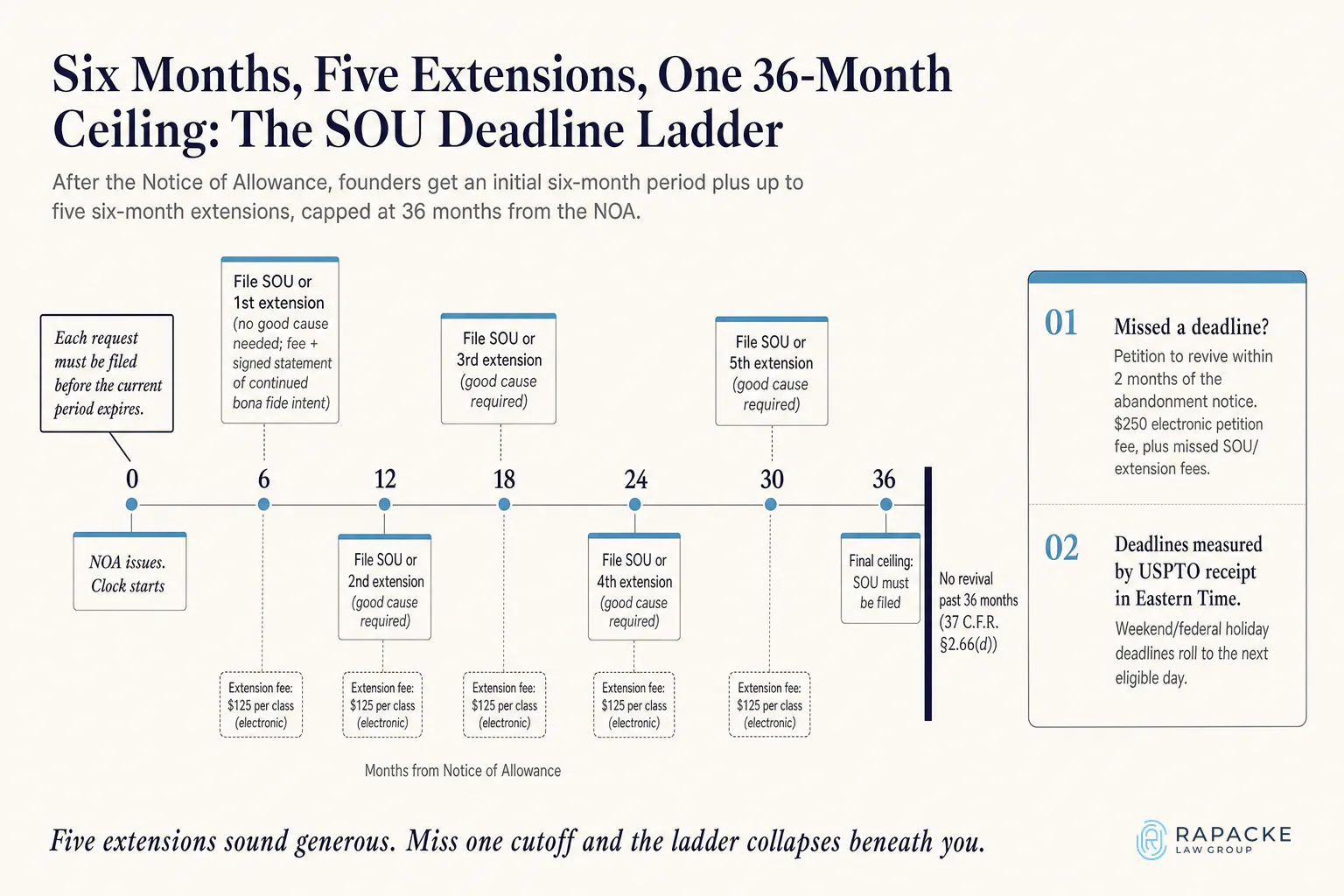
Trademark applicants most often miss the extension cutoffs, and a missed cutoff can even lead to a trademark trial if a dispute follows. 37 C.F.R. §2.89 allows six months plus five six-month extensions, capped at 36 months after the Notice of Allowance.
The six-month clock and the 36-month ceiling
Receipt is measured in Eastern Time under 37 C.F.R. §2.195. Weekend or holiday deadlines roll to the next business day (USPTO guidance).
Only extensions after the first must show ongoing efforts under §2.89(d). Trademark Center began accepting extensions September 3, 2026 (release notes, USPTO announcement).
Missed deadlines and the petition to revive
Missing a cutoff abandons the application, a result under U.S. trademark law and the Trademark Act that is hard to reverse. A petition to revive is due within two months of the notice under 37 C.F.R. §2.66 and TMEP 1714. Without notice, you get two months from actual knowledge, capped at six months, so ask a trademark attorney to confirm which window applies.
Under 37 C.F.R. §§2.88 and 2.89, the legal authority for these deadlines, and USPTO intent-to-use guidance, you must file a Statement of Use within three years of the Notice of Allowance. Miss that ceiling and the application is abandoned and cannot be revived, so you must refile and risk losing priority.
Why Do Software and SaaS Specimens Get Rejected?
SaaS specimens fail when they show the logo trademark but not the service.
Screenshots that fail the "point of sale" test
For downloadable Class 9 software, a web page showing the mark with a way to download, buy, or order is an acceptable point-of-sale specimen, though other specimens showing actual use can also qualify (TMEP 904.03(i)). SaaS (Class 42) can use sign-in screens for rendered services (TMEP 1301.04). Common failures:
- logo files or printer's proofs
- "coming soon" pages
- betas lacking ordinary-course service
Capture the URL and access date.
Mockups and digitally altered images
Real screenshots pass. Fabricated mockups fail. USPTO Examination Guide 3-19 flags floating marks and pixelation around the mark as warning signs, and TMEP 904.04(a) treats digitally created, digitally altered, or mockup images as improper specimens because they do not show actual use in commerce. A March 2026 USPTO presentation reported sanctions affecting 7,349 applications and registrations in fiscal 2026.
How Does Claiming Goods You Do Not Sell Put Your Trademark Registration at Risk?
Your Statement of Use must cover every listed item, a core part of the use minimum filing requirements. Unsold goods risk refusal, cancellation, and even legal action, so delete or divide them and keep filing stage identifications narrow.
Use on all listed goods and services
TMEP 1109.03 requires the mark to be in use on all listed goods and services before you file a Statement of Use, unless you divide out the items not yet in use. Dividing lets goods already in use proceed in a new application while the rest stay in the original, but outstanding deadlines generally apply to each resulting application, subject to limited exceptions (TMEP 1110.05).
False verification and fraud exposure
Cir. 2009), requires intent to deceive, yet Bose still stripped unsold WAVE goods. USPTO post-registration audits have also deleted goods or services from registrations that could not prove use.
Should You File a Statement of Use, an Amendment to Allege Use, or an Extension?
How the three filings compare
| Filing | When | Requires | Best For |
|---|---|---|---|
| Amendment to Allege Use (AAU) | Before publication | Dates, specimen, verification, fee | Mid-examination launch |
| Statement of Use | After Notice of Allowance | Same | Live product |
| Extension request | After Notice of Allowance | Intent, fee, good cause | Delayed launch |
The USPTO intent-to-use forms page bars use allegations between publication approval and the Notice of Allowance. Unlike an AAU, a Statement of Use cannot be withdrawn.
Statement of Use vs. Declaration of Use
A Section 8 Declaration, which protects the trademark owner's legal rights (15 U.S.C. §1058), due in years five to six, maintains the registration a Statement of Use creates.
How Can a Statement of Use Trademark Problem Slow Funding or an Acquisition?
Investors review trademark protection and other legal protection alongside patents. Lapsed deadlines, refused specimens, or improper transfers delay closing and can raise trademark infringement concerns. USPTO data shows divisional requests averaging 138 days.
What investors check in IP due diligence
NVCA model legal documents require IP representations, so resolve pending ITU deadlines first. Our SaaS Agreement Checklist for Tech Founders helps you know what legal documents you need.
The assignment restriction on intent-to-use applications
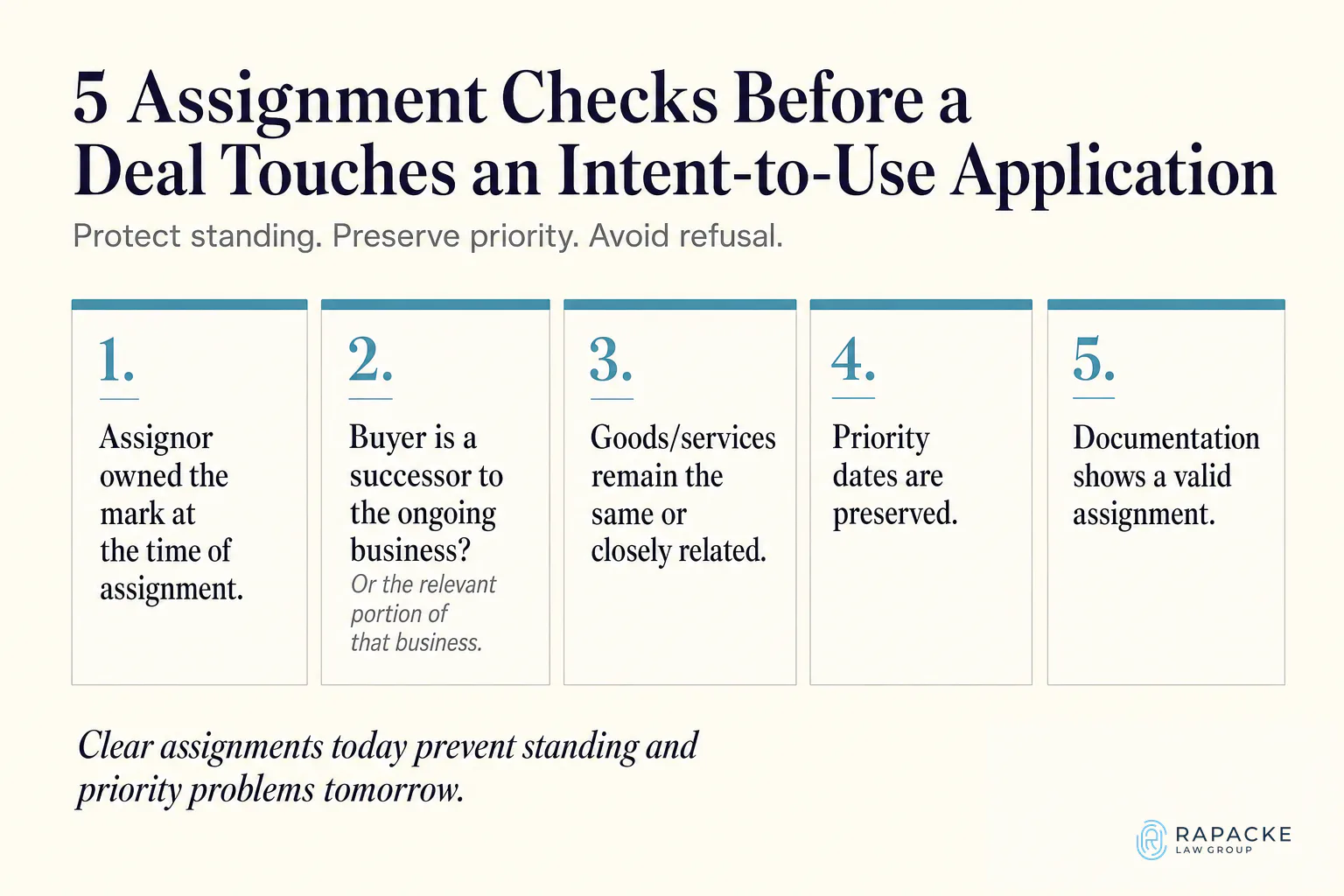
Under 15 U.S.C. §1060(a)(1), an ITU application cannot be assigned before an AAU or Statement of Use, except to a successor to the business. In Clorox Co. v. Chemical Bank, the TTAB found an early assignment voided the registration. Before restructuring:
- Confirm the owning entity.
- Check for a filed AAU or Statement of Use.
- Identify the business moving with the mark.
- Execute a written assignment.
- Record within three months under §1060(a)(4).
Frequently Asked Questions About the Statement of Use
Can you provide an example of a statement of use for a trademark?
A SaaS filing might claim first use on July 10, 2026, with a sign-in page as the specimen. TMEP 1109 requires accurate dates.
How much does it cost to file a statement of use for a trademark?
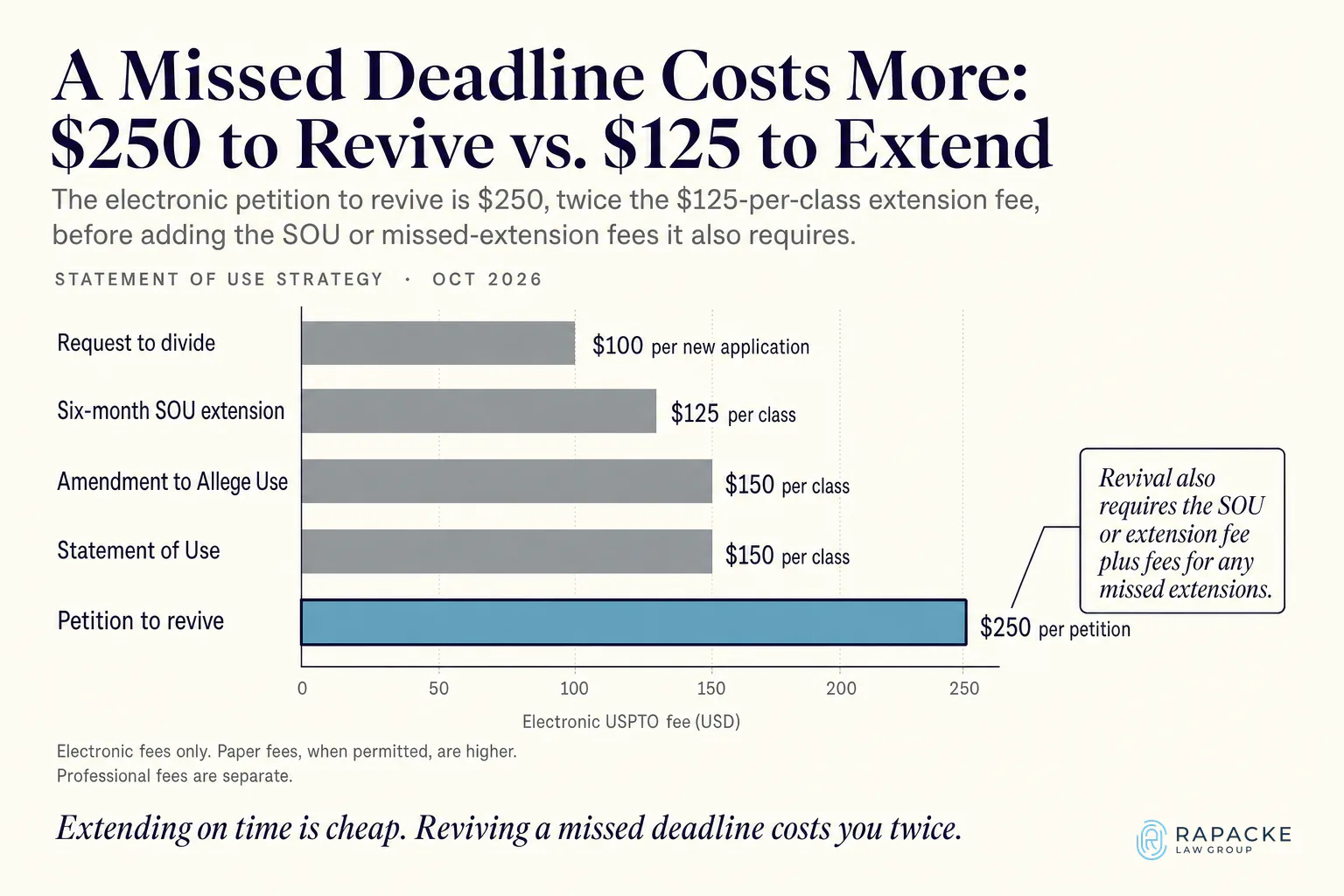
Filing costs $150 and each extension $125 per class under the USPTO fee schedule, the official trademark fee information. Revival costs $250 and division $100 per new application, as our trademark filing cost guide details.
What is proof of use in a trademark?
Proof of use is a specimen showing your mark in use, as a trademark owner must show in the application details. Labels fit goods and ads fit services, per TMEP 1301.04.
Should I use TM or SM?
Use TM for goods and SM for services until registration, as our TM vs R guide explains. The USPTO reserves ® for marks with a trademark registration certificate, not a state registration, as covered in our registered logo symbol guide.
Can you provide an example of a trademark disclaimer?
A disclaimer might read "No claim is made to the exclusive right to use SOFTWARE apart from the mark as shown." Under TMEP 1213, only that descriptive word loses protection.
Protect Your Priority Date Before the Clock Runs Out
A missed cutoff, a mockup specimen, or an overbroad goods list can cost your application its priority date and add corrective work to a funding round. Each risk is preventable with early docketing, real specimens, and a trimmed goods list.
Your Next Steps to Statement of Use Trademark Success
A Statement of Use turns priority into federal registration, and the trademark rights that come with it, only when the deadline, specimen, and goods list hold up.
The bottom line: A mockup or overbroad goods list invites refusal. Missed cutoffs force a revival petition or, after 36 months, a new application. A real specimen, a trimmed goods list, and a docketed deadline lock in your priority date.
Lost priority means a possible rebrand, wasted marketing spend, and a delayed funding round while investors wait for the issue to be cleaned up. The cost of acting late is far higher than the cost of filing correctly the first time.
- Schedule a Free IP Strategy Call to have an attorney review your specimen.
- Docket every six-month cutoff in Eastern Time with the trademark office, since a single missed date can cost priority and force a rebrand.
- Screenshot a dated sign-in or pricing page once users have access.
- Run a free trademark search with USPTO search tools and find trademark classes before adding classes.
Rapacke Law Group, staffed by experienced trademark attorneys, handles each application to register and other trademark filings, including Statements of Use, on fixed fees. For trademark applications, the RLG Guarantee is simple: get your trademark approved or pay nothing. 100% refund if rejected.
That fixed-fee model means predictable budgeting and no hourly surprises as you plan a funding round. Founders who know their IP costs up front can spend on product and growth, and they move faster than competitors who stall on legal bills or missed deadlines.
To Your Success,
Andrew Rapacke
Managing Partner, Registered Patent Attorney
Andrew Rapacke
Managing Partner, Registered Patent Attorney
Rapacke Law Group