

Key Takeaways
- File a provisional before any public demo: first-inventor-to-file rewards the filing date, not the invention date.
- Claim the specific implementation, not the concept, the Federal Circuit invalidated machine learning patents in 2025 for claiming results, not how they were achieved.
- Patent the methods; keep training data and model weights as trade secrets, copyright won't stop independent coding.
- Run a freedom-to-operate analysis before architecture freezes; design-arounds get expensive after hardware validation.
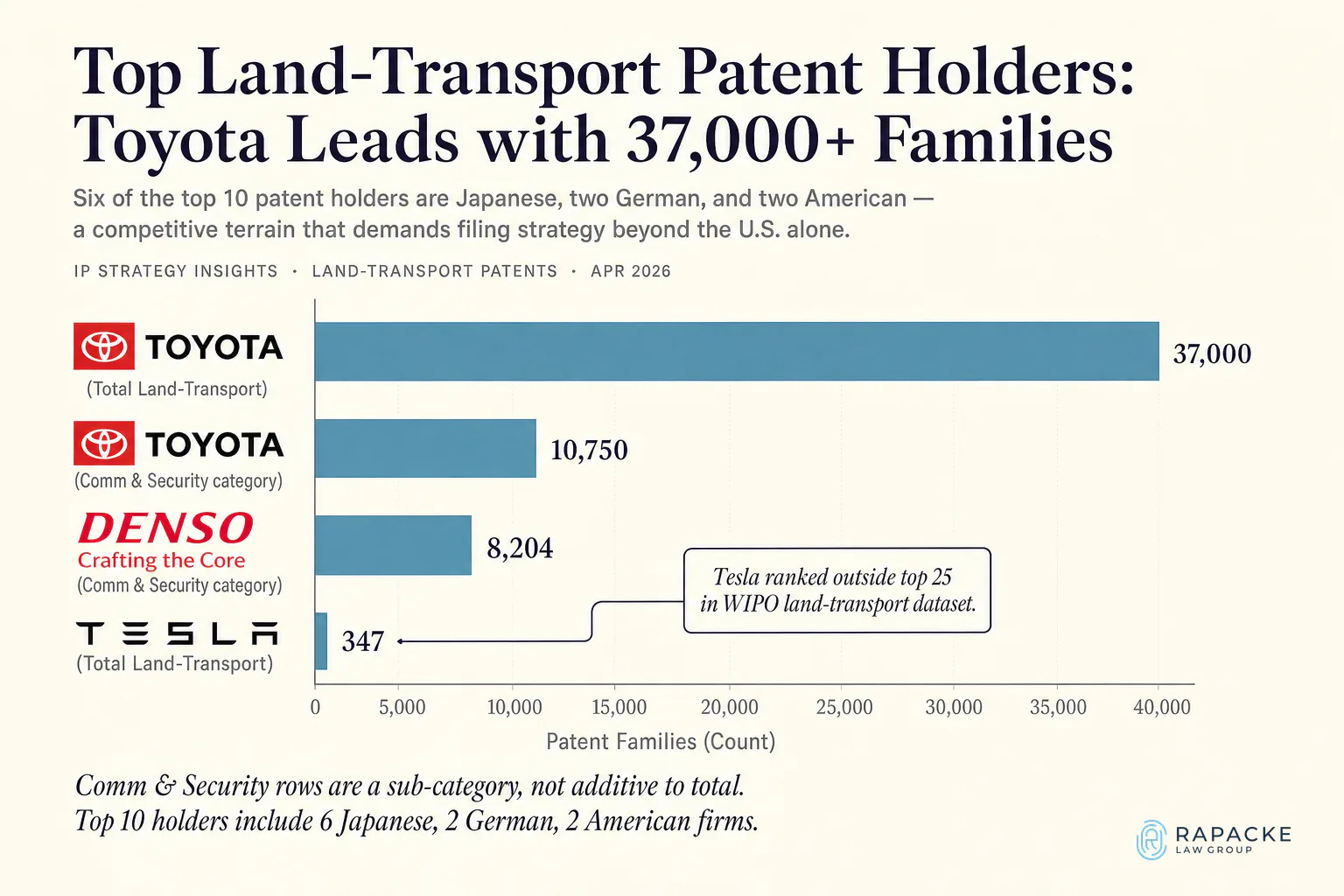
- Portfolio size doesn't track visibility: Toyota leads WIPO's land-transport dataset with 37,000+ patent families; Tesla falls outside the top 25.
*Written by Andrew Rapacke, Managing Partner, Registered Patent Attorney.* Andrew Rapacke is a registered patent attorney and the Managing Partner of The Rapacke Law Group, a full-service intellectual property law firm. He helps individuals and corporations across industries with the protection, prosecution, licensing, and enforcement of their intellectual property, with deep experience in patent, trademark, and copyright matters spanning software, AI and machine learning, blockchain, medical devices, and autonomous vehicle technology. A graduate of the United States Naval Academy, Andrew served as a Naval Engineering Officer before pursuing law and remains active in the startup and inventor communities throughout Florida.
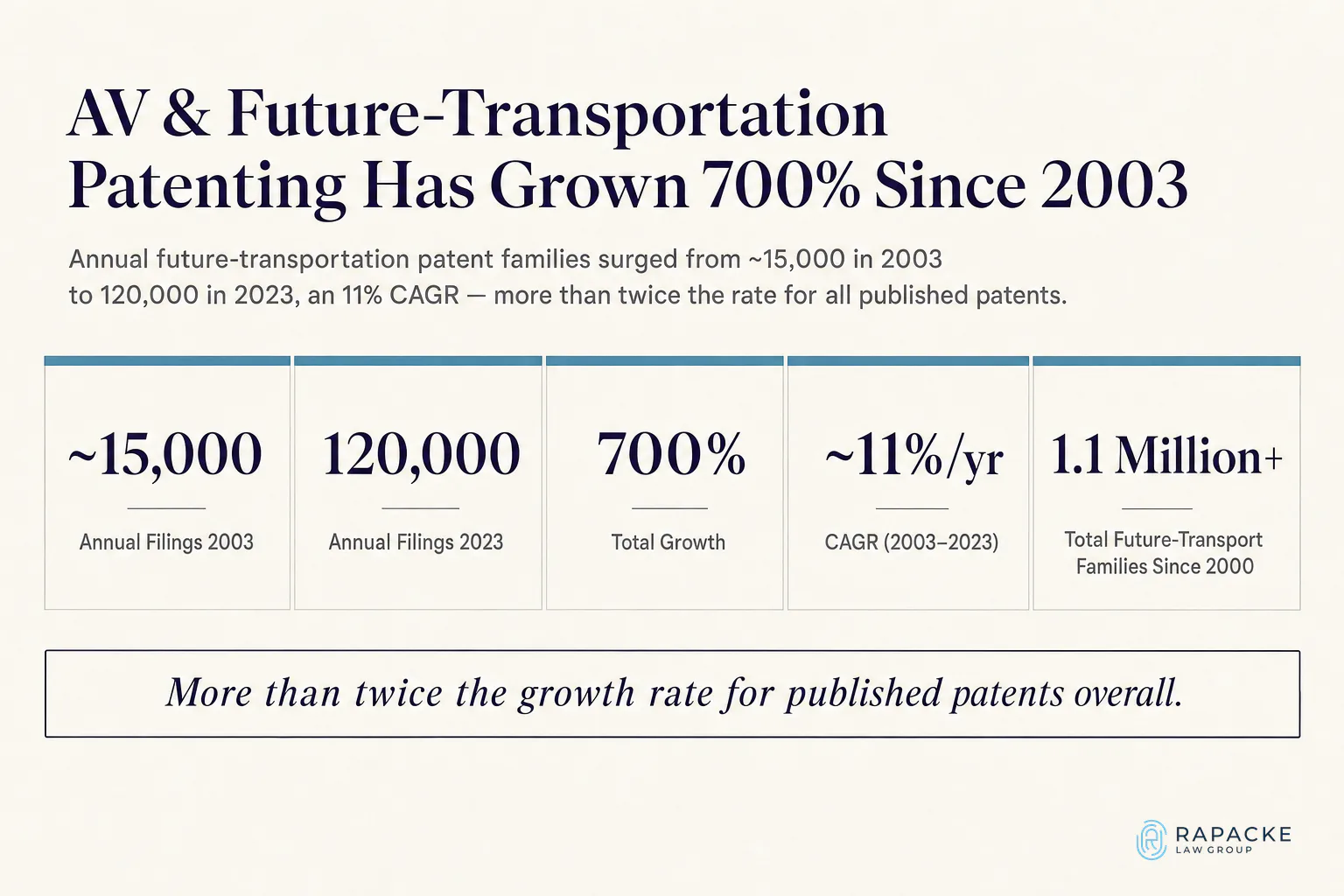
More than 1.1 million patent families tied to the future of transportation were published between 2000 and 2023, growing at roughly 11% a year, nearly triple the 4% growth rate of traditional transportation technologies, . Self driving car patents and autonomous vehicle patents sit inside that surge. A team can spend two years on a sensor fusion stack, then learn during diligence that an incumbent portfolio already covers the same ground. This guide maps the IP categories protecting self-driving technology, why AI claims survive or fail on drafting, the competitive terrain, and a protection sequence to run before your next milestone.
What Makes Self-Driving Car Patents Different from Standard Tech Patents
Self driving car patents span sensors, real-time computation, and vehicle control, so the strongest claims tie software to machine behavior. This gives them an edge over pure software filings when hardware is a claimed technical improvement.
Why AV Inventions Sit at the Intersection of Hardware and Software IP
Most autonomous vehicle patents cover LiDAR, radar, and camera processing built on advances in sensor technology, sensor fusion, path planning, and actuation. Per the USPTO's 2024 AI subject matter eligibility update, bolting a processor onto an abstract claim is not enough, anchor claims to measurable technical effects such as reduced classification latency, the discipline behind strong software patents and computer hardware claims.
How the Growth of Autonomous Vehicle Patents Has Accelerated the Filing Race
Land-transport patenting grew from about 8,800 families in 2000 to over 99,500 in 2023, with WIPO's four transport trends each at 11%-12% CAGR. Land transport is 82% of future-transportation families and Asia 76% of inventions, so U.S.-only filing leaves gaps abroad. Dense prior art makes early patent filings and search essential.
The Four IP Layers That Protect Autonomous Driving Technology
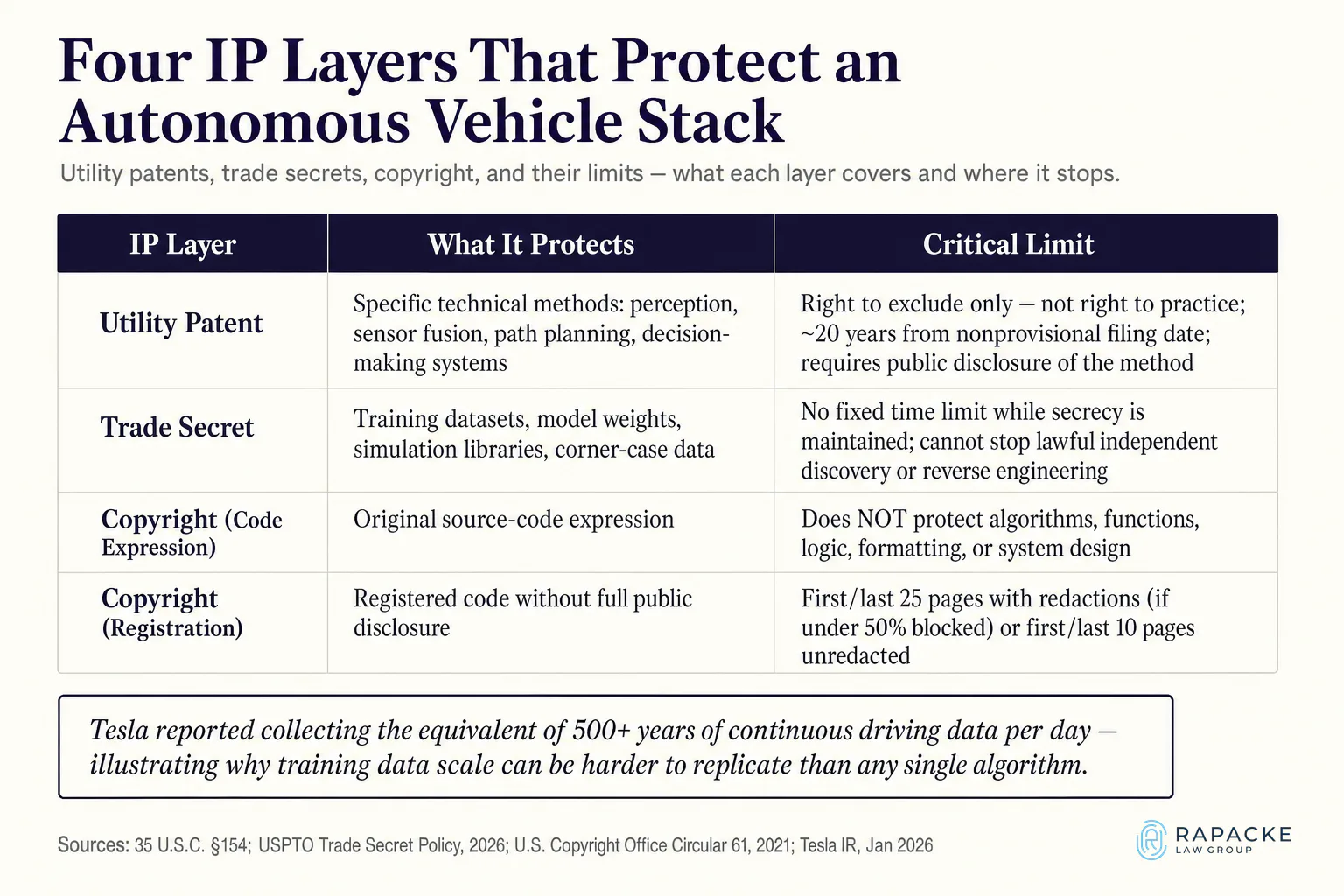
Serious AV players layer four rights: utility patents, trade secrets, copyright, and contracts.
Utility Patents Cover the Technical Methods at the Core of Your Stack
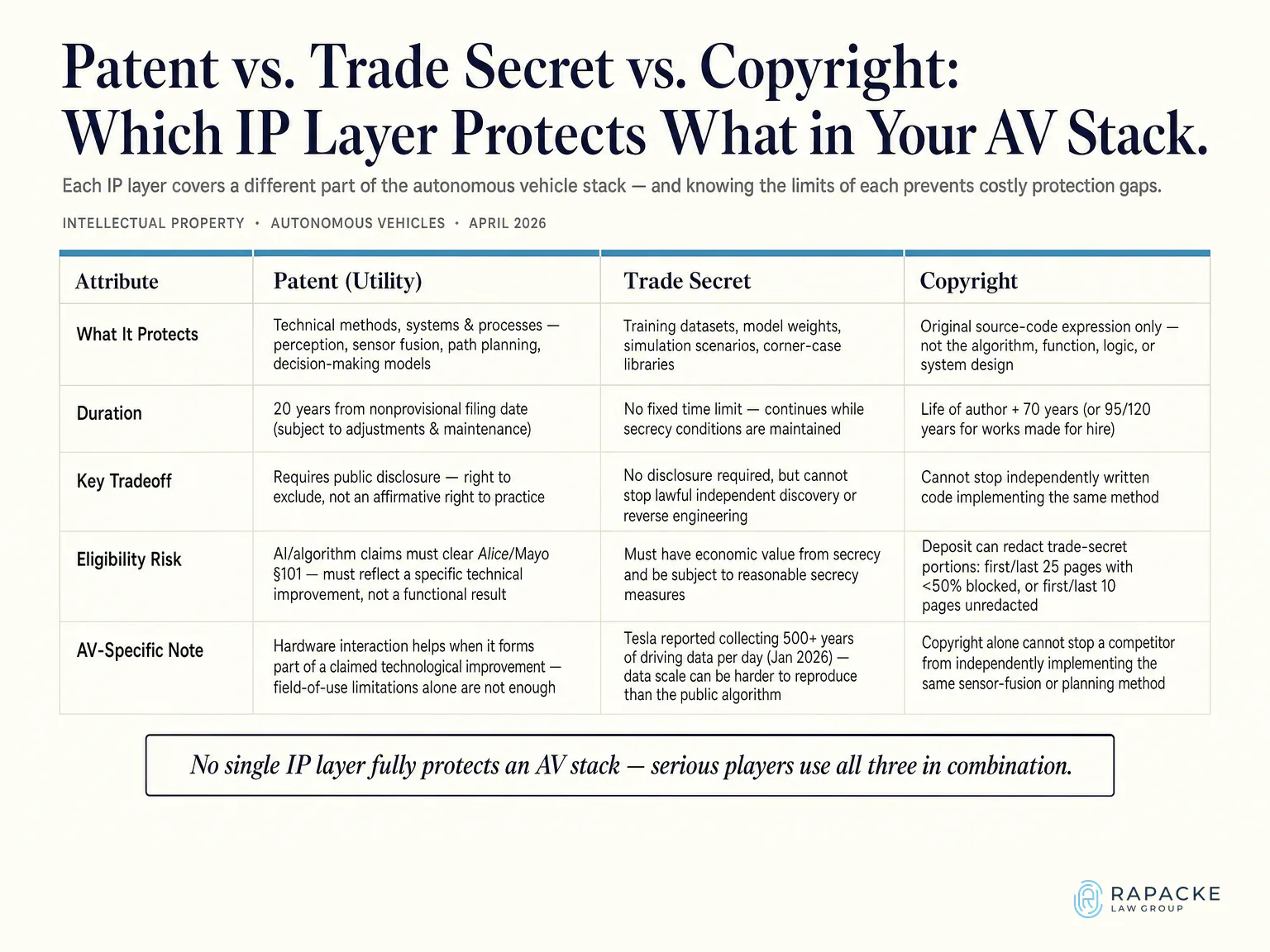
Utility patents cover perception, sensor fusion, planning, and decision-making methods — including systems designed to reduce human error — for 20 years from the earliest nonprovisional filing date (35 U.S.C. §154). They exclude others but grant no right to practice. Durable filings claim a narrow mechanism, not autonomous driving itself, see granted software patent examples.
Why Trade Secrets Often Protect Training Data and Model Weights
Training data, labeling pipelines, and trained weights are better kept as trade secrets, since patenting requires disclosure of intellectual property rights. Protection lasts indefinitely while information stays secret and reasonably guarded (USPTO trade secret policy), but cannot stop reverse engineering, so core methods still need patents. See intellectual property for AI makers.
What Copyright Does and Does Not Protect in AV Software
Copyright protects source code as expression, not the algorithm or design behind it (U.S. Copyright Office Circular 61), deposits can redact trade secrets, and it reaches literal copying only.
The Fourth Layer Most Startups Forget
Assignment agreements, work-for-hire terms, and NDAs with contractors, suppliers, and labeling vendors decide who owns the IP your engineers create.
Why AI and Algorithm Claims in This Field Live or Die on Patent Drafting
AI claims in autonomous driving fail under 35 U.S.C. §101 when they recite a desired outcome instead of the technical mechanism producing it. The fix is drafting, not a different invention.
The Alice and Mayo Framework Explained for AV Developers
Alice Corp. v. CLS Bank International and Mayo Collaborative Services v. Prometheus Laboratories created a two-step test, is the claim directed to an abstract idea, and does it add significantly more, meaning a specific practical application or technological improvement? The USPTO added AI Examples 47 through 49 in 2024 and posted subject matter eligibility training materials. For the broader doctrinal picture, see our overview of artificial intelligence and intellectual property.
How to Draft Claims That Survive Section 101
In Recentive Analytics v. Fox, decided April 18, 2025, the Federal Circuit held machine learning patents ineligible for applying generic models to new data environments without claiming a technological improvement. Functional claim language alone is insufficient: "real-time," "iteratively trained," and "neural network" are not inventive by themselves. Your specification must explain the improvement in technical terms, and the claims must recite the steps that deliver it — a lesson drawn from years of software development and AI patent prosecution. The data on whether software patents are enforceable tracks the same mechanism-versus-result divide.
What the Competitive Patent Landscape Actually Looks Like Right Now
Established automakers and Tier 1 suppliers dominate, not the brands consumers associate with self-driving. Rankings shift with search design.
The Major Patent Portfolio Holders
WIPO's land-transport dataset ranks Toyota first with more than 37,000 patent families, then Denso, Honda, Panasonic, Bosch, Nissan, Volkswagen, Hitachi, Ford, and General Motors. This patent data shows that established automakers dominate the landscape. Tesla does not appear among the top 25, see what the patents of Tesla actually claim. Waymo's AV-specific portfolio doesn't surface in broad land-transport queries. By country, Japan 29% of international land-transport patent families, the US 23%, Korea 16%, China 15%, Germany 13%. The European Patent Office serves as the key filing venue for German and broader European applicants.
The Densest Technical Clusters
Human machine interface patenting in land transport rose from about 2,200 families in 2000 to roughly 25,500 in 2023, facial recognition alone from 20 to 2,851. Low-latency communication patents grew from about 100 to more than 2,000, cybersecurity filings from 62 to more than 1,400, and mobility batteries from roughly 3,000 to nearly 41,000. China's annual future-transport output rose from about 38,900 families in 2018 to nearly 76,000 in 2023, a 14.3% compound annual growth rate — far outpacing other regions. Assume dense prior art.
How to Protect Your Own Autonomous Vehicle Innovation Before Someone Else Does
Filing date controls under first-inventor-to-file, delay narrows claim scope left to you.
Why Filing a Provisional Application Early Matters
A provisional patent application secures a filing date for 12 months, never examined, never a patent itself, and not extendable. Patent applications must fully support later claims under §112(a). Later claims hold only if the disclosure satisfies §112(a), document inputs, timing constraints, fallback states, and alternative embodiments. An NDA'd investor pitch isn't public disclosure, a conference demo or sale offer forfeits foreign rights.
Claim the Implementation, Not the Concept
"A method for autonomous path planning" is a concept. "A method for computing a collision-free trajectory by sampling a costmap from fused LiDAR and radar point clouds" is an implementation that covers the control algorithms directing vehicle motion.
Why a Freedom-to-Operate Analysis Is Essential Before You Commercialize
Patentability asks whether an invention is new and nonobvious under 35 U.S.C. §102 and §103, freedom to operate asks whether making, using, selling, or importing your product infringes in-force third-party claims under §271. A U.S. patent grants the right to exclude, not the right to practice. Owning a united states patent does not answer the second question, a narrow improvement can still read on an earlier, broader claim.
What an FTO Analysis Actually Delivers
A real FTO produces element-by-element claim charts against your final product architecture, not abstracts or assignee names. Reliable patent statistics show redesign after supplier commitments costs far more than acting before architecture freeze.
Patent, Publish, or Keep It Secret
Patent methods central to your moat, publish defensively on adjacent features, and keep data and weights as trade secrets. Publication destroys secrecy, so sequence deliberately and consult patent information resources before deciding.
What to Look for in an Automotive Patent Attorney for AV and AI Technology
The right attorney drafts AI claims that survive §101 scrutiny and separates patentability searching from FTO claim charting. General patent experience is not the same skill.
Why AV and AI Work Requires Specialized Experience
Both patent attorneys and agents may prosecute before the USPTO — the United States Patent and trademark office — under 37 C.F.R. §11.7, attorneys add state bar admission for opinions, contracts, and infringement analysis. Verify any practitioner on the USPTO roster and ask how they vet AI patent tooling.
Practicing Against Portfolios of This Scale
Generic claim language is a liability against the largest holder's 37,000+ patent families, making specialized patent portfolios essential for competitive protection. Andrew Rapacke and Rapacke Law Group focus on AI patent strategy, freedom-to-operate analysis, and flat-fee work backed by the RLG Guarantee, full refunds if the USPTO denies a provisional application or a patentability search shows the invention is not novel.
Frequently Asked Questions About Autonomous Vehicle Patents
Does Tesla have a patent on self-driving cars?
No company owns the general concept. Tesla patents specific implementations in vision-based perception and neural network processing, covering autonomous technology that operates without a human driver. Its Patent Pledge is a conditional standstill, not an open license.
Who made the first autonomous vehicle?
No single inventor. Two foundational 1980s programs ran independently, Ernst Dickmanns's VaMoRs in Germany and Carnegie Mellon's NAVLAB project, both rooted in computer science and engineering.
Is Tesla's Full Self-Driving system patented?
FSD names a software suite, not one patent. Implementations can be patented while code stays under copyright and weights remain trade secrets, Tesla classifies consumer FSD (Supervised) as SAE Level 2, which still requires human drivers to remain attentive.
What did Elon Musk say about self-driving cars?
At Tesla's 2019 Autonomy Investor Day, Musk predicted over one million robotaxis operating without human intervention in 2020, a forecast not met.
Can training data or model weights be patented?
Claimed as information, they face eligibility and utility obstacles and are better protected as trade secrets. The systems that generate or deploy them remain patentable as concrete improvements to autonomous technology.
Your Next Steps to Autonomous Vehicle Patent Success
Autonomous vehicle innovation compounds fast, patenting in future-of-transportation technologies grows at a compound annual growth rate of roughly 11% annually versus 4% for traditional transportation technologies, and incumbents hold patent portfolios measured in tens of thousands of families.
The bottom line: A weak patent recites what your system accomplishes and collapses at the first §101 rejection. A strong patent recites how your architecture achieves it, survives examination, and gives an acquirer or investor something to underwrite.
Delaying your filing has real business consequences. Every week without a filed application is a week a competitor can establish prior art that narrows or eliminates your claim scope. A late freedom-to-operate read can force a costly redesign after supplier commitments are locked in, turning a manageable legal task into an engineering crisis. Gaps in your patent position can erode investor confidence during diligence, trigger valuation haircuts, and leave you exposed to patent disputes from incumbents holding tens of thousands of families. Acting before your next demo, pitch, or architecture freeze is the single highest-leverage IP decision most founders and engineers can make.
- Schedule a Free IP Strategy Call to map your AV patent position
- Run a prior art search on your core perception or planning method
- File a provisional before any demo, pitch, or conference talk
- Commission an FTO read before architecture freeze
Flat-fee pricing means costs are known upfront. The RLG Guarantee covers your downside: full refund if the USPTO denies your provisional application, or a 100% refund if our patentability search finds your invention is not novel.
To Your Success,
Andrew Rapacke Managing Partner, Registered Patent Attorney Rapacke Law Group