
Key Takeaways
- Volume of patents does not equal protected value. Nikola Tesla held about 300 patents and nonetheless died broke, in part because he surrendered lucrative royalty rights and lacked the capital and business partners needed to consistently license and enforce his inventions.
- Tesla, Inc.'s 2014 patent pledge is a promise of non-enforcement, not a license or a transfer. The company still owns every patent and keeps filing new ones.
- The strongest patents protect the underlying mechanism of an invention, not one product version. That is how Nikola Tesla's AC motor patents earned Westinghouse royalties.
- File early. Under the first-to-file system, a delay hands competitors a legal opening even when your invention came first.
- A patent portfolio compounds through continuations, divisionals, and international filings. Plan the next filing before the current one grants.
*Written by Andrew Rapacke, Managing Partner, Registered Patent Attorney.* Andrew Rapacke is a registered patent attorney and the Managing Partner of The Rapacke Law Group, a full-service intellectual property law firm. He helps individuals and corporations across industries with the protection, prosecution, licensing, and enforcement of their intellectual property, with deep experience in patent, trademark, and copyright matters spanning software, AI and machine learning, blockchain, medical devices, and autonomous vehicle technology. A graduate of the United States Naval Academy, Andrew served as a Naval Engineering Officer before pursuing law and remains active in the startup and inventor communities throughout Florida.
Nikola Tesla held roughly 300 patents across the United States, United Kingdom, and dozens of other countries, yet struggled to convert that intellectual property into lasting commercial success. Nearly a century later, the company that borrowed his name built a patent portfolio of about 4,475 patents worldwide, and in 2014 publicly pledged not to sue good faith users of certain existing EV patents while retaining ownership and enforcement rights over the rest. The patents of Tesla, both the inventor and the automaker, tell two very different stories about what a patent actually does and what it fails to do when strategy is missing.
Neither approach is obviously right. Nikola Tesla filed numerous inventions, capturing little of their value despite holding basic patents on some of the era's most foundational technologies. Tesla, Inc. filed aggressively, opened part of its portfolio, and became one of the most valuable companies on earth. Understanding why is worth more to an inventor than any list of patent numbers.
This article walks through the patent strategies behind both Teslas, what worked, what did not, and what any inventor or startup founder can apply before scaling. You will learn how a strong patent claim creates leverage, why a pledge is not a license, and which decisions protect an invention versus leaving it exposed.
Why the Two "Teslas" Are the Most Instructive Patent Case Studies in History
Few names carry two patent legacies as different as Tesla. Studying the patents of Tesla, both the inventor and the automaker, reveals a distinct lesson about turning invention into protected value. If you want to see how modern companies structure this same tension, our breakdown of what makes patent portfolios valuable in the age of AI and tech innovation puts the numbers in context.
Nikola Tesla's Patent Legacy Was Over 300 Inventions and One Cautionary Story
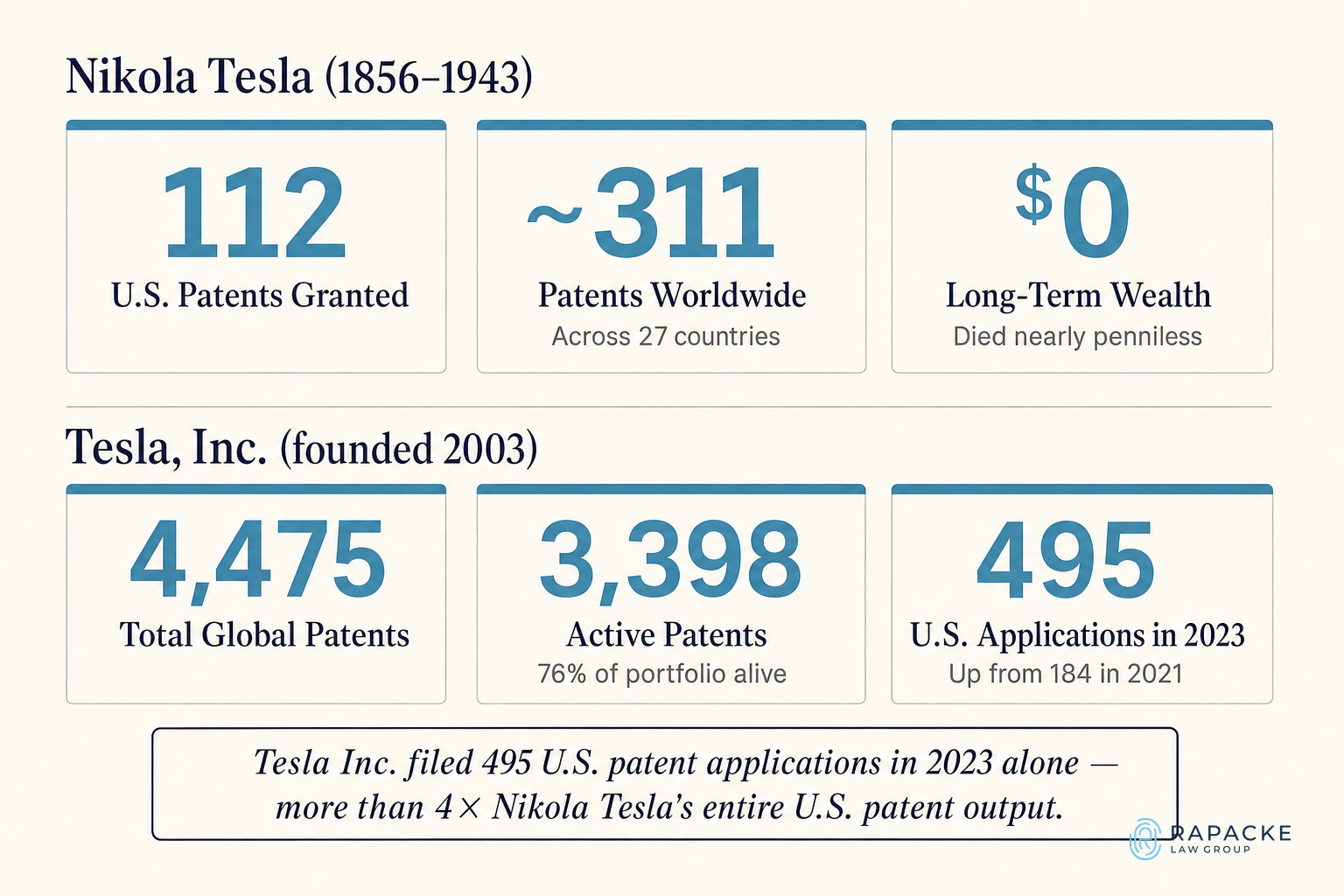
According to the Nikola Tesla Museum, Nikola Tesla obtained at least 112 U.S. patents and 199 additional patents across 26 other countries, for a minimum of 311 patents in 27 countries. His filings covered the induction motor, the rotating magnetic field, high frequency current systems, dynamo electric machines, wireless energy transmission, and the Tesla electric light and electric arc lamp. The nikola tesla patents on dynamo electric machines alone influenced generations of electrical engineers. Yet as the Smithsonian documents, he died nearly penniless. Volume of patents alone does not equal protected value. Strategy behind those filings matters just as much as the inventions.
Tesla Motors Built a Modern Patent Portfolio
Tesla, Inc. built a portfolio of about 4,475 patents globally, roughly 3,398 of them active, belonging to 1,269 unique patent families, per GreyB's analysis. Public patent analytics show the company's annual filing volume rising significantly into the early 2020s, with a noticeable jump by 2023, though published sources do not agree on exact U.S. application counts. Interestingly, Elon Musk is an inventor on only about 25 patents worldwide, spread across just eight patent families. Tesla's IP strength comes from its engineering teams, not its CEO. A growing company's patent portfolio should map directly to its research roadmap. Each filing stakes a strategic claim on future technology, a pattern you can see repeated in our look at what makes patent portfolios valuable.
What Separates a Patent That Protects From a Patent That Sits on a Shelf
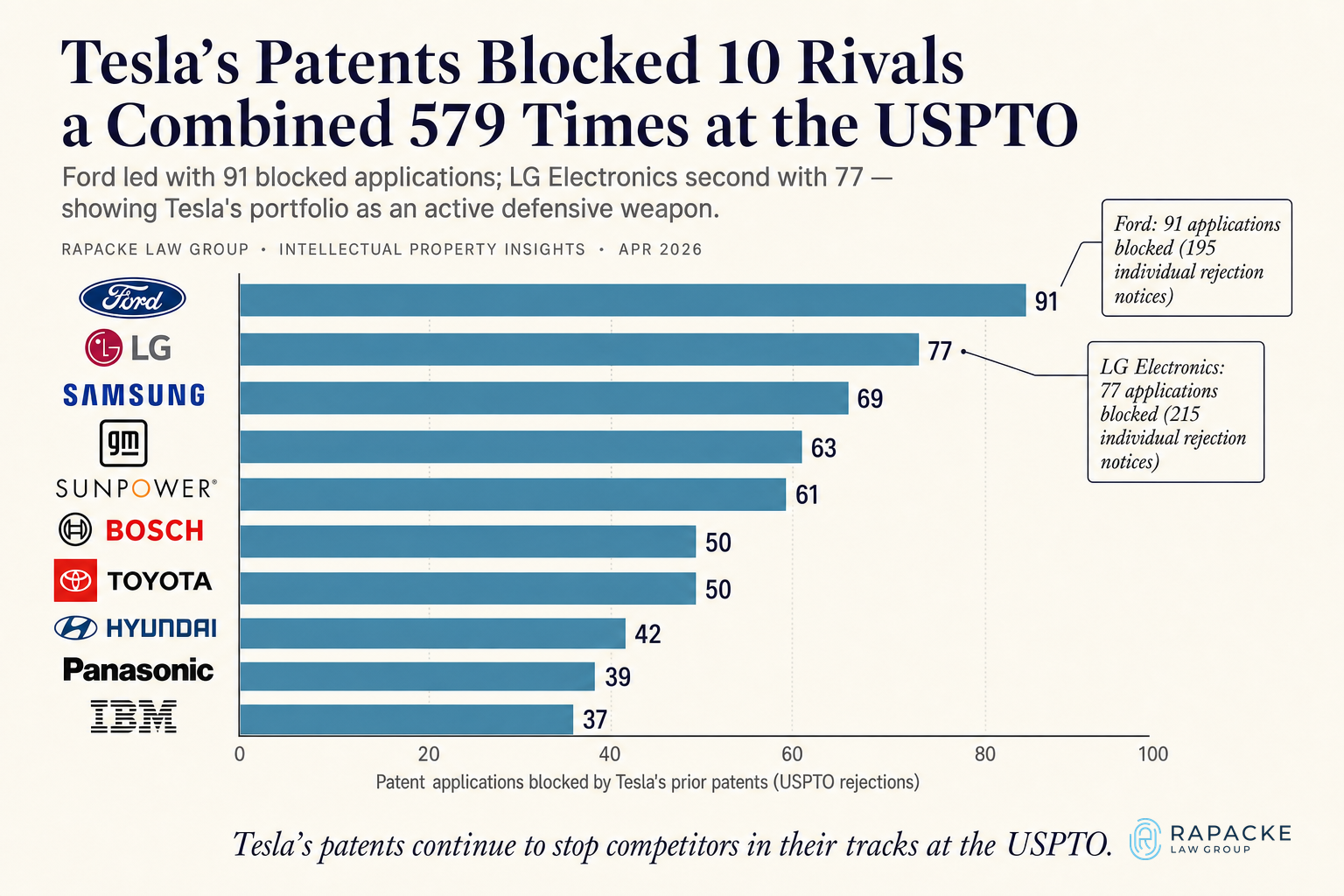
Not all patent applications become enforceable assets. Tesla's patents are among the most known patents in the EV sector, widely cited by examiners in office actions against competitors, functioning as real prior art barriers rather than mere paperwork. As the chart below shows, two Teslas produced two very different outcomes: 112 U.S. patents and about 311 worldwide for the inventor, against 4,475 global patents for the company. Nikola Tesla's hundreds of patents were rarely leveraged to block rivals or generate steady revenue. Before filing, ask whether an application protects a commercializable product or simply documents an idea. The distinction between a patent and a guarded trade secret is one many companies weigh, as our comparison of proprietary versus patented approaches at Microsoft, Tesla, and McDonald's explains.
How Nikola Tesla's Core Inventions Actually Got Protected
The gap between Nikola Tesla's greatest success and his greatest failure lives inside the patents themselves, each a tesla invention built for a different commercial reality, and the business built around them.
The Induction Motor and Rotating Magnetic Field Patents Were Strategic, Not Accidental
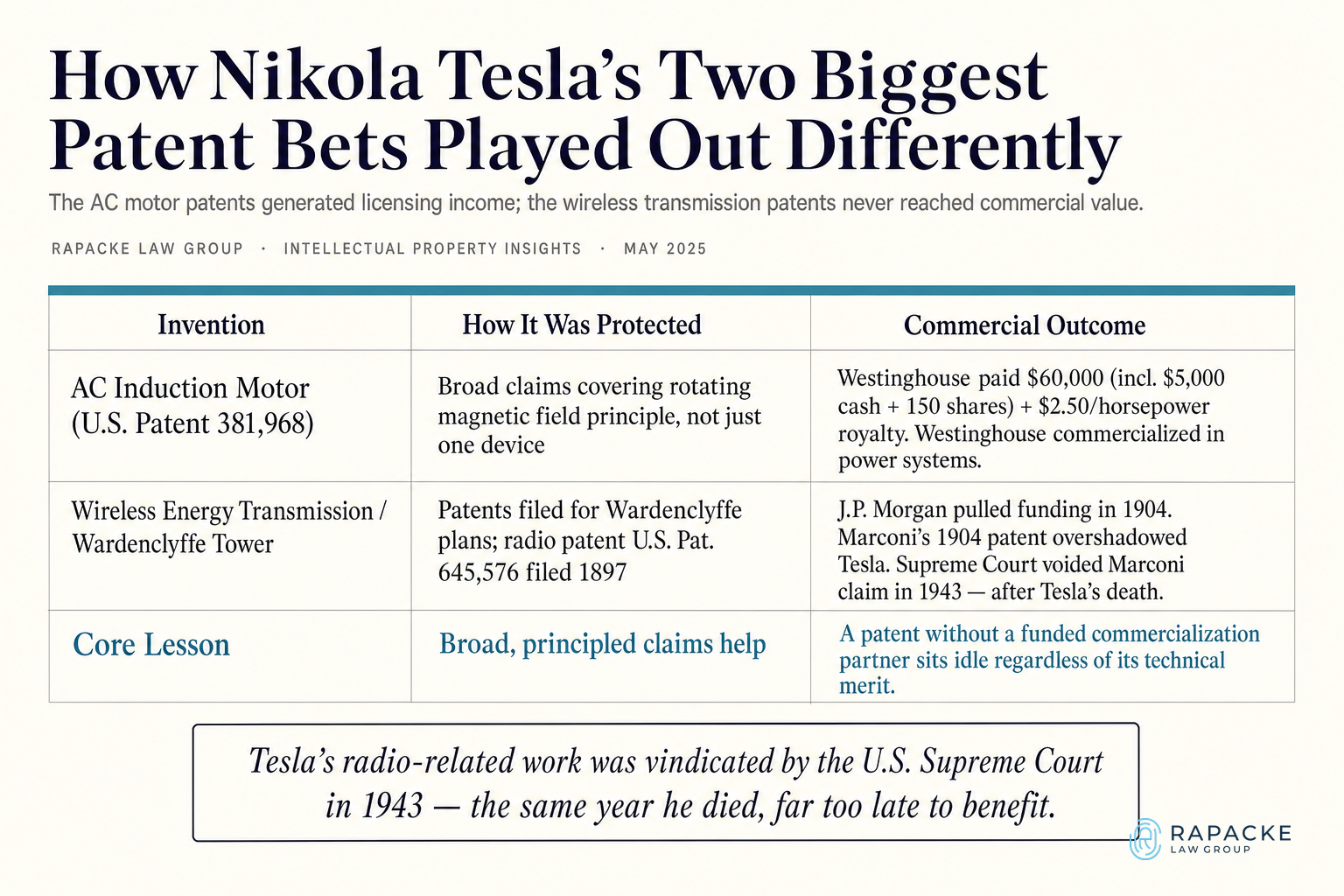
Nikola Tesla's polyphase AC induction motor patents, including U.S. Patent 381,968 as his first patent in that family, were written to cover the broad principle of the rotating magnetic field rather than a single device. That breadth is why George Westinghouse could license the entire technology. According to PBS, Westinghouse paid Tesla $60,000 plus a royalty of $2.50 per horsepower in 1888. The strongest filings protect the underlying mechanism, not one version of the product. That is how patent claims create durable leverage.
Why Tesla's Wireless Energy Transmission Patents Failed to Deliver Value
Nikola Tesla held patents on wireless energy transmission and high frequency current applications, yet he never commercialized them. The Wardenclyffe Tower project stalled when J.P. Morgan's backing ended in the early 1900s, and the project was abandoned in 1906, as the Smithsonian recounts. Without capital, a licensee, or enforcement capability, even breakthrough patents expire quietly. A patent is only as powerful as the business infrastructure around it.
What Tesla's International Filings Reveal About Global IP Strategy
Nikola Tesla filed patents in 26 countries beyond the United States, with clusters in European industrial centers including France, the United Kingdom, Belgium, Germany, Italy, and Austria, per the Nikola Tesla Museum. That early instinct recognized a truth inventors still face. As the comparison shows, his AC motor bet paid off through licensing while the wireless bet collapsed for lack of capital. A U.S. patent alone does not stop competitors manufacturing or selling abroad. Inventors commercializing in multiple markets need a filing strategy that covers those markets, not just their home country. The same logic drives modern tech giants, as our analysis of how patents by Apple shape the future of technology shows.
Tesla Motors' Open Source Patent Pledge and What It Actually Means Legally
Arguably the most misunderstood chapter in the patents of Tesla is the 2014 pledge. The legal reality is narrower than the headlines suggested.
What Elon Musk Actually Said in the 2014 Announcement
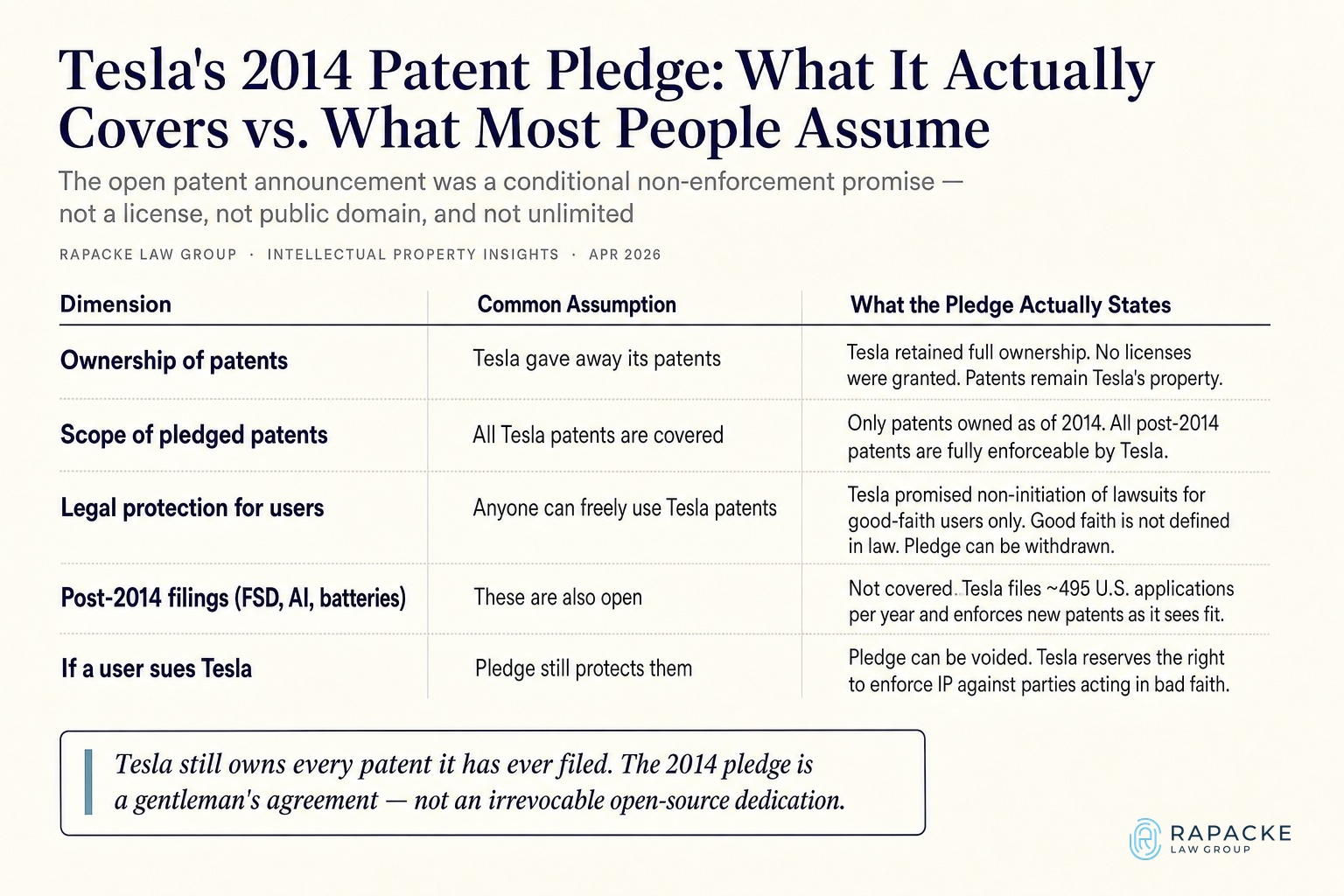
In June 2014, Elon Musk wrote that "Tesla will not initiate patent lawsuits against anyone who, in good faith, wants to use our technology," in a post titled All Our Patent Are Belong To You. Reporters called it open sourcing, but Tesla did not release its patents into the public domain. A patent pledge is a promise of non-enforcement, not a transfer. The underlying intellectual property rights stayed with Tesla, and the pledge can be conditioned or revisited. Legal scholars analyzing the pledge describe it as a conditional covenant not to sue rather than a license, raising doctrinal questions about reliance and revocability.
Does Tesla's Open Source Philosophy Mean Competitors Can Use the Technology for Free
Not without conditions. The pledge protects good faith users of tesla technology, meaning those not acting against Tesla's interests. It does not cover other third party features embedded in Tesla vehicles, and it does not shield a company that sues Tesla and expects the pledge to survive. As GreyB and other analysts note, Musk's pledge does not define "good faith," and there is no case law yet interpreting this specific condition, so relying on the pledge carries legal uncertainty. Some analysts frame the pledge as a strategic tool that effectively asks adopters to give up their own rights to assert IP against Tesla in exchange for access. Founders considering building on Tesla's pledged technology should get formal legal advice first. A pledge is not a license.
Why Tesla Still Files New Patent Applications Aggressively
Tesla continues to file at a high volume. Musk's pledge does not explicitly address future patents, and Tesla has continued to file new patents in areas like full self driving systems, battery technology, neural network architectures, and machine learning algorithms. Those patents technically remain enforceable unless Tesla applies the same non-aggression policy to them, and major categories such as robotics and AI infrastructure were never inside the pledge's scope. Open source gestures and aggressive filing are not contradictory. Established companies often do both, opening older foundations to grow the market while guarding next generation technology. Founders navigating the same question can learn from the proprietary versus patented debate that defines competitive success.
The Technology Areas Where Tesla Patents Create the Strongest Competitive Moat
A patent portfolio's power lies in where it concentrates. Tesla's filings cluster exactly where copying would hurt it most.
Battery Technology and Electric Vehicle Systems Are Tesla's Deepest Patent Moat
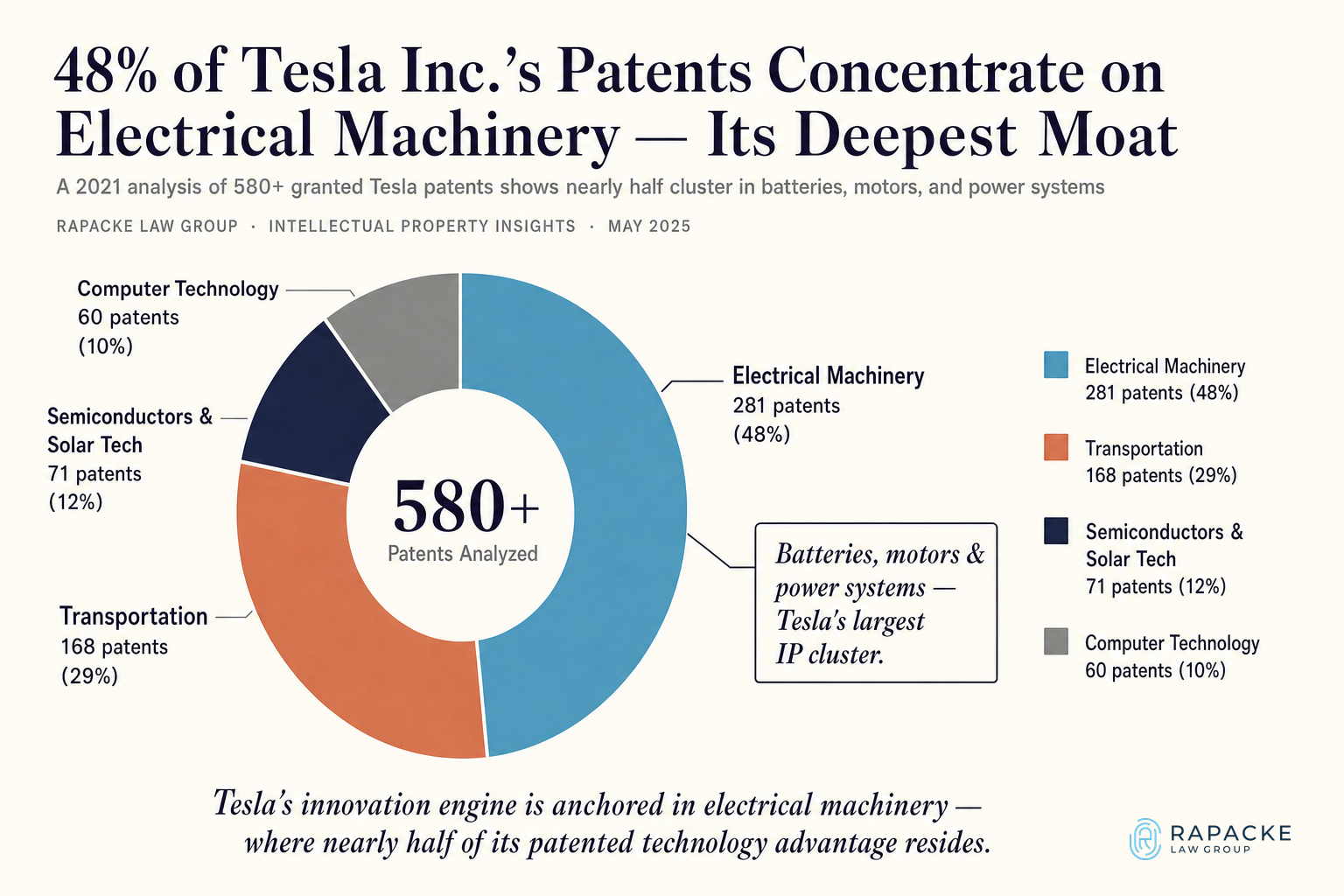
Tesla's most defensible intellectual property sits in battery management, cell chemistry, and electric vehicle powertrains. A 2021 CleanTechnica analysis, summarizing a Nikkei Asia and Intellectual Property Landscape study, found 281 of Tesla's then 580 granted patents fell in electrical machinery categories, roughly 48 percent of the portfolio and by far the largest cluster, followed by 168 in transportation and 71 in semiconductors. A patent family is a group of related filings tied to one core invention, and depth in a single technology area matters more than raw count. When building a portfolio, concentrate filings in the technology that would cause the most damage if copied. Depth beats breadth.
Artificial Intelligence and Full Self Driving Patents Are the Fastest Growing Category
Tesla's patent applications in artificial intelligence, machine learning algorithms, and full self driving software have surged. The 2021 CleanTechnica analysis found the company held around 60 patents in computer technology, many tied to machine learning for autonomous driving, and its continued filing activity suggests that number has grown. Software and AI patents work differently from hardware patents. The claims must cover a specific technical implementation, such as a method for training a neural network to detect objects, rather than an abstract idea. That distinction matters for every SaaS founder watching Tesla's approach. If you are patenting machine learning work, our guides to AI patent requirements and the conditions of patentability and these AI patent examples leading the tech revolution walk through exactly how those claims get written.
How Tesla's Portfolio Compares to Direct EV Competitors
Legacy automakers hold far more patents than Tesla, reflecting decades of combustion era engineering rather than a superior EV position. Patent counts also vary by provider. GreyB reports about 4,475 Tesla patents globally, while Lumenci counts roughly 4,225 total patent assets including 1,607 in the United States, a reminder that totals shift depending on whether families, continuations, and design patents are included. Tesla's smaller portfolio is concentrated on the EV and computing frontier, and its patents frequently appear as prior art cited against competitors' applications. A portfolio's strength is always relative to competitors. Knowing where rivals file reveals your own gaps, a theme we explore in what company has the most AI patents.
What Nikola Tesla's Mistakes Teach Inventors About Patent Strategy Today
Nikola Tesla's failures illustrate several mistakes that modern founders still make. Each one is avoidable.
Not Controlling Your Patent Rights Is a Business Ending Risk
Nikola Tesla sold or licensed his AC patents to Westinghouse and later agreed to cancel his royalty contract in the 1890s after Westinghouse warned the ongoing payments could endanger the company's finances. Historians note that walking away from that contract forfeited enormous royalty income and contributed to Tesla's later financial difficulties, as discussed in the Smithsonian's profile of the inventor. An assignment transfers ownership permanently. A license preserves your ownership while still generating revenue. Understand which one you are signing before you sign it.
Filing Too Late Left Tesla's Best Ideas Unprotected
Nikola Tesla often delayed filing, and radio is the painful example. Guglielmo Marconi secured the commercial radio patents and the acclaim, even though the U.S. Supreme Court later credited Tesla's prior work in Marconi Wireless Telegraph Co. v. United States in 1943, decades after his death. The United States Patent and Trademark Office now runs a first-to-file system under the America Invents Act. Documenting and patent filing quickly is not optional. Delay hands a competitor a legal opening even when your invention came first.
Nikola Tesla Had Individual Inventions, Not an IP Portfolio Strategy
Tesla patented one invention at a time with no continuations or family strategy, so competitors could design around a single claim, file on the same invention from a different angle, or wait for expiration. Tesla, Inc. does the opposite, layering continuation and divisional applications around a core technology to extend and broaden protection. As the pledge comparison shows, most people assume Tesla gave its technology away, when in fact the company kept ownership and kept filing. A portfolio strategy means each new filing reinforces the last, stacking protection so no single claim is the only line of defense. Our overview of patent portfolio strategy breaks down how to build that layered protection deliberately.
What Founders and Inventors Can Apply From Tesla's Patent Playbook Right Now
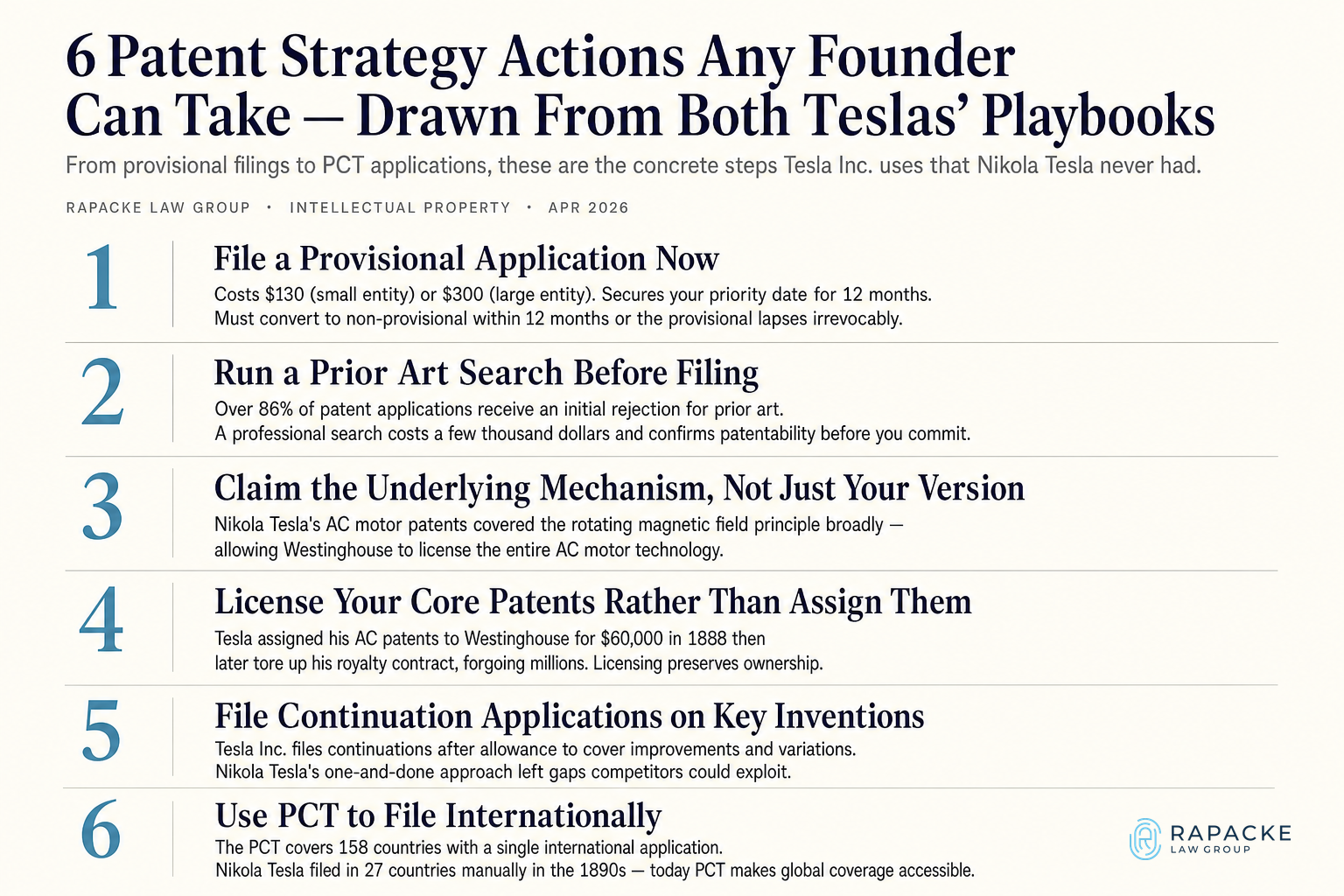
The practical lessons from both Teslas fit into a short sequence any founder can start this quarter.
Start With a Prior Art Search Before Filing Anything
Knowing what already exists changes everything. Tesla, Inc. runs freedom to operate analysis before launching new products, while Nikola Tesla's radio claim collapsed partly because prior work existed. The stakes are real. According to the Patent Trademark Blog's summary of a Yale Journal on Law and Technology study of USPTO data, over 86.4 percent of utility patent applications receive an initial Office Action rejection. A prior art search is the first decision gate in any serious patent strategy. Skipping it wastes filing fees and attorney time. Under The RLG Guarantee for patentability searches, you get a full refund if our search finds your invention is not novel, so the first step carries no downside risk.
Provisional Patent Applications Give You 12 Months of Runway
Many founders do not realize they can file a provisional patent application to lock a priority date without committing to full prosecution costs. The USPTO fee schedule lists a modest small entity provisional filing fee, and the exact amount is updated periodically, so confirm the current figure before filing. A provisional buys 12 months to refine the invention, court investors, and label the product patent pending. You must file the non-provisional within that window or the provisional lapses. The RLG Guarantee for provisionals gives you a full refund if the USPTO denies your provisional patent application. If you have a working invention but are not ready for full prosecution, file the provisional now.
Building a Patent Portfolio Takes Ongoing Strategy
Tesla, Inc. did not build its moat with one application. It filed continuously, used continuation applications to extend protection, and expanded abroad through PCT international applications, a system that now reaches 158 countries per WIPO. As the checklist below reinforces, solo inventors and SaaS founders should treat IP like a product roadmap. Plan the next filing before the current one grants, and revisit strategy every time you ship a significant new feature. For software teams, our software patents checklist for founders covers what to nail down before filing. Because we work on a fixed fee model, you know the cost of each filing before you commit, which makes planning a multi-year portfolio far more predictable than hourly billing.
Frequently Asked Questions About the Patents of Tesla
How many patents did Tesla own?
Nikola Tesla is credited with about 300 patents worldwide, at least 112 issued in the United States plus 199 in other countries, for a minimum of 311 total, per the Nikola Tesla Museum. Tesla, Inc. holds a far larger corporate portfolio, roughly 4,475 patents globally with about 3,398 active as of 2026, according to GreyB. The two figures get confused because both entities share the Tesla name, and anyone researching the patents of Tesla should note they are entirely separate.
Is Elon Musk related to Nikola Tesla?
No. Elon Musk has no familial connection to Nikola Tesla, who died in 1943. Co-founder Martin Eberhard proposed the name Tesla Motors in 2003 as a tribute to Nikola Tesla's work on the AC induction motor, as The Motley Fool recounts. Musk led the Series A investment round and joined the board in 2004, and became CEO in 2008.
What has Tesla patented?
Nikola Tesla patented foundational electrical inventions including the rotating magnetic field, the induction motor, the regulator for alternate current motors, the Tesla electric light, the electric arc lamp, and wireless energy transmission systems. Tesla, Inc. holds patents across battery technology, electric vehicle powertrains, full self driving software, neural network architectures, and machine learning algorithms, along with charging and solar filings per GreyB.
What happened to Tesla's patents?
Nikola Tesla's patents have all long expired and sit in the public domain. Some were assigned to partners like Westinghouse, and his radio claims were only vindicated posthumously by the U.S. Supreme Court in 1943. Tesla, Inc.'s patents remain active and are filed continuously, though the 2014 pledge committed the company to not initiating patent lawsuits against good faith users of certain technology.
Can you use Tesla Motors' patents for free?
Not without conditions. The 2014 patent pledge is a promise of non-enforcement, not a license and not a transfer of intellectual property rights, and the patents remain Tesla's property. There is no reported case law interpreting the pledge's "good faith" condition, and the pledge does not cover third party features embedded in Tesla vehicles or protect a party that asserts IP rights against Tesla. Consult a registered patent attorney before assuming free access.
How does Tesla protect its newest inventions if it pledged not to sue?
The pledge was framed around patents Tesla owned in 2014 and does not clearly extend to later filings. The company keeps filing aggressively, with sustained annual volume in artificial intelligence, full self driving systems, and battery technology per GreyB. Those newer patents technically remain enforceable, so Tesla balances ecosystem goodwill against protecting its next generation competitive advantages.
Your Next Steps to Patent Strategy Success
The core tension is simple. Reviewing the patents of Tesla on both sides of history shows that Nikola Tesla's 300 patents could not protect his financial future without licensing control and capital behind them, while Tesla, Inc. turned focused filing and a strategic pledge into a durable competitive moat. Patent protection is not a filing event. It is an ongoing strategy.
The bottom line, a weak patent documents an idea and sits on a shelf, while a strong patent protects a commercializable product, blocks competitors as prior art, and generates leverage in funding rounds and licensing talks. The difference is deliberate claim drafting and a portfolio built to compound, not raw filing volume.
That leaves you with a few decisions. First, whether your invention is genuinely patentable given the prior art. Second, whether to file a provisional patent application now to secure your priority date while you refine the product. Third, whether you have a plan to build a patent portfolio rather than a single lonely filing that competitors can design around. Waiting is the expensive option. Under first-to-file rules, every month of delay is a month a competitor can beat you to the office, and an unprotected core feature can sink a funding round or invite a copycat before you scale.
Take these steps now:
- Schedule a Free IP Strategy Call to map your inventions to a filing plan built for how you actually scale.
- Run a prior art search before spending on a full application, backed by The RLG Guarantee that returns 100 percent of your fee if your invention is not novel.
- File a provisional to lock your priority date, with a full refund if the USPTO denies the application.
- Deepen your strategy with our AI Patent Mastery resource and The Must-Have SaaS Patent Guide 2.0.
Answering those questions well is exactly what separates a patent that protects from a patent that sits on a shelf. With a fixed fee model and outcome-backed guarantees, the cost of protecting your invention is predictable, while the cost of leaving it exposed is not. That asymmetry is the whole competitive advantage.
To Your Success,
Andrew Rapacke Managing Partner, Registered Patent Attorney Rapacke Law Group