


Key Takeaways
- Electronic filing costs $350 per class, plus $200 per class for free-form goods descriptions and $100 for missing information ([current USPTO fee schedule](https://www.uspto.gov/sites/default/files/documents/USPTO-fee-schedule_current.pdf)).
- Trademark Center replaced TEAS for new applications January 18, 2025; TEAS still handles office actions and maintenance filings.
- The USPTO averaged 4.2 months to first action and 9.7 months to registration or abandonment (August 10, 2026).
- A wrong owner or inaccurate goods description can be unfixable; identifications narrow later, never broaden.
- Registration grants presumptive nationwide rights, but enforcement is yours; earlier common law users retain existing-market rights.
*Written by Andrew Rapacke, Managing Partner, Registered Patent Attorney.* Andrew Rapacke is a registered patent attorney and the Managing Partner of The Rapacke Law Group, a full-service intellectual property law firm. He helps individuals and corporations across industries with the protection, prosecution, licensing, and enforcement of their intellectual property, with deep experience in patent, trademark, and copyright matters spanning software, AI and machine learning, blockchain, medical devices, and autonomous vehicle technology. A graduate of the United States Naval Academy, Andrew served as a Naval Engineering Officer before pursuing law and remains active in the startup and inventor communities throughout Florida.
Brand owners filed 824,192 trademark application classes in fiscal year 2025, roughly 57,000 more than the year before, according to the USPTO FY2025 Agency Financial Report. Every trademark filing ahead of yours is a potential obstacle. An intent-to-use application submitted weeks earlier can mature into a registration with nationwide priority. A prior good-faith user keeps rights in the territory it already served, but expansion beyond that area is generally blocked.
This guide covers what to do before you file, how to choose a filing basis, how the USPTO Trademark Center process works, what government fees total in 2026, and what happens during the trademark application process including examination, publication, and maintenance, plus the errors that push applications toward refusal or abandonment.
What Trademark Filing Actually Does for Your Brand (and What It Doesn't)
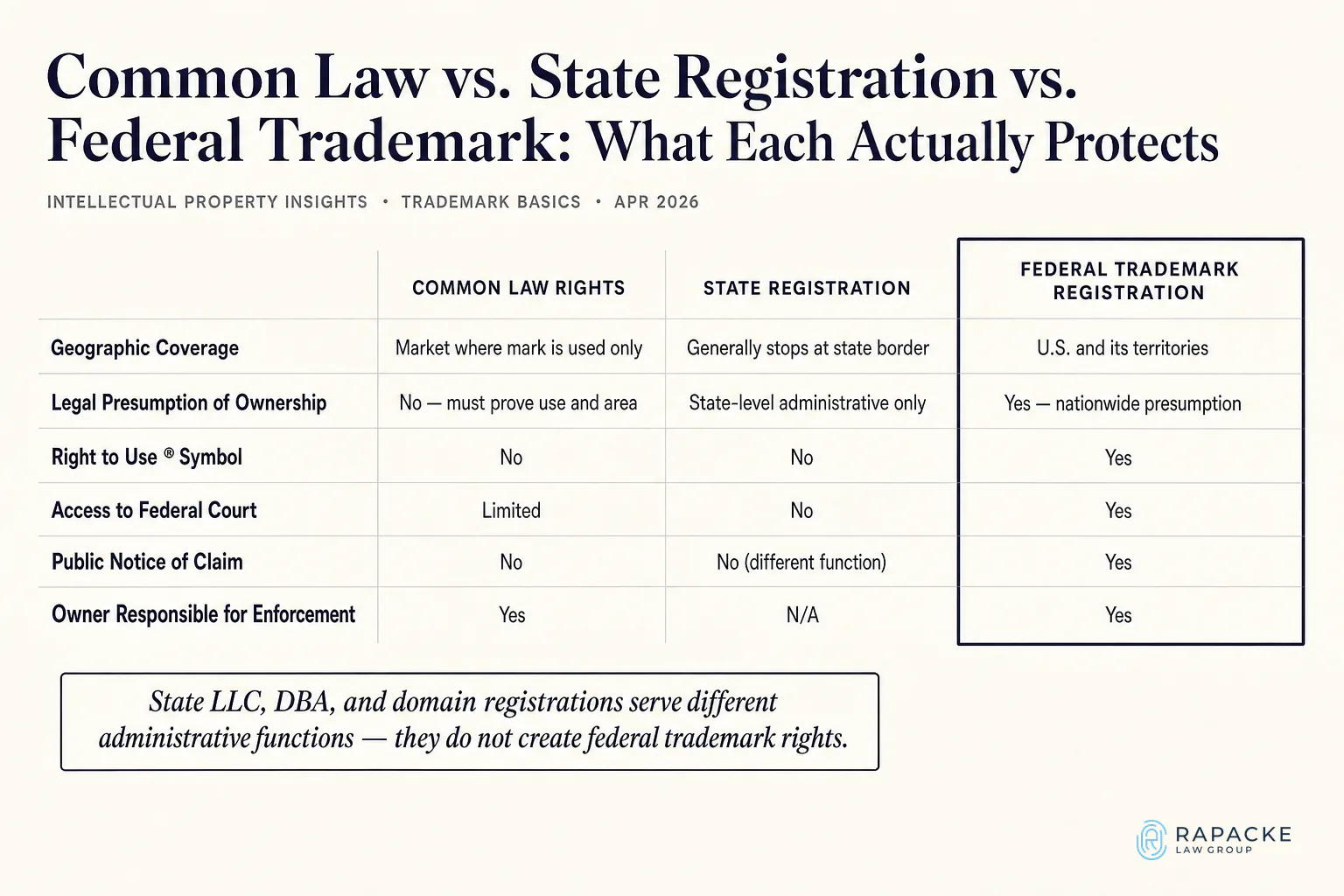
A trademark filing does not create your rights, using the mark does. Federal registration adds public notice, a legal presumption of ownership, access to federal court, the right to use the ® symbol, and rights extending throughout the United States and its territories, according to the USPTO. If you are still working out what a trademark actually protects, start there.
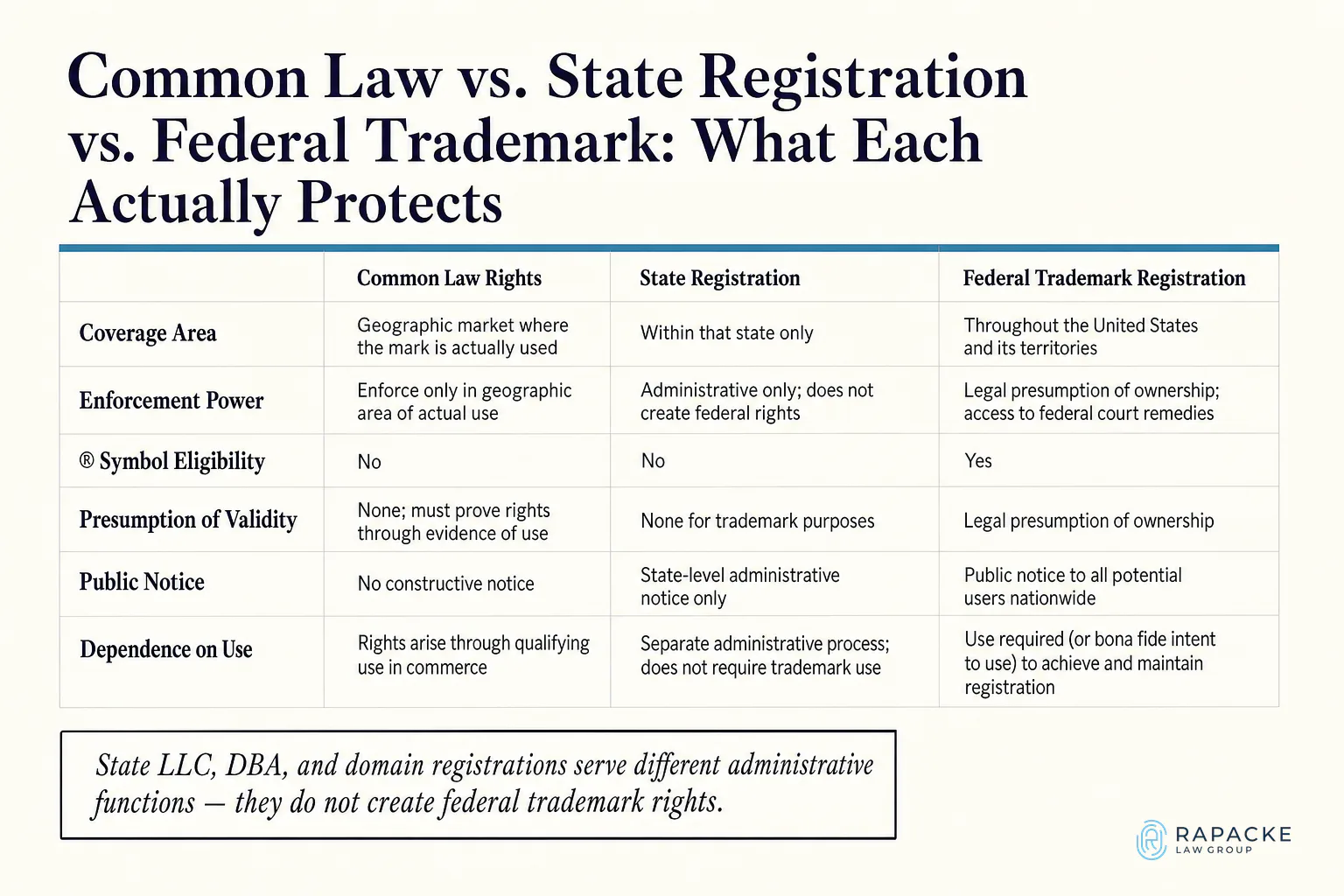
That difference is geographic. Common law trademark rights arise from actual use and reach only the market where you operate. A registration carries presumptive nationwide scope, subject to earlier users and territorial exceptions. An Austin, Texas coffee brand with three shops and no registration has rights in Austin, with a registration, it can challenge a copycat launching in Denver.
What "Use in Commerce" Means and Why It Matters
The Lanham Act defines "commerce" as "all commerce which may lawfully be regulated by Congress," and defines "use in commerce" as "the bona fide use of a mark in the ordinary course of trade, and not made merely to reserve a right in a mark" (15 U.S.C. §1127). In Christian Faith Fellowship Church v. adidas AG, the Federal Circuit held that a $38.34 out-of-state sale of two marked hats satisfied the statutory commerce requirement. Crossing state lines is a useful rule of thumb, not the full legal test, and the USPTO trademark application process does not substitute for legal advice on whether your use qualifies.
Federal Registration vs. State Business Name Registration
Registering an LLC, DBA, or domain name is administrative. None of it creates federal trademark protection or common law trademark rights beyond your area, and state rights generally stop at the state border. File a separate federal application with the U.S. Patent Office for national scope, and compare state trademark versus federal registration before committing budget to either.
What a Registered Trademark Cannot Do
Federal registration covers the goods and services you listed plus legally related offerings. It does not cover patents or copyrights, and it does not enforce itself. Trademark class numbers are administrative categories, so goods in different classes can still be confusingly related.
Run a Comprehensive Trademark Search Before You File a Single Form
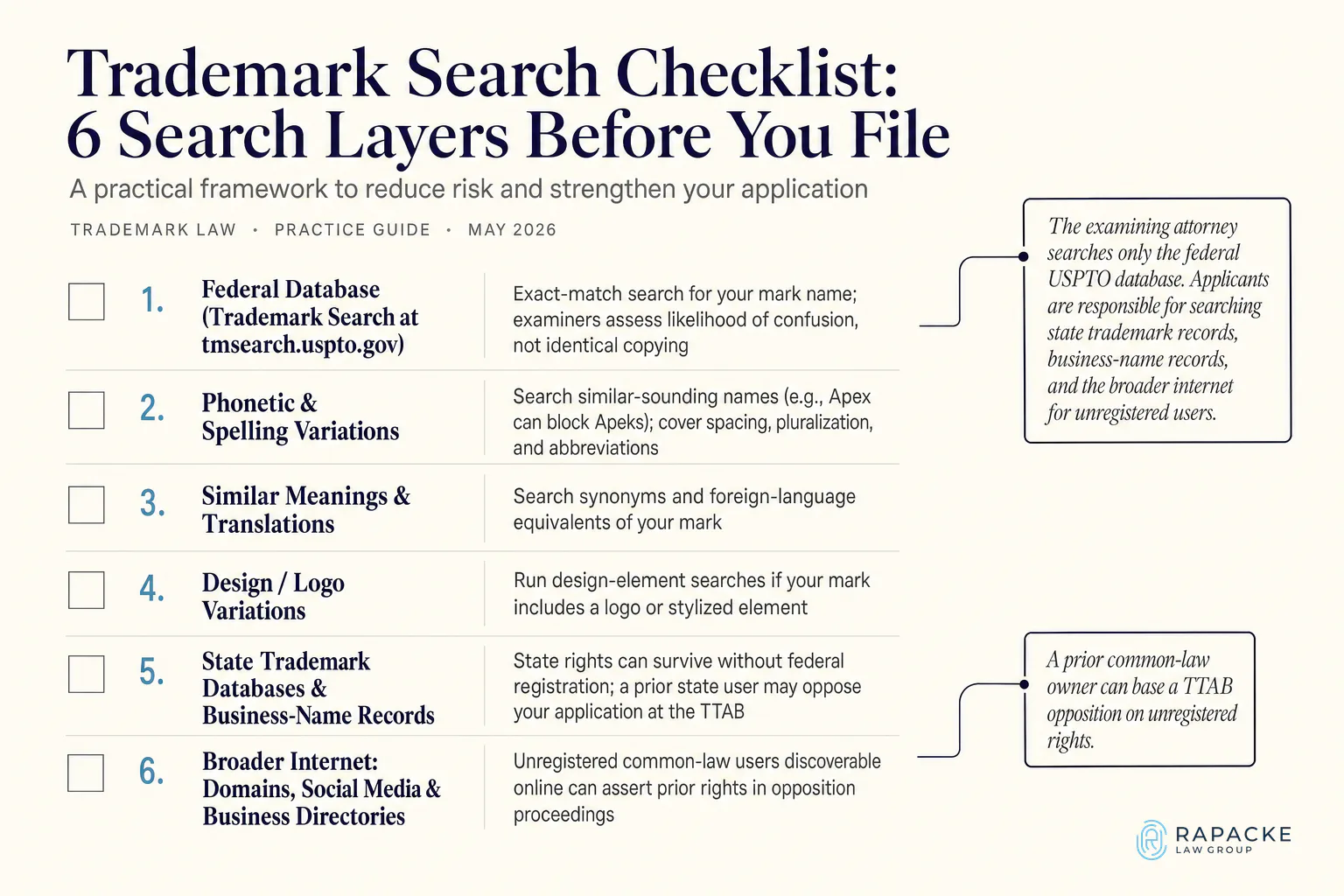
Likelihood of confusion is a common refusal ground, and marks need not be identical to conflict. Similarity in sound, appearance, meaning, or commercial impression can be enough when goods or services are related, per USPTO guidance. An existing "Apex" registration can block "Apeks," for example.
How to Search the Federal Trademark Database
The USPTO Trademark Electronic Search System (TESS) is retired, clearance searches now run through Trademark Search at tmsearch.uspto.gov, while Trademark Center handles filings. Use the trademark electronic search system to search exact matches first, then phonetic equivalents, then spelling, spacing, and plural variants. Our walkthrough on using trademark and patent office search tools before you file structures each pass.
Why You Should Search Beyond USPTO Records
The examining attorney searches only the federal database. A prior common law owner can oppose your application at the Trademark Trial and Appeal Board on unregistered rights, the TTAB lets filers assert a common law word mark or upload a design mark. Clearance needs six layers, exact matches, phonetic equivalents, spelling and spacing variants, translations and abbreviations, design variations, and common law use in state registries, directories, domains, and social handles.
When a Professional Trademark Search Is Worth the Cost
A comprehensive search of international databases, industry publications, and common law sources catches conflicts a self-search misses, and a trademark lawyer can also advise on the strength of your mark before you file. Professional representation is optional for U.S.-domiciled applicants, but for a brand tied to funding, launch, or revenue it is basic risk management, and a legal team can also uncover conflicts a self-search misses. Investors running IP diligence will ask what you cleared and when, document it.
Choose the Right Trademark Filing Basis Before You Start the Application
Your filing basis determines what you must prove and when. The United States Patent and Trademark Office recognizes four principal bases, the wrong one causes delays, extra fees, or abandonment.
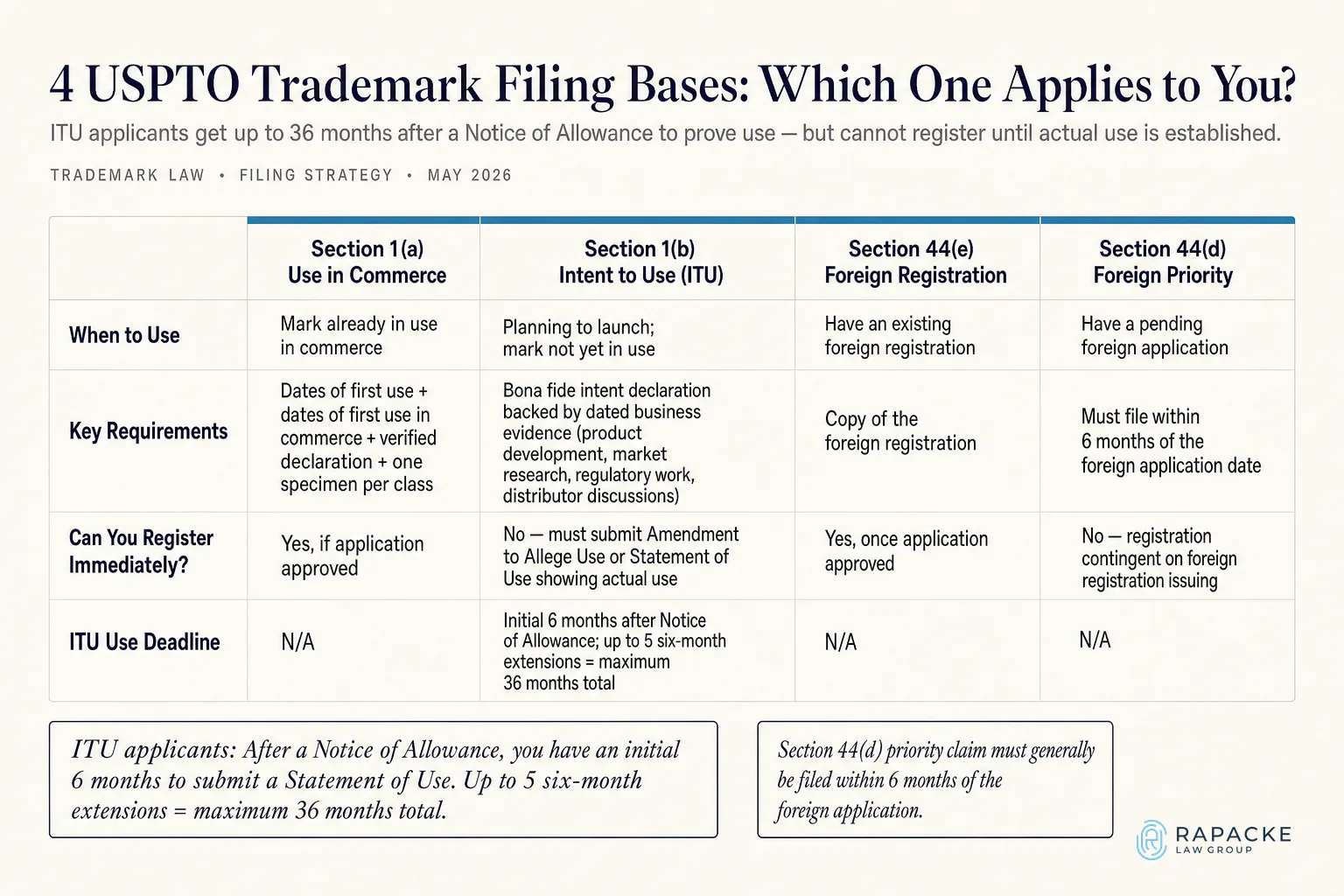
| Filing basis | Best for | Core requirement |
|---|---|---|
| Section 1(a) use in commerce | Brands already selling | Dates of first use plus one specimen per class |
| Section 1(b) intent to use | Pre-launch products | Bona fide intent, later Statement of Use |
| Section 44(d) foreign priority | Filers with a recent foreign application | Claim filed within six months of the foreign filing |
| Section 44(e) foreign registration | Owners of a home-country registration | Copy of the foreign registration |
Use in Commerce vs. Intent to Use
Section 1(a) requires current use plus evidence. An intent to use application under Section 1(b) lets you file pre-launch, but registration waits for an Amendment to Allege Use or Statement of Use. After a Notice of Allowance, six months extendable by five six-month requests gives a 36-month maximum (15 U.S.C. §1051(d), USPTO intent to use forms guidance).
What You Need to Prove Use in Commerce
A specimen is real marketplace evidence, labels, packaging, tags, or a working point-of-sale webpage for goods, advertising for services actually rendered. Mockups, printer's proofs, and draft webpages are routinely refused (USPTO specimen guidance).
Foreign Application Basis and the Madrid Protocol
Foreign applicants may rely on a home-country application or registration, U.S. owners can extend protection via the Madrid Protocol. Madrid yields a bundle of national rights, each examined in the designated country, not one worldwide registration, and is a key tool for international trademark protection. Discuss international plans and the relevant legal requirements with a trademark attorney before filing.
How to File Through Trademark Center and the Trademark Electronic Application System
Trademark Center became the exclusive electronic system for new applications on January 18, 2025, replacing the Trademark Electronic Application System for initial filings. TEAS now handles only post-filing forms such as office action responses and maintenance filings. Electronic filing has been mandatory since 2020, with narrow exceptions, and a permitted paper application costs $850 per class. Our guide on how to get a federal trademark maps each screen to its decision.
Create Your USPTO Account and Start a New Application
You need a USPTO.gov account with multifactor authentication and identity verification, which the USPTO says usually takes under 15 minutes online. Enter the owner's exact legal name and entity type, confirming you meet all application requirements, as an ownership error can require a new application and fee.
Define Your Mark Type, Goods, Services, and Trademark Class
Choose a standard character mark (wording in any font) or a stylized/design mark (a specific design), then identify your goods and services. The World Intellectual Property Organization's Nice Classification has 45 trademark classes: 1-34 goods, 35-45 services. Reviewing trademark basics on class selection before filing can prevent costly identification errors. A SaaS company commonly needs Class 42 for hosted software and Class 9 for downloadable software, but your identification language controls, so check the USPTO ID Manual and our breakdown of trademark services classes. Each class carries its own fee. Software and AI founders should also see The Must-Have SaaS Patent Guide 2.0 and AI Patent Mastery.
Submit Your Specimen, Sign, and Pay
Upload one specimen per class for use-based filings, with the URL and access date for webpage specimens, then sign the sworn declaration, false statements can support cancellation. The filing fee is non-refundable even if the application is refused, so review all legal rights and obligations before submitting.
What the Government Fees for Trademark Filing Actually Cost
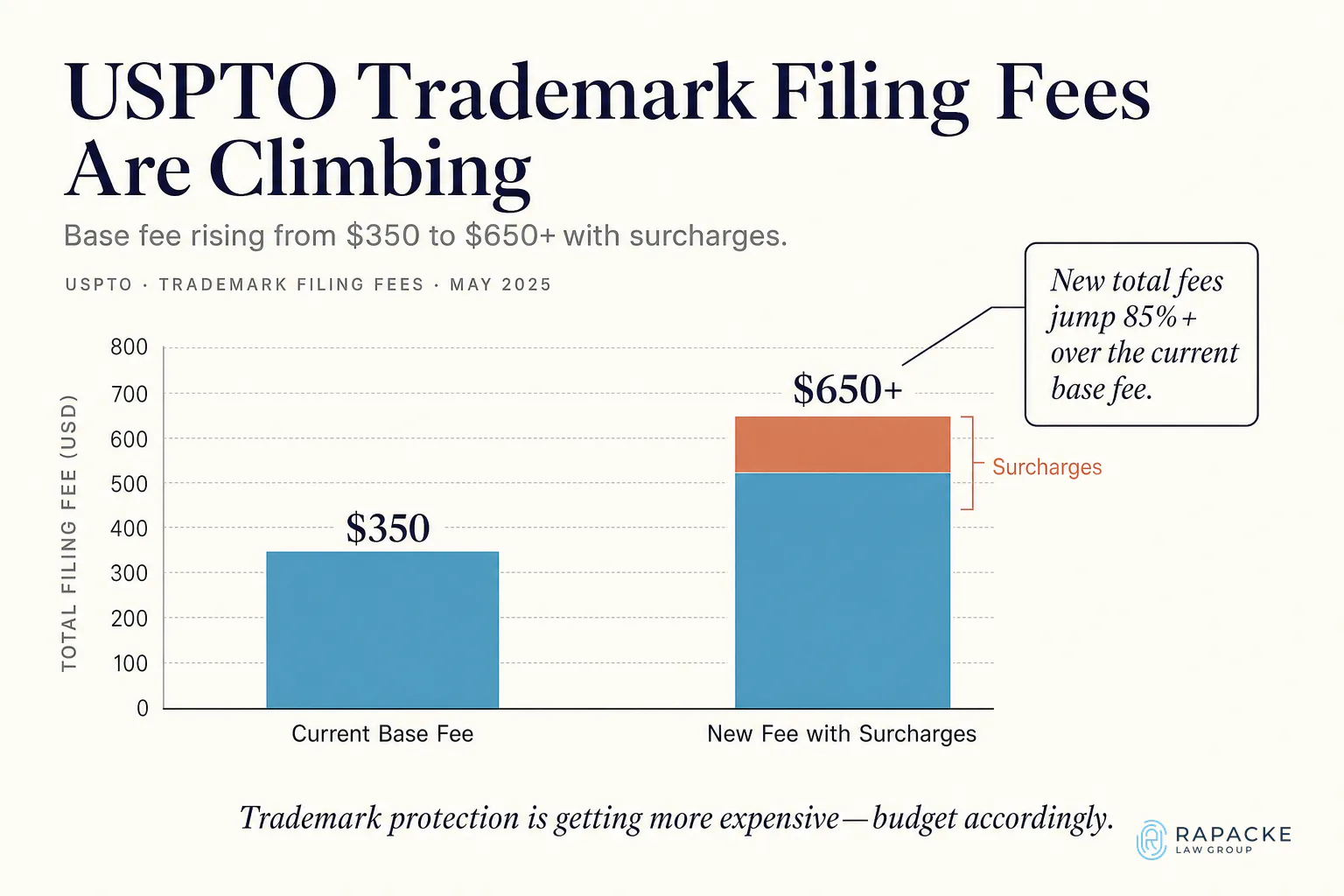
TEAS Plus and TEAS Standard ended January 18, 2025, so teas standard applications are no longer accepted for new filings. The electronic base fee is a flat $350 per class, $1,050 for three, per the USPTO. A free-form goods description adds $200 per class, missing required information adds $100, taking a single-class filing to $650. See our USPTO fee changes and what they did to trademark filing cost breakdown.
USPTO Filing Fees You Should Budget For
| Fee item | Current amount |
|---|---|
| Electronic base application | $350 per class |
| Free-form description surcharge | $200 per class |
| Insufficient information surcharge | $100 per class |
| Statement of Use or Amendment to Allege Use | $150 per class |
| Six-month Statement of Use extension | $125 per class |
| Three-month office action response extension | $125 |
| Petition to revive abandoned application | $250 |
| Section 8 five-year declaration of use | $325 per class |
| Combined Section 8 and Section 15 declaration | $575 per class |
| Combined Section 8 and Section 9 ten-year renewal | $650 per class |
| Maintenance grace period surcharge | $100 per class |
A one-class intent-to-use filing starts at $500, five extensions push it to $1,125. Each maintenance cycle carries its own per-class fee.
Attorney Fees and Total Cost
Attorney fees are separate and vary by scope and complexity. Flat fees stay predictable when a refusal, response, and refiling can cost more than the original representation. Budget per class over ten years.
What Happens After You Submit Your Trademark Application
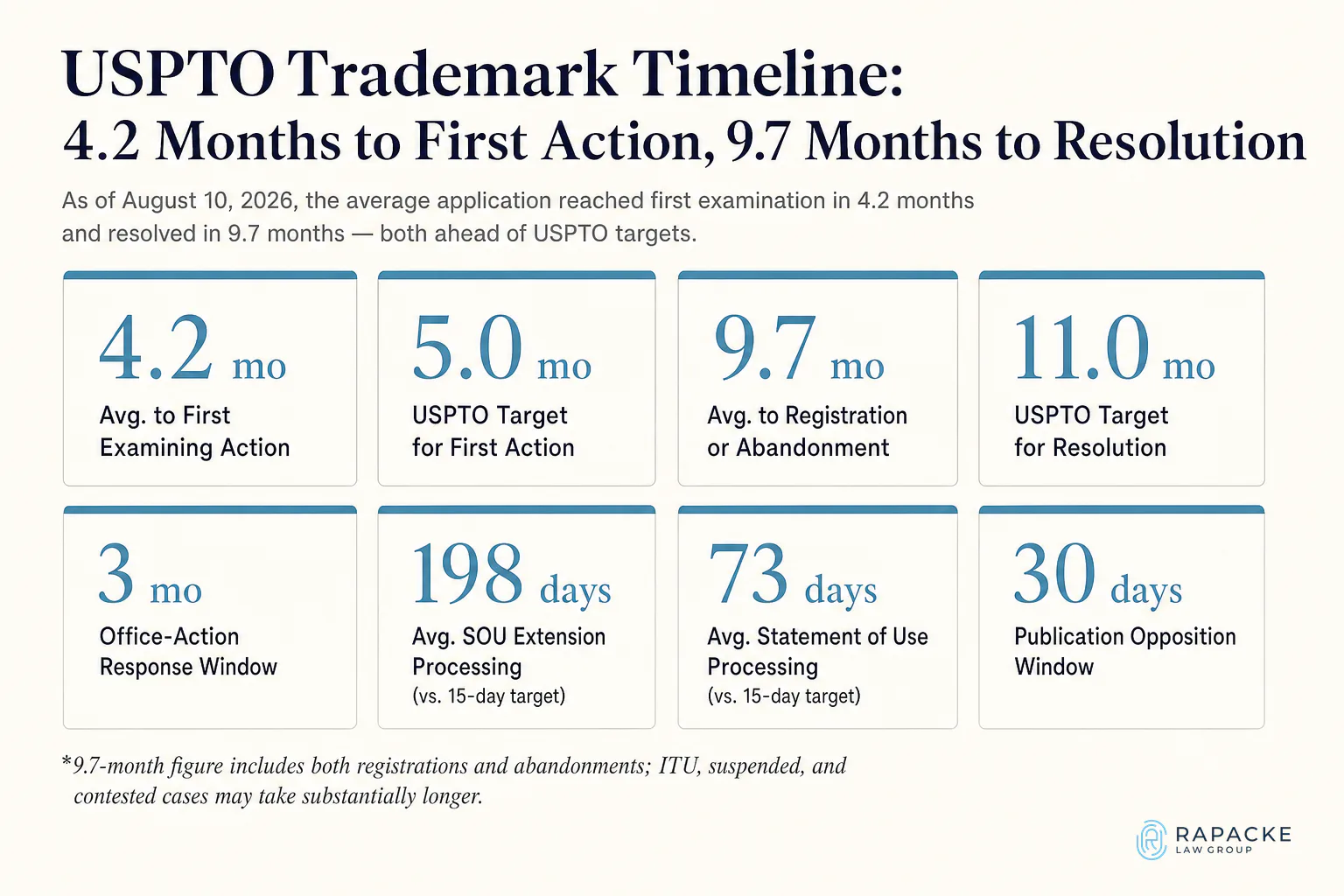
As of August 10, 2026, the USPTO reported averages of 4.2 months from filing to first examining action (5.0-month target) and 9.7 months from filing to registration or abandonment (11.0-month target). That second figure excludes suspended, contested, and extended intent-to-use cases, so treat it as a benchmark; check the current wait times webpage on the USPTO Trademarks Dashboard for the latest data.
Examination and the Trademark Office Action
An examining attorney reviews your application for likelihood of confusion, descriptiveness, specimen problems, and identification defects. Issues trigger a trademark office action — one of several recurring trademark office actions applicants must respond to — due within three months for non-Madrid applicants (one three-month extension, $125) or six months for Madrid filings, with no extension. Miss it and the application goes abandoned. See our guide to navigating a trademark office action response.
Publication in the Trademark Official Gazette
Approved applications publish in the Trademark Official Gazette, opening a 30-day opposition window for trademark owners at the trademark trial board, formally known as the Trademark Trial and Appeal Board. The Board handled roughly 7,650 trademark oppositions and 19,130 extension requests in fiscal year 2025 (USPTO FY2025 Agency Financial Report).
Registration, Maintenance, and the ® Symbol
After the opposition window closes, or an intent-to-use applicant files an accepted Statement of Use, the USPTO issues the registration certificate. Only then may you use ® with the registered goods and services, and the registered trademark symbol signals your legal rights to the public. Maintenance filings fall in years five to six, nine to ten, and every ten years after, a six-month grace period costs an extra $100 per class, and missing it cancels the registered trademark.
Mistakes That Get Trademark Applications Refused or Abandoned
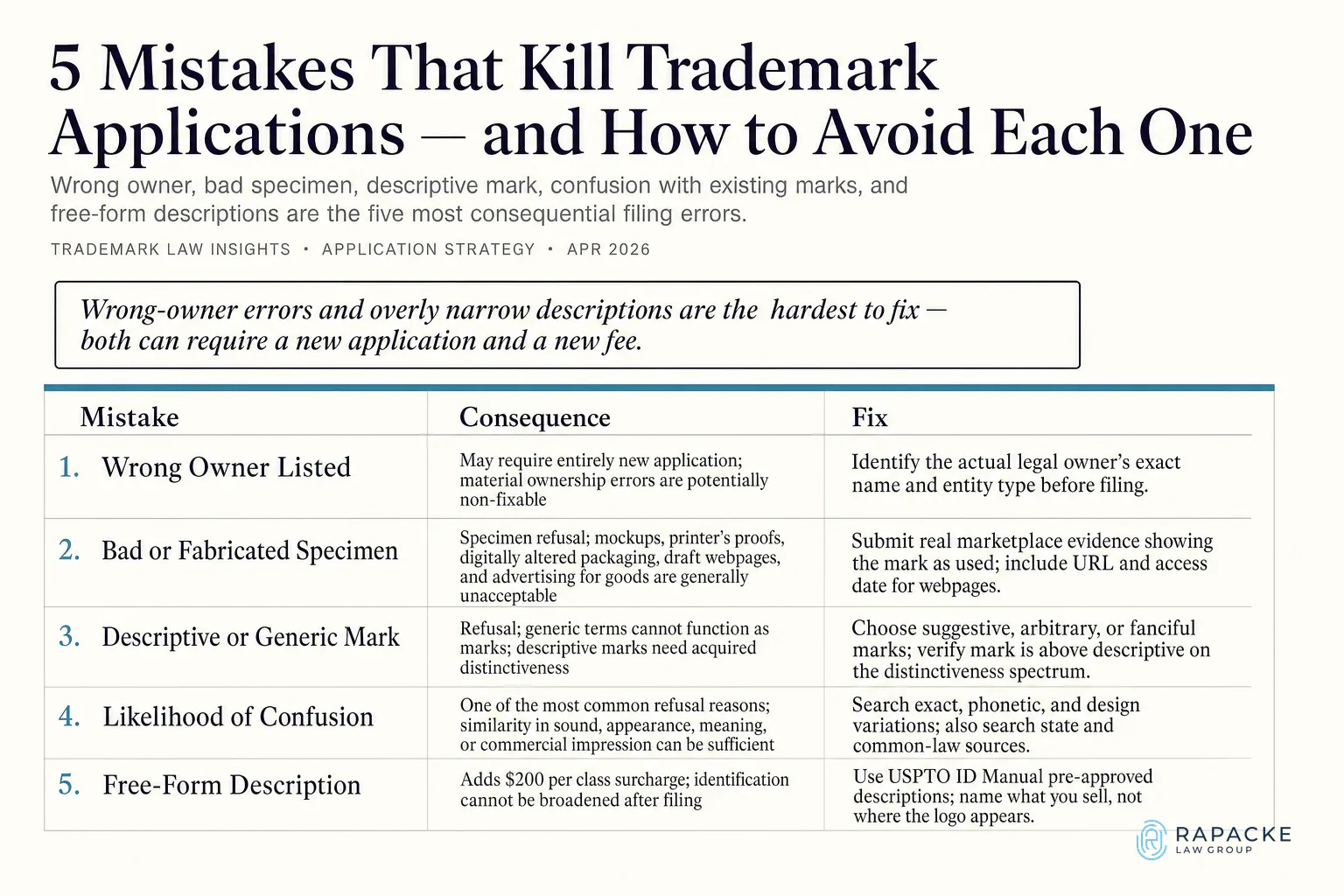
Most refusals trace back to pre-filing choices made during the application process, not clerical slips.
Choosing a Mark That Is Too Descriptive or Generic
Marks run from generic to descriptive, suggestive, arbitrary, and fanciful. Generic terms never register, descriptive marks need acquired distinctiveness, per USPTO guidance on strong trademarks. "Cold Brew" for cold brew coffee would face serious genericness or descriptiveness obstacles. Without distinctiveness, supplemental trademark registration is a narrower fallback with real benefits.
Filing With a Vague or Inaccurate Description
Identify what you sell, not where the logo appears, a winery sells wine, not labels. Identifications can be narrowed later, rarely broadened, so sloppy wording permanently caps your coverage. Classification errors can sometimes be corrected, a wrong description often cannot.
Missing Deadlines
Office action responses, Statements of Use, and maintenance filings run on fixed clocks. Reviving an unintentionally abandoned application costs $250 within a short window and requires showing the delay was unintentional; familiarity with trademark rules on revival petitions is essential. The uspto trademark application process recommends checking application status every three to four months, and checking again every three to four months after you file maintenance documents.
Frequently Asked Questions About Trademark Filing
How much does it cost to file a trademark?
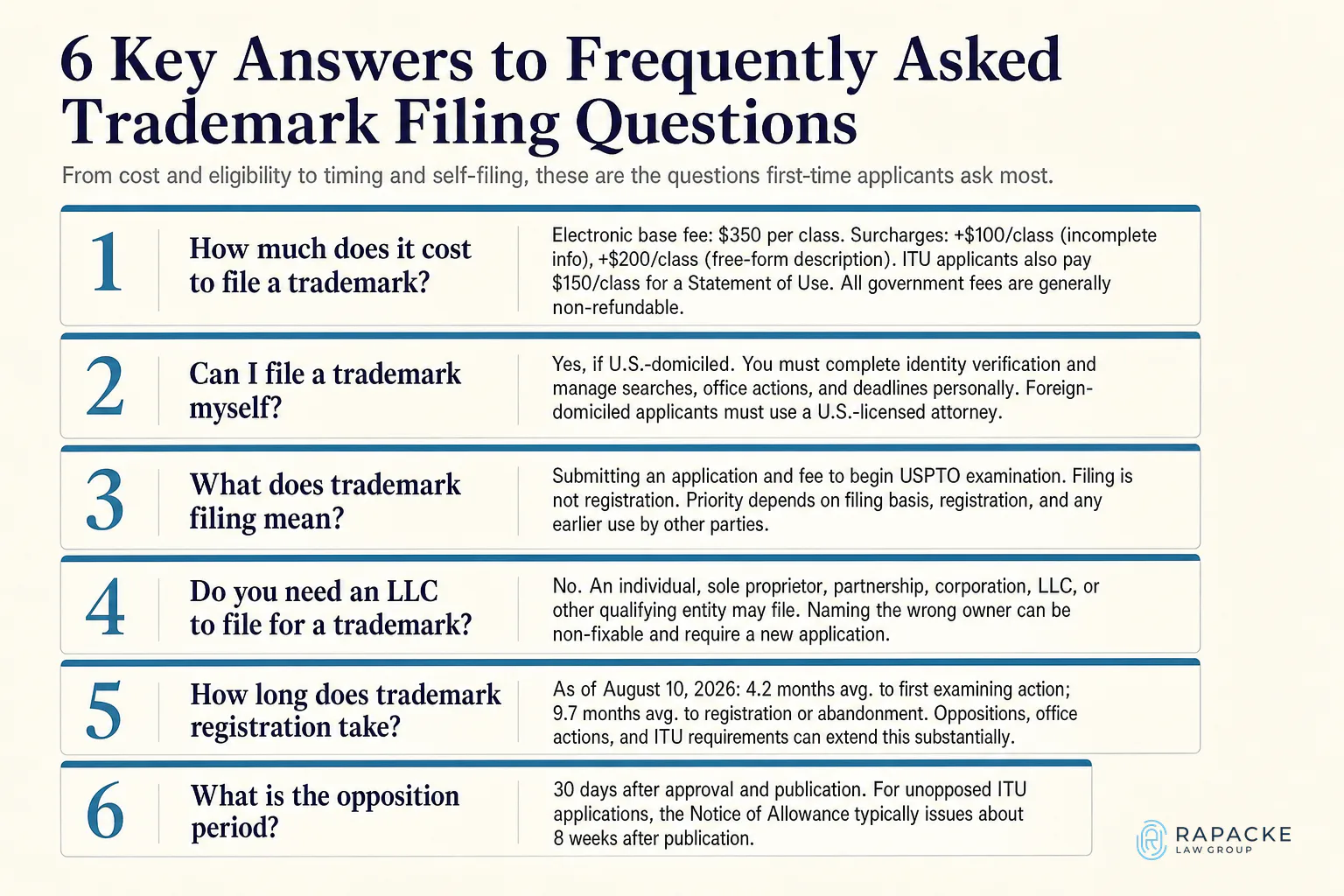
$350 per class electronic base fee, plus $200 per class for free-form goods descriptions, $100 for missing required information, and $150 for a Statement of Use. The application fee is non-refundable whether paid per class or in total, and attorney fees are separate.
Can I file a trademark myself?
Yes, if you're U.S.-domiciled and want to register my trademark yourself, but you assume clearance searching, office action responses, and every deadline. Foreign-domiciled applicants must be represented by a U.S.-licensed attorney, required since August 3, 2019.
What does trademark filing mean?
Submitting a u.s. application to register a mark and paying the fee to the United States Patent Office to begin federal examination. Filing a federal trademark application is not registration, it creates a filing date whose priority effect depends on your filing basis and on prior use by others.
Do you need an LLC to file for a trademark?
No. Individuals, sole proprietors, partnerships, corporations, and LLCs can all own a registration at the United States Patent Office. Naming the wrong owner at filing may be unfixable, requiring a new application and fee at the United States Patent Office.
How long does the trademark registration process take?
USPTO data from August 2026 shows 4.2 months to a first examining action and 9.7 months to registration or abandonment, office actions, suspensions, and oppositions extend that. The USPTO Trademarks Dashboard estimates registration roughly four months after a Statement of Use is filed, check it for current pendency.
Your Next Steps to Trademark Filing Success
Filing earlier improves your position, but trademark rights still depend on real use, accurate ownership, a defensible description, and ongoing maintenance. A complete trademark filing strategy accounts for every stage of the trademark filing process: clearance search, accurate identification of goods and services, the right filing basis, timely responses to office actions, and maintenance filings in years five, six, nine, and ten — consult trademark resources from the USPTO and qualified counsel for guidance at each step. Skipping any step risks losing the protection you paid to obtain.
The business consequences of a failed or delayed registration are real. A competitor's earlier application can force a costly rebrand, disrupt a product launch, or derail investor diligence, which is why every trademark owner must secure legal protection for their mark early. Failing to secure rights before scaling means your brand equity is built on a foundation that a single opposition can collapse, and rebranding after market entry typically costs far more than a decade of maintenance fees.
The bottom line: A weak trademark filing is a descriptive name, a copied goods description, and hope that nobody objects. A strong one is a cleared name, a pre-approved identification, the right classes, the right filing basis, and a docket that never misses a date — and it starts with a proper trademark application form submitted accurately, which is the legal foundation of enforceable trademark rights. Both cost $350 per class, but only one survives an opposition or supports an enforcement letter.
Registration rights go to first-to-file-or-use, and a competitor's earlier application can force a rebrand that costs more than a decade of maintenance fees.
- Schedule a Free IP Strategy Call for a clearance read and filing plan.
- Search federal, state, and common law sources before you print anything.
- Pull descriptions from the USPTO ID Manual to avoid the $200 surcharge.
- Choose your basis deliberately: use in commerce if selling, intent to use if pre-launch.
- Calendar office action and Statement of Use deadlines, plus years five, six, nine, and ten.
Rapacke Law Group handles search, application preparation, and USPTO filing on a flat fee, so cost is known upfront.
The RLG Guarantee: Get your trademark approved or pay nothing. If your mark is rejected, you receive a 100% refund, no questions asked.
To Your Success,
Andrew Rapacke is Managing Partner and a Registered Patent Attorney at Rapacke Law Group, where his practice focuses on patent and trademark protection for software, SaaS, and AI companies. Connect on LinkedIn, follow @rapackelaw on Twitter/X, or follow @rapackelaw on Instagram.
Andrew Rapacke Managing Partner, Registered Patent Attorney Rapacke Law Group