
Key Takeaways
- Only a human being can be named as an inventor. The Federal Circuit confirmed in *Thaler v. Vidal* that the Patent Act's term "individual" means a natural person, and the USPTO's 2024 guidance requires a human to make a "significant contribution" to each claimed invention.
- AI patent claims often fail Section 101 when they merely recite "using AI to analyze data" without a specific technical improvement. In Alice-affected fields, the probability of a first-action §101 rejection rose about 31% in the 18 months after the decision, so tie the AI system to a concrete technical benefit.
- Document every human decision during AI-assisted development before you file. Dated engineering logs and commit histories can be critical evidence to establish inventorship if it is later challenged.
- Trade secret protection can outlast a patent's 20-year term for AI model weights and proprietary datasets, because patents require public disclosure 18 months after filing.
- The strongest AI intellectual property strategy usually layers both. Patent the novel application or method while keeping trained weights and training data as trade secrets.
*Written by Andrew Rapacke, Managing Partner, Registered Patent Attorney.* Andrew Rapacke is a registered patent attorney and the Managing Partner of The Rapacke Law Group, a full-service intellectual property law firm. He helps individuals and corporations across industries with the protection, prosecution, licensing, and enforcement of their intellectual property, with deep experience in patent, trademark office filings, and copyright matters spanning software, AI and machine learning, blockchain, medical devices, and autonomous vehicle technology. A graduate of the United States Naval Academy, Andrew served as a Naval Engineering Officer before pursuing law and remains active in the startup and inventor communities throughout Florida.
A SaaS founder trains a machine learning model to generate a novel drug-interaction prediction method, files a patent application with real confidence, and receives a rejection from the U.S. patent office. Picture that founder for a moment, because the invention was not the problem. The examiner flagged the claims as directed to an abstract idea under Alice Corp. v. CLS Bank International, and separately questioned whether a human being made the inventive contribution when the model produced the core output — a challenge every patent applicant building with AI must now anticipate. That single filing collided with three of the hardest questions at the intersection of artificial intelligence and patent law, what tool helped invent it, who counts as the inventor, and how the claims were drafted.
This is the situation many tech founders now face, as AI-related patent applications have surged in recent years. The USPTO reports that annual AI patent applications grew from roughly 30,000 in 2002 to more than 60,000 in 2018, and AI-based patents spread from about 9% of technology categories in 1976 to over 42% by 2018. That growth in AI patents means more scrutiny, more prior art, and more ways for a filing to fail.
This article walks through the five most important intersections of AI and patent law that every inventor and tech founder should understand before filing. You will learn how to structure inventorship for AI-assisted inventions, what the USPTO's 2024 guidance actually requires, how to draft claims that survive Section 101 review, when trade secret protection beats a patent, and how AI is reshaping the patent process itself. A seven-question pre-filing checklist ties it all together. For a deeper dive on the eligibility side, see our guide to patent eligibility for AI inventions.
Why AI-Assisted Inventions Create a Real Inventorship Problem Right Now
If an AI system helped create the invention, who is the inventor? Inventorship is a threshold question, and material errors in inventorship can render a patent invalid or unenforceable if they are not properly corrected. For founders building in this space, our overview of intellectual property for AI makers is a useful companion to this section.
The USPTO's 2024 Inventorship Guidance Draws a Hard Line
The USPTO's February 2024 guidance on AI-assisted inventions confirms that only natural persons can be named as inventors on a U.S. patent application, and the united states patent office has made clear this rule applies to all AI-related inventions. That position rests on Thaler v. Vidal (Fed. Cir. 2022), where the Federal Circuit held that the Patent Act's use of "individual" is limited to natural persons, not an AI system named DABUS. In April 2023, the Supreme Court declined to hear the appeal, leaving the human-inventor rule intact.
The legal test is not whether AI was used. It is whether a human being made a significant contribution to the conception of each claimed invention, meaning the inventive process must include genuine human activitym, the same standard the Federal Circuit applied in Pannu v. Iomai Corp. Given that AI-related patent applications more than doubled from 30,000 in 2002 to over 60,000 in 2018, this issue now affects a large and growing segment of new filings. Document every human decision point during AI-assisted development before you file, because those records help establish that the inventive process was driven by human activity and are critical to inventorship. If you want the full picture of what the office actually grants, read can you patent AI.
What "Significant Contribution" Means in Practice for AI-Assisted Inventions
The USPTO recognizes several qualifying human contributions, selecting or curating large amounts of training data, defining the specific problem the AI model solves, interpreting and applying the model's output to reduce it to a claimed invention, and engineering the architecture of the AI system itself. According to Davis Polk's analysis of the guidance, designing the prompt or input that elicits a particular solution can rise to inventorship, while a person who merely accepts an AI's output does not qualify.
Think of it like a photographer using an automated camera. Pressing the shutter on whatever the machine frames is not authorship, but choosing the subject, controlling the parameters, and curating the result is. If your team used generative AI during R&D, have your patent attorney review each inventor's specific technical contributions before the application is prepared. Questions about whether specific machine learning work qualifies come up constantly, and our piece on whether machine learning algorithms are patentable breaks this down further.
The European Patent Office Takes the Same Position
This is not a U.S. quirk. Stephen Thaler's DABUS case put this question before patent offices around the world. The European Patent Office refused the parallel DABUS applications, and its Board of Appeal affirmed in 2022 that an AI system cannot be an inventor on a European patent application. The UK High Court reached the same conclusion, and the Australian courts have also held that only natural persons can be inventors. One notable outlier stands apart, since South Africa's patent office granted a patent naming DABUS as inventor. For founders pursuing international patent protection through PCT applications, human inventorship is now a requirement in all major patent jurisdictions, such as the U.S., EPO states, the U.K., and Australia, and patent offices in these regions have consistently enforced it, though a few jurisdictions like South Africa have begun experimenting with allowing AI systems to be listed as inventors. Any global IP strategy must account for it across every major jurisdiction.
How AI Innovations Must Clear the Patent Eligibility Hurdle
Naming a human inventor gets you past the first gate. The next question is whether the AI invention itself qualifies for patent protection under 35 U.S.C. § 101.
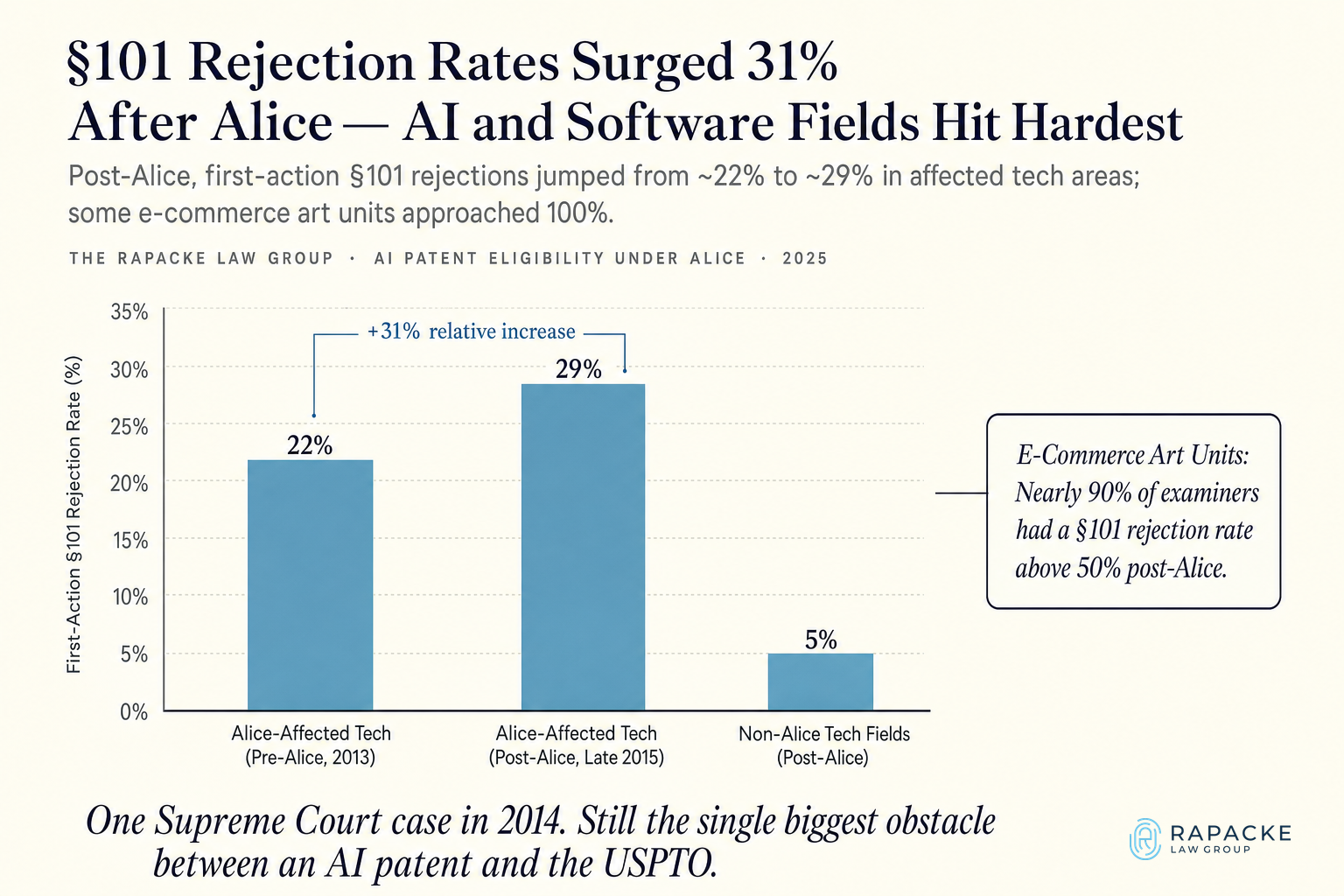 §101 Rejection Rates Surged 31% After Alice — AI and Software Fields Hit Hardest — Source: USPTO OCE via Squire Patton Boggs, 2020; Fenwick & West Bilski Blog, 2016
The Alice Framework Still Controls AI Patent Applications
The Alice test runs in two steps. Step one asks whether the claim is directed to an abstract idea, natural phenomena, or law of nature. Step two asks whether the claim adds an "inventive concept" that transforms the abstract idea into patent-eligible subject matter. AI inventions routinely stumble at step one because AI algorithms and mathematical concepts are abstract ideas standing alone. As the Alice decision established, an abstract idea does not become patentable simply by running it on a generic computer.
The data shows how sharply this bit. According to the USPTO Office of the Chief Economist's Adjusting to Alice report, the probability of a first-action §101 rejection in affected technology fields rose from roughly 22% before the decision to about 29% within 18 months after, a 31% relative increase, while non-Alice fields stayed near 5%. In some e-commerce-related business-method art units, more than three-quarters of applications received §101 rejections after Alice, with some units exhibiting even higher rejection rates. A claim that merely recites "using AI to analyze data" will fail. The claim must tie the AI functionality to a specific, concrete technical improvement.
How to Frame AI Patent Claims to Survive Section 101
Practical claim drafting for AI-based inventions follows a clear pattern. Anchor claims to a specific technical problem the AI system solves. Describe the architectural components with particularity. Claim the trained neural network's specific function within a technical process. Avoid purely functional language that describes a result without describing how the system achieves it.
Two Federal Circuit decisions show what survives. In Enfish, LLC v. Microsoft Corp. (Fed. Cir. 2016), claims to a self-referential database table were not abstract because they improved computer functionality itself. In McRO, Inc. v. Bandai Namco Games America Inc. (Fed. Cir. 2016), an automated lip-sync animation method survived because the claims used specific, bounded rules and did not preempt all approaches. Work with a patent attorney to convert functional AI descriptions into structural claims that describe how the system reaches the technical result. Founders who want a working template can start with our software patents checklist.
Deep Learning, Neural Networks, and Where They Fit in Eligibility Analysis
Deep learning architectures and artificial neural networks that perform concrete technical functions, such as image recognition, speech recognition, or anomaly detection, have been successfully patented when the claims tie to a technical application of the underlying AI technology rather than the math alone. Artificial intelligence has spread across nearly every industry, and by 2018 42% of all USPTO technology categories included AI-related patents, up from a small fraction in the 1970s.
No-code and low-code platforms create a specific wrinkle for AI technology. When the invention is an AI-assisted automation layer rather than a core algorithm, generic automation often draws a §101 rejection unless the patent claims a concrete technical process the layer enables. The more specific your claims are about how the AI architecture achieves a concrete result, the stronger the eligibility argument. For the underlying legal standards, our breakdown of AI patent requirements and the conditions of patentability covers each element in detail.
What the USPTO Examination Process Looks Like for AI Patent Applications
Once you file, what actually happens? The examination process for AI patent applications has its own rhythm, and understanding it helps you plan.
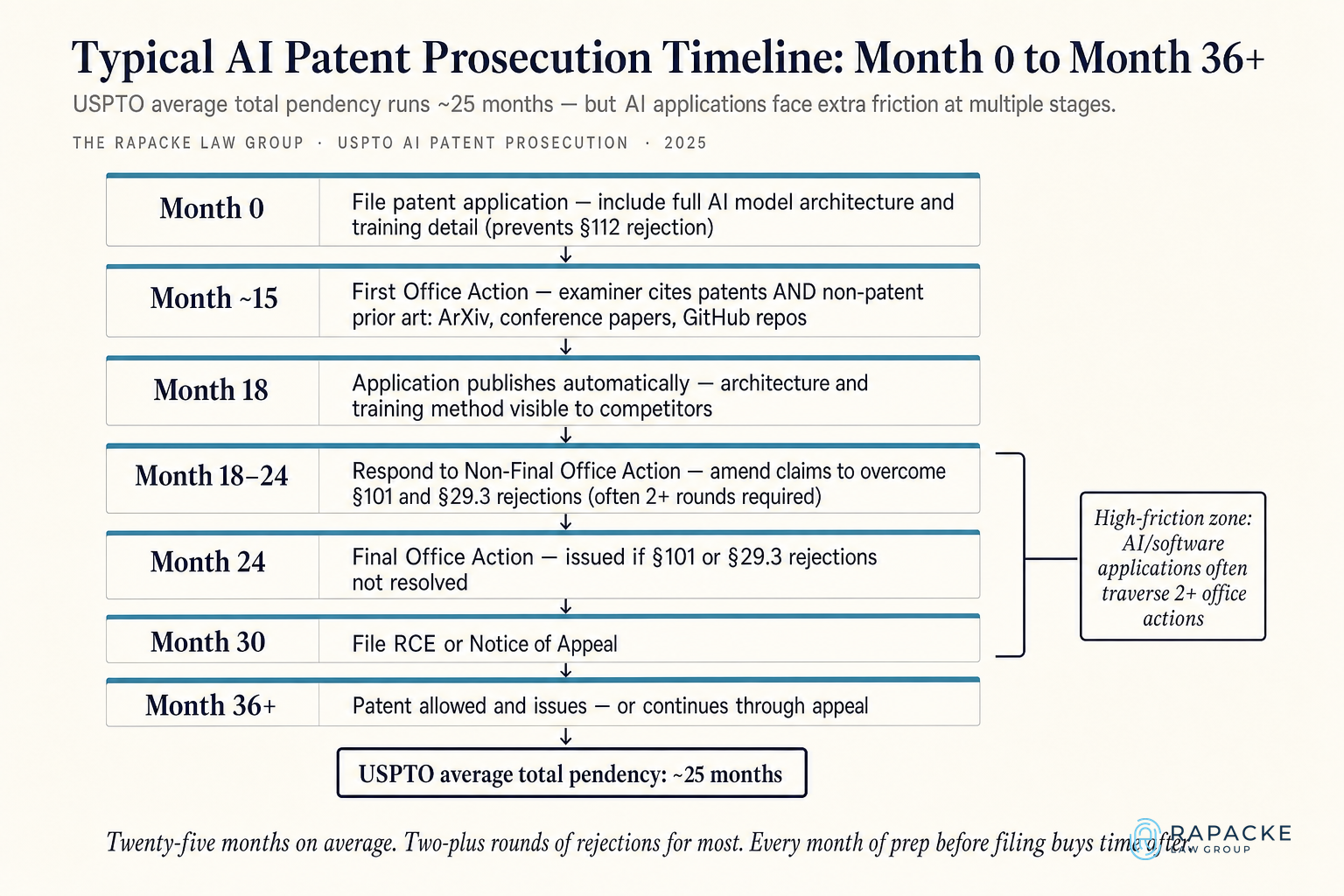 Typical AI Patent Prosecution Timeline: Month 0 to Month 36+ — Source: USPTO Patents Dashboard, 2023; Fenwick & West Bilski Blog, 2016
How Patent Examiners Evaluate AI-Related Applications
The u.s. patent office routes AI applications to specialized examining units, primarily Technology Center 2100 for computer and AI inventions and TC 1600 for AI in life sciences. Patent examiners evaluate these applications against prior art, Section 101 eligibility, Section 112 written description requirements, and Section 103 obviousness.
AI patent applications face heavier prior art scrutiny than most fields because AI technologies and machine learning techniques are extensively documented in academic literature, which qualifies as prior art. The scale is enormous. According to Stanford's 2024 AI Index Report, spanning computer science and adjacent disciplines, annual AI publications nearly tripled from about 88,000 in 2010 to more than 240,000 by 2022. Examiners routinely cite conference papers, arXiv preprints, and open-source repositories in AI cases. Commission a prior art search before drafting your patent application to map the landscape your examiner will be searching.
Patent Office Actions and How to Respond Without Losing Claim Scope
It is not unusual for non-final Office Actions on AI-related applications to include multiple grounds of rejection, for example §101 for an abstract idea, §103 for obviousness over prior art, and §112 for insufficient description of how the AI system functions.
Respond strategically rather than simply amending claims to escape every rejection. Excessive narrowing during patent prosecution limits patent rights later, because every concession becomes part of the permanent record that courts read when interpreting claim scope. Treat every Office Action response as a strategic document, not just a procedural filing.
Why AI Patent Drafting Upfront Avoids Examination Holdups
Thorough initial claim drafting reduces the number of Office Actions dramatically. That means independent claims at multiple scope levels, broad, medium, and narrow, plus a specification with a detailed description of the AI system's technical components, ensuring the full invention is disclosed adequately. With AI inventions that are probabilistic or model-dependent, the specification must explain what the trained model does in terms a skilled engineer could understand and replicate.
USPTO total pendency now averages roughly 29.3 months, so a filing built to withstand examination saves real time. Investing more in the patent application before filing reduces total prosecution cost and delay more reliably than any other single factor. Choosing the right counsel matters here too, and our guide to choosing an AI patent attorney explains what to look for.
Patents Versus Trade Secrets for AI Inventions, How to Choose
This is the strategic fork most founders underthink, and it can determine whether your competitive advantage survives.
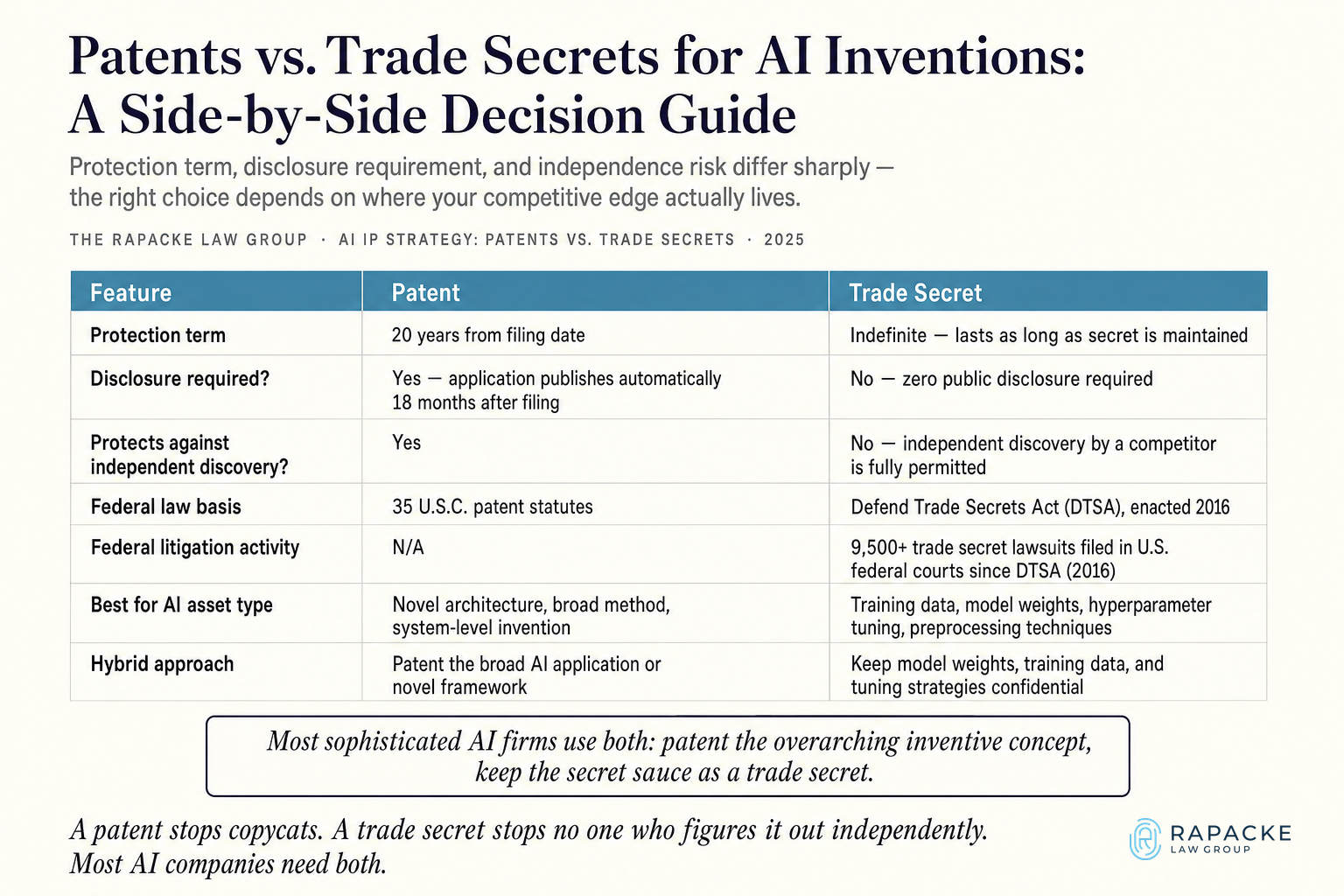 Patents vs. Trade Secrets for AI Inventions: A Side-by-Side Decision Guide — Source: BitLaw (35 U.S.C. §122); Foley Hoag DTSA Decade Report, 2026
What You Give Up When You Patent an AI System
A patent grants a limited right to exclude others, running 20 years from the earliest effective filing date, in exchange for public disclosure of the invention. For AI inventions, that means disclosing your model architecture, training approach, and optimization methods in the specification. U.S. patent applications publish 18 months after filing by default, so competitors can read that disclosure and design around your claims.
When the real value of your AI system lives in the trained model weights or a proprietary dataset rather than the algorithm itself, a patent may protect less than you expect. Identify what part of your AI invention is actually novel before deciding whether to patent it, the algorithm, the application, or the trained model.
When Trade Secret Protection Is the Stronger Strategy for AI Models
Trade secret protection has no expiration date and requires no public disclosure. For AI systems where the competitive edge lives in trained weights, proprietary datasets, or fine-tuning methodology, trade secret law under the Defend Trade Secrets Act of 2016 can provide stronger long-term protection than a patent, and in some cases copyright protection may also apply to specific AI-generated outputs. The volume of activity is telling. Since the DTSA passed, more than 9,500 trade secret lawsuits have been filed in U.S. federal courts, many in tech.
The catch is that trade secrets offer zero protection against independent discovery or reverse engineering. If another team develops the same AI technique on its own, you cannot stop them. Coca-Cola's formula has stayed secret for more than a century, a reminder that some assets outlive any patent term, but only because access was tightly controlled. Implement formal trade secret protocols, including NDAs, access controls, and documented confidentiality procedures, before sharing any AI model architecture.
Combining Patents and Trade Secrets in a Layered AI IP Strategy
The most defensible AI intellectual property strategy usually layers both protections. Patent the novel technical application or method while keeping the trained model, datasets, and proprietary optimization techniques as trade secrets, and consider how related inventions in your pipeline fit into the same framework. A startup might patent its AI-driven anomaly detection method as applied to industrial IoT sensors while keeping its training dataset and model weights confidential.
Many AI startups favor trade secrets for core AI algorithms and reserve patents for broader system or method claims. The biggest players use this layered approach at scale, as our look at how Google built its intellectual property portfolio shows. Work with a patent attorney to map each component of your AI invention and assign it to the appropriate protection vehicle before any public disclosure, and align your patent strategies across related inventions as early as possible.
How AI Is Changing the Patent Process Itself
AI is not just the subject of patents. It is increasingly a tool inside the patent workflow, which changes what inventors should expect.
AI Tools in Prior Art Searches and Patent Drafting
AI-powered prior art search tools scan millions of patents and scientific papers far faster than manual review, raising the baseline quality of searches so surface-level innovations get caught early. The USPTO uses AI internally too. Its 2023 AI Patent Dataset applies a BERT-based machine learning model to identify which patent documents contain AI innovations.
On the drafting side, generative AI can produce first-draft claims and specification language, but those AI-generated works and outputs need expert review. AI drafting tools frequently generate overclaimed or underclaimed language that creates prosecution problems. The risk is real. In one 2025 case, a judge reprimanded attorneys who filed AI-generated briefs containing fabricated citations. Use AI to accelerate research and drafting, but treat every output as a starting draft a registered patent attorney must review and refine.
What Generative AI Means for Patent Portfolio Management
As AI lowers the cost of generating application drafts, the volume of patent applications keeps rising, which intensifies the prior art landscape for everyone. For founders managing a patent portfolio, that means running freedom-to-operate analyses earlier in the product development cycle. AI also enables faster patent landscape analysis, helping startups spot white space in a technology area more efficiently.
The growth is dramatic. The u.s. patent office and its international counterparts have seen worldwide AI patent grants jump 62.7% from 2021 to 2022 alone, according to Stanford's AI Index. Studying how established companies build around their products is instructive, and our analysis of patents by Apple shows what a mature portfolio strategy looks like. Run a patent landscape analysis with AI-powered tools before committing significant R&D resources to any AI feature or product line.
The Future of AI and Patent Law, Key Developments to Watch
Several open questions will shape AI and patent law over the next few years. The USPTO has actively sought public comment on AI-assisted inventorship and on whether AI-generated material should count as prior art, and a u.s. court continues to work through how the Alice framework applies as AI becomes embedded in every sector. The USPTO's 2025 inventorship guidance reaffirmed that inventorship is limited to natural persons while confirming that traditional joint-inventorship analysis under Pannu still governs among human collaborators even when AI tools are used, a rule that applies in a significant manner to all AI-assisted filings. The Federal Circuit's treatment of AI-related claims continues to evolve, and the USPTO's rulemaking is ongoing. Revisit your AI patent strategy annually, because the regulatory and case law environment is shifting faster here than in any other area of patent law.
The AI Inventor's Pre-Filing Checklist Seven Questions to Answer Before You File
Run through these seven questions with a registered patent attorney before drafting a single claim. Each one maps to a failure mode that sinks AI patent applications.
Inventorship and Documentation Checks
(1) Can every named inventor articulate a specific, significant contribution to conceiving the claimed invention, independent of what the AI system produced? A "no" here means an inventorship defect that can invalidate the patent later.
(2) Have you documented the R&D process in dated engineering logs, commit histories, or lab notebooks that show human decision-making throughout? These records can be critical evidence if inventorship is challenged.
(3) If an AI tool was used, have you identified which outputs the human inventors adapted, applied, or modified versus adopted wholesale? Per the USPTO's 2024 guidance, a person who simply pressed "run" is not an inventor. If you cannot answer yes to all three, pause the filing and complete a formal inventorship review.
Eligibility and Prior Art Checks
(4) Do your core claims describe a specific technical improvement to a computer system or a concrete application of an AI method, rather than the generic use of AI to perform a function? If the claim reads as an abstract idea, it will draw a §101 rejection.
(5) Has a professional prior art search been run against not only existing patents but also academic literature, GitHub, and preprint servers like arXiv? AI research is commonly published in open venues before any patent is filed, and open-source AI projects on GitHub reached roughly 1.8 million by 2023, reflecting the ai ability to generate and share innovations rapidly. A patent-only prior art search is insufficient for AI inventions.
IP Strategy and Protection Vehicle Checks
(6) Have you mapped each component of the AI invention, algorithm, trained model, dataset, and application layer, to the right protection vehicle, patent, trade secret, or copyright? Different components deserve different protection, and a computer program layer may qualify for copyright protection in addition to other vehicles.
(7) Have you evaluated whether trade secret protection fits any component better than patent protection, given the disclosure requirements and the nature of your competitive advantage? If the novelty lives in your training data or model weights, disclosing them in a patent may cost more than it protects. Answering these two questions early prevents the most expensive strategic mistakes in AI IP planning.
Frequently Asked Questions About AI and Patent Law
Can AI be granted a patent?
No. Under current U.S. patent law, only human beings can be named as inventors on a patent application. The Federal Circuit confirmed this in Thaler v. Vidal, holding that the term "individual" in the Patent Act refers to a natural person, and the united states patent office's 2024 guidance reaffirms that an invention made with AI assistance is patentable only if a human made the inventive contribution. You can patent an AI-driven invention, but you must credit a human inventor who conceived it.
What is the relationship between patent law and AI?
Patent law and AI intersect in two ways. First, AI technologies are the subject of patent applications, so founders file to protect AI systems, machine learning methods, trained neural networks, and AI-powered applications. Second, AI tools are increasingly used within the patent process itself for prior art searching, claim drafting, and landscape analysis. The core legal challenges are eligibility under Section 101, inventorship, and prior art given the enormous volume of published AI research.
How does AI affect patent law?
AI is reshaping patent law on several fronts. The surge in AI-related patent applications, which more than doubled between 2002 and 2018, has made the prior art landscape far more crowded, forcing examiners to search a vast body of AI publications. At the same time, AI tools are accelerating prior art searches and drafting. Courts and the USPTO are working through open questions about AI-assisted inventorship, AI-generated prior art, and how the Alice framework applies to sophisticated AI claims, so expect continued developments.
Will AI take over patent lawyers?
No, though AI tools are changing how patent lawyers work. Generative AI can accelerate initial drafting and prior art research, but the strategic judgment needed to navigate Section 101 rejections, preserve claim scope, advise on inventorship, and build a defensible portfolio requires legal advice and expertise AI cannot replicate. As Bloomberg Law's analysis put it, AI raises the quality of routine work, but the best lawyers add value through judgment and human insight. Patent attorneys who use AI will outpace those who do not, but AI is not replacing the lawyers.
What is the 30% rule in AI?
The "30% rule" is not a legal doctrine in patent law. It is an informal guideline about AI adoption suggesting that roughly 70% of a workflow can be handled by AI while humans handle the remaining 30% for creativity, judgment, and quality control. In patent law, the actual standard for inventorship is the "significant contribution" test, not any percentage. Conflating an informal framework with the real legal standard is a common source of filing errors.
Your Next Steps to AI Patent Success
AI and patent law now sit at the center of nearly every serious tech venture, and the founders who treat intellectual property as a first-class part of their roadmap are the ones who keep control of what they build. This guide covered the five intersections that decide whether an AI filing survives, inventorship, Section 101 eligibility, the examination process, patents versus trade secrets, and how AI is reshaping the workflow itself.
The bottom line, a weak patent reads as "using AI to analyze data" and collapses under a §101 rejection or an inventorship challenge, while a strong patent ties a named human inventor to a specific, concrete technical improvement and layers trade secret protection around the model weights and training data that competitors would most want to copy.
Waiting is the expensive choice. AI patent applications are growing in volume, the legal standards are shifting, and every month you delay is a month a competitor could patent or publish a similar invention first. A filing that fails on inventorship or Section 101 will draw rejections you must overcome, and unresolved issues can expose your invention to the public record without giving you any protection in return.
Here is how to move forward:
- Schedule a Free IP Strategy Call to walk through your AI invention and get an honest assessment of patentability before you commit to a full application.
- Deepen your strategy first with the firm's AI Patent Mastery resource and our overview of AI and machine learning IP.
- Run the seven-question pre-filing checklist above with a registered patent attorney before drafting a single claim.
The Rapacke Law Group works with tech founders and inventors to assess AI invention patentability, document inventorship correctly, draft applications structured to survive examination, and build layered IP strategies that combine patent and trade secret protection where it makes sense. The firm's fixed-fee model and the RLG Guarantee remove billing surprises, so you know exactly what you are getting before the engagement starts. With provisional patent applications, that guarantee means a full refund if the USPTO denies the application, so the downside risk sits with the firm, not with you.
The AI inventions being built right now will define the next decade of technology, and the patents filed today will decide who controls them. Getting the strategy right is the difference between owning your advantage and handing it to a competitor.
To Your Success,
Andrew Rapacke Managing Partner, Registered Patent Attorney Connect on LinkedIn (Andrew Rapacke) or follow the firm on X and Instagram (@rapackelaw)
Andrew Rapacke Managing Partner, Registered Patent Attorney Rapacke Law Group